wayground logo

Free Printable Worksheets

Font size

S
M
L
XL
Worksheets

CHEMISTRY EXAM 2021

Total questions: 111

Worksheet time: 2hrs 13mins

Name
Class
Date
1.
Particles of a liquid
a)
are tightly packed together and stay in a fixed position.
b)
have no viscosity.
c)
decrease in volume with increasing temperature.
d)
are free to move around one another but still touch.
2.

For the diagram above, if the substance is a solid between point A and B, between which two points will the object exist as a liquid and a gas?

a)

B to C

b)

C to D

c)

D to E

d)

E to F

3.

For the images above, which of the following line segments represent a phase change?

a)

A to B

b)

B to C

c)

C to D

d)

E to F

4.
Which form of matter does not take the shape of its container?
a)
liquid
b)
gas
c)
solid
d)
air
5.
Evaporation is when liquid particles absorb enough energy to leave the 
a)
surface
b)
bottom
c)
center
d)
liquid throughout
6.

Which form of matter has a definite shape and takes up space (has definite volume)?

a)

liquid

b)

solid

c)

gas

d)

clay

7.
The molecules in the picture are tightly held together with little movement. They have shape and energy.  Therefore, the picture represents _________.
a)
solid
b)
liquid
c)
gas
d)
plasma
8.
What does this picture represent? 
a)
solid
b)
liquid
c)
gas
d)
plasma
9.
What does this picture represent? 
a)
solid
b)
liquid 
c)
gas
d)
plasma
10.

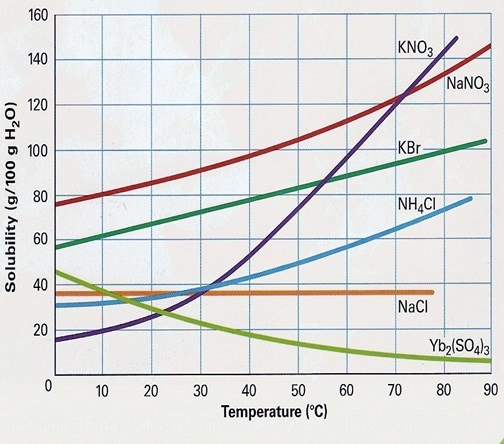
Identify how many grams of KNO3 is required to make a saturated solution at 40'C.

a)

50 g

b)

45 g

c)

60 g

d)

33 g

11.

Identify a method to decrease the dissolving rate of a solution:

a)

decrease the temperature

b)

add KE

c)

stir the solution

d)

increase the temperature

12.
Which substance is MOST soluble at 0 ºC?
a)
KI
b)
NaNO3
c)
NaCl
d)
Ce2(SO4)3
13.
Name the separation method that causes wet clothes on a clothes line to dry
a)
Chromatography
b)
Filtration
c)
Distillation
d)
Evaporation
14.

Dyes in water soluble markers may be separated by means of..

a)

crystallization

b)

sublimation

c)

chromatography

d)

sedimentation

15.
Which one of the following would you use to separate sand from iron filings?
a)
a bar magnet
b)
filter paper
c)
chromatography paper
d)
alum
16.
Water and alcohol are easily separated by distillation because of their
a)
 different melting points
b)
different colours
c)
different densities
d)
different boiling points
17.

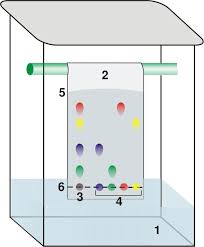
The diagram shows the chromatogram for three colouring dyes and that for a brown marker. What dye(s) are contained in the marker's ink?

a)

purple and green

b)

purple and yellow

c)

purple only

d)

green and yellow

18.
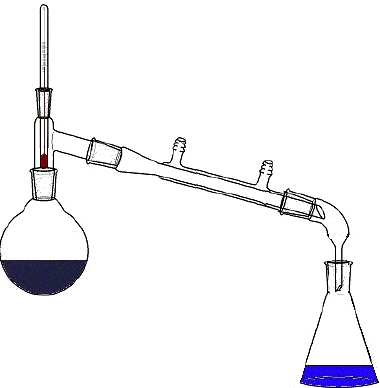
Look at the apparatus setup. It cannot be used to separate which of the following mixtures? 
a)
Marble chips from oil 
b)
Alcohol and water
c)
Chalk from sugar solution
d)
Sand and sea water
19.

The mixture we will work with contains salt, sand, iron filings, and gravel. All four

substances are in dry, granular form. What type of mixture is this classified as?

a)

Homogeneous mixture

b)

Heterogeneous mixture

c)

Solution

d)

Compound

20.
Elements combine to form __________.
a)
compounds
b)
atoms
c)
positive ions
d)
negative ions
21.
What part of an atom is involved in chemical bonding?
a)
protons
b)
neutrons
c)
electrons
d)
nucleus
22.
How many valence electrons does nitrogen have?
a)
3
b)

2

c)
5
d)
1
23.
Compounds made from only nonmetals are _________________ compounds.
a)
ionic
b)
covalent
c)
metallic
d)
chemical
24.
A covalent bond involves a __________ of electrons.
a)
sharing
b)
borrowing
c)
exchanging
d)
switching
25.
Low melting point and low solubility in water are general properties of ______________________ compounds
a)
ionic
b)
covalent
c)
chemical
d)
glucose
26.
What is the name of NF3?
a)
mononitrogen trifluoride
b)
nitrogen trifluoride
c)
nitrogen flouride
d)
nitrogen fluorine 
27.
What is the formula for Sodium Bromide? 
a)
NaBr
b)
NaBr2
c)
Na2Br
d)
Na3Br
28.
What is the name for MgH2?
a)
Magnesium hydride
b)
Magnesium dihydride
c)
Monomagnesium hydride
d)
Monomagnesium dihydride
29.
When metals bond with non-metals they form what type of bonds
a)
covalent
b)
ionic
c)
cooperative
d)
lewis
30.
How do the following two elements bond together?
Cr3+  O2-         
a)
CrO
b)
Cr3O2
c)
Cr2O3
d)
CrO3
31.

What are the three particles that make up the atom?

a)

protons, neutrons and isotopes

b)

protons, negatives and electrons

c)

neutrons, isotopes and electrons

d)

protons, neutrons and electrons

32.

The central region of an atom where its neutrons and protons are is its

a)

nucleus

b)

core

c)

electron cloud

d)

centre

33.

Particles in an atom that are neutral and have no charge are

a)

protons

b)

neutrons

c)

electrons

34.

Isotopes of an element contain an equal number of protons but a different number of ____________________.

a)

neutrons

b)

electrons

c)

atomic numbers

35.

What is an atomic number?

a)

Number of electrons an atom has

b)

Number of neutrons an atom has

c)

Number of protons an atom has

36.

What is an atomic mass?

a)

The total number of electrons in an atom

b)

The total number of neutrons in an atom

c)

The total number of protons and electrons in an atom

d)

The total number of protons and neutrons in an atom

37.
Which statement best describes an element?
a)
any combination of two or more atoms of different types
b)
a pure substance made up of only one kind of atom
c)
a substance containing only carbon atoms
d)
any kind of crystal
38.

What happens when the data in an investigation do not support the original hypothesis?

a)

The scientist gives up and starts an investigation on a new topic.

b)

The data must be incorrect and are thrown out.

c)

The hypothesis will be revised.

d)

The data are altered so that they support the original hypothesis.

39.

What is the atomic number for aluminum from the figure?

a)

13

b)

14

c)

26.98

d)

27

40.
The atomic number tells you what?
a)
number of electrons
b)
number of protons
c)
number of neutrons
d)
both electrons and protons in an atom.
41.
Which is an alkali metal?
a)
Magnesium
b)
Iron
c)
Sodium
d)
Europium
42.
What is the element symbol for boron? 
a)
B
b)
Bo
c)
Bn
d)
W
43.
The atomic number of this pictured element is
a)
28
b)
58.6934
c)
Ni
d)
Nickel
44.

Defined as the loss of electrons.

a)

oxidation

b)

reduction

c)

redox

d)

OIL RIG

45.

Defined as the gain of electrons.

a)

oxidation

b)

redox

c)

reduction

d)

LEO GER

46.

Cl2 + 2e- --> 2Cl - is an example of:

a)

a chemical reaction

b)

redox

c)

oxidation

d)

reduction

47.

An increase in oxidation number.

a)

more acidic

b)

reduction

c)

less basic

d)

oxidation

48.

A decrease in oxidation number.

a)

concentrated

b)

reduction

c)

oxidation

d)

dilute

49.

What is the oxidation number of C in SrCO3?

a)

-4

b)

+2

c)

-6

d)

+4

50.

What is the oxidation number of Cr in Cr2O72- ?

a)

+14

b)

+6

c)

-6

d)

-14

51.

What is a half-reaction of this equation, Na + Cl --> NaCl ?

a)

Cl + e- --> Cl-

b)

Cl - e- --> Cl-

c)

Na --> Na + e-

d)

Na° + Cl°--> Na+1Cl-1

52.

What is the reducing agent here: N2 + 3H2 --> 2NH3

a)

N2

b)

H2

c)

NH3

d)

2NH3

53.
What type of reaction is the following? 
Zn(s) + 2Cu(NO3)2(aq) ---> 2Cu(s) + Zn(NO3)2(aq)
a)
double displacement
b)
single displacement
c)
precipitation
d)
neutralization
54.
2Pb(NO3)2   -->   2PbO +  4NO2  +  O2
a)
Synthesis
b)
Decomposition
c)
Single Displacement
d)
Combustion
55.
Name the following ionic compound: Cs2S
a)
cesium sulfide
b)
cesium sulfate
c)
cesium (II) sulfate
d)
cesium (II) sulfide
56.
Which problem is balanced?
a)
PbO2 + 2H2
b)
SO2 + H20 --> H2SO4
c)
2Na + 2H2O --> 2NaOH + H2
57.

Which of the following represents a redox reaction?

a)

(a) NaOH + HCl → NaCl + H2O

b)

(b) BaCl2 + H2SO4 → BaSO4 + 2HCl

c)

(c) CuSO4 + 2H2O → Cu(OH)2 + H2SO3

d)

(d) Zn + 2HCl → ZnCl2 + H2

58.

The sum of the oxidation numbers in Na2CO3 is equivalent to

a)

0

b)

-2

c)

+1

d)

-1

59.

In the half equation:

Cu --> Cu2+ + 2e-

Copper undergoes...

a)

Spectatorship

b)

Reduction

c)

Deprotonation

d)

Oxidation

60.

Which substance is reduced in the following reaction?


2PbSO4 + H2O → Pb + PbO2 + 2H2SO4

a)

Pb

b)

PbSO4

c)

PbO2

61.
Bases
a)
formed from joining positive and negative ions
b)
increase OH ions
c)
forms a salt and water
d)
increases H2O ions
62.
Which of the following is a chemical property of a base
a)
a slippery feel
b)
conducts an electric current
c)
turns red litmus paper blue
d)
forms hydronium ions in water
63.
A salt is formed when nitric acid combines with sodium hydroxide. What are present in the salt that forms?
a)
Sodium chloride
b)
sodium ions and nitrate ions
c)
only sodium ions
d)
only nitrate ions
64.

Which of the following values would represent the pH of a strong base?

a)

1

b)

8

c)

7

d)

13

65.

Which of the following values would represent the pH of a strong acid?

a)

1

b)

6

c)

7

d)

13

66.

When you place blue litmus paper into an unknown clear solution, the blue litmus paper turns red.

Which of the following represents the most logical conclusion?

a)

The substance has a pH value of "2".

b)

The substance is a base.

c)

The substance has a pH value of "7".

d)

The substance is acidic.

67.

Many cleaning solutions are bases. Which of the following is a common property among basic solutions?

a)

slippery feel

b)

white color

c)

salty taste

d)

sour taste

68.

1. An example of an acidic oxide is:

a)

MgO

b)

CO2

c)

BaO

d)

Na2O

69.

After a compound X was added to water, the pH using indicator paper was less than 7. The resulting solution was added to some calcium carbonate and it was noted that effervescence took place. What could compound X be?

a)

HNO3

b)

MgO

c)

Na2O

d)

CaO

70.

Sulfuric acid reacts with sodium carbonate to form

a)

hydrogen gas

b)

carbon dioxide gas

c)

sodium sulfate

d)

water

71.
Which statement correctly describes the 2 electrodes?
a)
The anode is negative and the cathode is positive
b)
The anode and cathode are both positive
c)
The anode is positive and the cathode is negative
d)
The anode and cathode are both negative.
72.

___________ electrode is an inert electrode.

a)

Copper

b)

Iron

c)

Carbon

d)

Zinc

73.
Positive ions (cations) will move towards the cathode (-) where they will discharge by....
a)
Breaking apart
b)
Losing electrons
c)
Clumping together.
d)
Gaining electrons
74.

Which equation shows what happen to chloride ions at the anode.

a)

Cl- --> Cl + e-

b)

2Cl- --> Cl2 + 2e-

c)

Cl2 - -> 2e- + 2Cl-

d)

Cl2 + 2e- --> 2Cl-

75.

Choose the half-equation that shows the discharge of aluminium ion.

a)

Al3+ - 3e- --> Al

b)

Al2+ + 3e- --> Al

c)

Al3+ + 3e- --> Al

d)

Al3+ --> Al + 3e-

76.
In an aqueous solution of copper chloride, which ions are attracted to the negative electrode?
a)
Cu2+ and Cland Hand OH-
b)
Cu2+ and H
c)
 Cland OH-
d)
Cu2+ 
77.

What are the ions present in molten Al2O3?

a)

Al2+ and O3-

b)

Al2- and O3+

c)

Al3+ and O2-

d)

Al3- and O2+

78.

Oxidation is loss of electron. Where does oxidation take place during electrolysis.

a)

At anode

b)

In the electrolyte

c)

At the circuit

d)

At cathode

79.
What is the name of the positive electrode?
a)
cathode
b)
anode
80.
What is the name of the negative electrode?
a)
cathode
b)
anode
81.

What ions are present in molten aluminium oxide?

a)

Al3+, O2-, H+, OH-

b)

Al3+, O2-

c)

Al3+, OH-

82.
What particle carries the charge in the wire?
a)
electron
b)
proton
c)
ion
d)
atom
83.
What particle carries the charge in the electrolyte?
a)
electron
b)
proton
c)
ion
d)
atom
84.
Which non-metal is often used for electrodes?
a)
carbon
b)
copper
c)
zinc
d)
silicon dioxide
85.
Describe oxidation in terms of electrons
a)
oxidation is gain of electrons
b)
oxidation is loss of electrons
86.
Why can ionic compounds not conduct electricity when they are solid?
a)
their electrons are not free to move
b)
their ions are free to move
c)
their ions are not free to move
d)
their electrons are free to move
87.
What type of charge does a metal ion have?
a)
+
b)
-
88.
The electrode connected to the positive terminal of a battery is __________.
a)
cathode
b)
anode
89.

What is the name of the factor in an experiment that you change?

a)

independent variable

b)

dependent variable

c)

constants/controls

d)

interference

90.

List four factors that affects the rate of a reaction

a)

temperature

b)

concentration

c)

surface area

d)

volume

e)

catalysts

91.

A temperature increase causes the particles ......

a)

to slow down

b)

move faster

c)

collide higher

d)

in the right order

92.
What does NOT happen when the temperature is increased?
a)
Particles collide more often
b)
Particles collide with more energy
c)
Particles move faster
d)
More particles collide in the correct orientation
93.
In an exothermic reaction, heat is ...
a)
taken in
b)
given out
94.
A(n) ____________ is a special type of scientific investigation that is performed under controlled conditions.
a)
experiment
b)
lab
c)
inquiry
d)
hypothesis
95.
An experiment generally tests how one _________ is affected by another.
a)
Variable
b)
test
c)
scientist
d)
option
96.
The variable that affects the dependent variable is called the _________ variable.
a)
dependent
b)
optional
c)
independent
d)
scientific
97.
A good experiment usually tests a(n) __________. 
a)
variable
b)
scientist
c)
opinion
d)
hypothesis
98.
What is the volume of Object X?
a)
10.0 cm3
b)
15.0 cm3
c)
20.0 cm3
d)
25.0 cm3
99.

Which of the following elements will form a cation?

a)

Arsenic

b)

Copper

c)

Bromine

d)

Fluorine

100.

Which of the following will form an anion?

a)

Tin

b)

Lead

c)

Chlorine

d)

Zinc

101.
Silver nitrate and Nitric acid were mixed with an unknown solution. A white ppt formed. The formula of the ion present is
a)
Br-
b)
Cl2
c)
Cl-
d)
Br2
102.
Silver nitrate and Nitric acid were mixed with an unknown solution. A cream ppt formed. The formula of the ion present is
a)
I-
b)
Br+
c)
Br-
d)
Cl+
103.
Silver nitrate and Nitric acid were mixed with an unknown solution. A yellow ppt formed. The formula of the ion present is
a)
I2
b)
I+
c)
I-
d)
Br-
104.
NaOH is added to an unknown solution. A blue ppt forms. The formula of the ion is:
a)
Fe
b)
Fe3+
c)
Fe2+
d)
Cu2+
105.
NaOH is added to an unknown solution. A orange-brown ppt forms. The formula of the ion is:
a)
Fe2+
b)
Fe3+
c)
Cu2+
d)
Cl-
106.
NaOH is added to an unknown solution. A green ppt forms. The formula of the ion is:
a)
Fe2+
b)
Fe3+
c)
Cu2+
d)
Na+
107.
Anyhdrous copper sulphate is added to water. The colour change is from:
a)
White-Blue
b)
Pink-Blue
c)
Blue-Pink
d)
Blue-White
108.
How do you test for hydrogen gas?
a)
Relight a glowing splint
b)
Makes a squeaky pop with a lit splint
c)
Turns limewater milky
d)
Bleaches damp limtus paper
109.
How do you test for oxygen gas?
a)
Makes a squeaky pop with a lit splint
b)
Relights a glowing splint
c)
Bleaches damp litmus paper
d)
Turns limewater milky
110.
How do you test for carbon dioxide gas?
a)
Turns limewater milky
b)
Relights a glowing splint
c)
Makes a squeaky pop with a splint
d)
Bleaches damp litmus paper
111.
How do you test for Chlorine gas?
a)
Bleaches damp litmus paper
b)
Makes a squeaky pop with a lit splint
c)
Relights a glowing splint
d)
Turns limewater milky