
 Worksheets
Solutions test sample
Total questions: 27
Worksheet time: 37mins

The drawings below represent beakers of aqueous solutions. Each o represents a dissolved solute particles.Which solution is most concentrated?
A
B
C
D
E

The drawings below represent beakers of aqueous solutions. Each o represents a dissolved solute particle.Which solution is least concentrated?
A
B
C
E
F

When Solutions E and F are combined, the resulting solution has the same concentration as Solution _____.
A
B
C
D
E

What do you call the red particles in this mixture?
Solvent
Solute
Solution
What do you call the blue substance in this mixture?
Solvent
Solute
Solution
Which two words describe a mixture where you CAN'T see the different parts?
Solution
Homogenous Mixture
Heterogenous Mixture
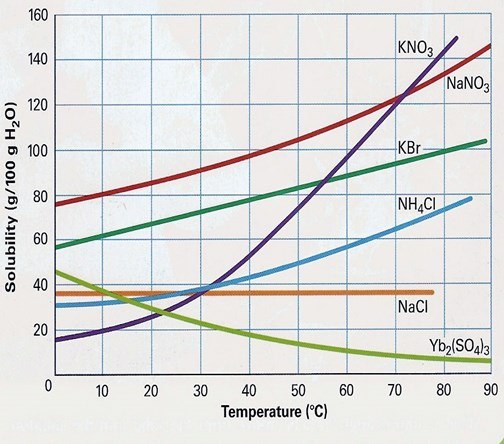
At 30'C, which substance has the lowest solubility?
KNO3
KBr
NaCl
Yb2(SO4)3
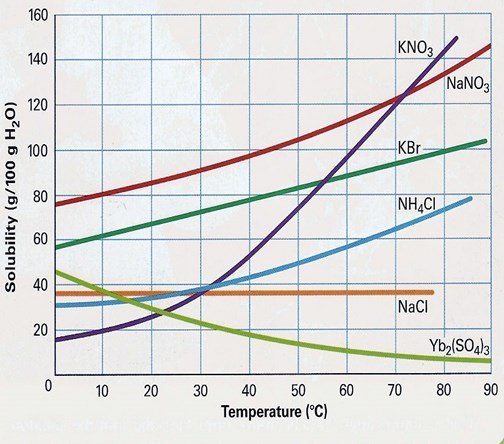
At which temperature do KBr and KNO3 have the same solubility?
60
55
50
Never
What is a solvent?
A liquid that will dissolve a solid solute
Another word for solution
A thing that make drinks change colour
Usually the solid about to be dissolved
A homogeneous mixture is the same thing as...
a solution
a heterogeneous mixture
a compound
an element
Which solution is more concentrated?
Solution 1:
500 mL of water
100 g of salt
Solution 2:
500 mL of water
90 g of salt
Solution 1
Solution 2
They have the same concentration
I have no idea
Which solution is more diluted?
Solution 1:
1000 mL of water
60g of salt
Solution 2:
500 mL of water
60 g of salt
Not enough information to tell
Solution 1
Solution 2
They are equally diluted
Calculate the mass percent of solution, if there is 100 g of sugar and 400 g of water
30
25
20
15
Based on Reference Table F, which of these salts is the best electrolyte?
sodium nitrate
magnesium carbonate
silver chloride
barium sulfate
Which of the following is not an electrolyte?
KBr
LiOH
RbNO3
CH4
A type of mixture that forms when one substance dissolves in another is known as a
heterogeneous mixture
solution
solute
solvent

How many grams are soluble in 100 g of water at 100 ºC?
300 grams
250 grams
100 grams
50 grams

Which solute is most likely a gas?
NH3
NaNO3
KCl
NaCl

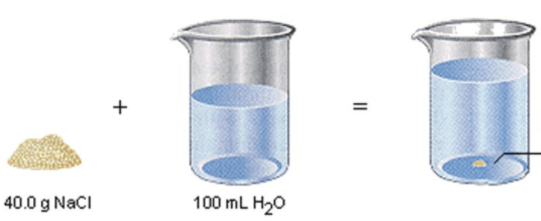
Identify the saturation associated with the product of this experiment.
Unsaturated
Saturated
Supersaturated
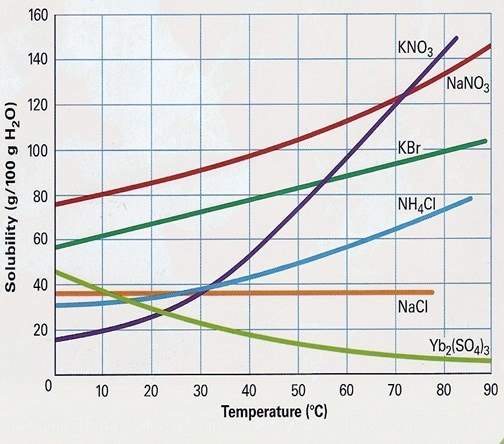
Determine the solubility for the substances at 55'C and arrange them in order from lowest to highest solubility.
NaCl, NH4Cl, KBr, NaNO3
NaCl, NH4Cl, NaNO3, KBr
NH4Cl, NaCl, NaNO3, KBr
NaNO3, KBr, NH4Cl, NaCl
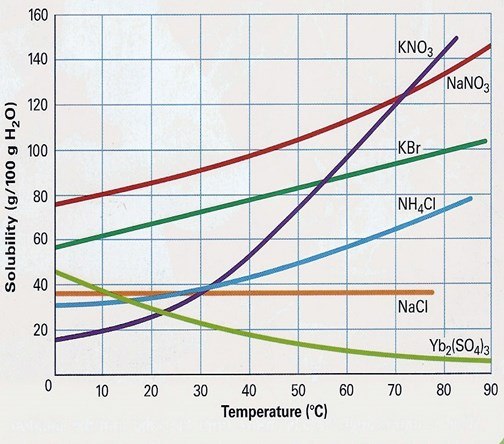
At 80'C, KBr's solubility is:
100
90
80
0

