
NEW
Font size
S
M
L
XL
 Worksheets
Carbon, Enzymes and ATP
Total questions: 18
Worksheet time: 11mins
Name
Class
Date
1.
Connects monomers to form a polymer
a)
Dehydration synthesis
b)
hydrolysis
2.
Breaks up polymers, forming monomers
a)
dehydration synthesis
b)
hydrolysis
3.

The following figure is illustrating
a)
Dehydration Synthesis
b)
Hydrolysis
4.

The following figure is illustrating
a)
Dehydration Synthesis
b)
Hydrolysis
5.
What is a substance called if it speeds up a chemical reaction?
a)
reusable
b)
catalyst
c)
specific
d)
fragile
6.
With what 3 letters do enzymes typically end?
a)
-ose
b)
-ase
c)
-ese
d)
-tic
7.
An enzyme speeds up a chemical reaction in the cell but can only be used once. True or False?
a)
true
b)
false
8.
What is the function of an enzyme?
a)
enzymes break themselves into small pieces
b)
enzymes slow down chemical reactions
c)
enzymes speed up chemical reactions
d)
enzymes combine products to form reactants
9.
What happens when enzymes are heated to a high temperature?
a)
The enzymes die.
b)
The active site of the enzyme is denatured.
c)
The enzymes amino acid sequence changes.
d)
The enzymes remain the same.
10.
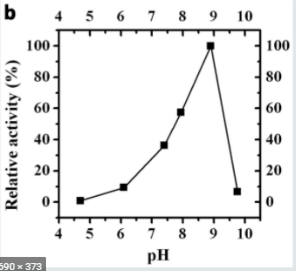
What is the optimal pH for this enzyme?
a)
6
b)
10
c)
9
d)
7
11.

What is the optimal temperature of this enzyme?
a)
60
b)
40
c)
70
d)
30
12.

Which enzyme represents the substrate?
a)
A
b)
B
c)
C
d)
D
13.

Which letter represents the enzyme?
a)
A
b)
B
c)
C
d)
D
14.
What is the function of ATP in living things?
a)
provides energy for cells
b)
stores genetic information
c)
provides structure in the nucleus
15.
Where is the energy stored in ATP molecules
a)
In the Ribose Sugar
b)
In the Adenine group
c)
In the Phosphate bonds
d)
In the Bank
16.
Energy is released from ATP when
a)
a phosphate group is added
b)
adenine bonds to ribose
c)
ATP is exposed to sunlight
d)
a phosphate group is removed
17.

Which bond of the ATP molecule is broken in order to release energy?
a)
A
b)
B
c)
C
d)
D
18.
Which form of cellular transport requires would not occur if there were no ATP present
a)
Active Transport
b)
Diffusion
c)
Osmosis
d)
Facilitated Diffusion
Reset

