
 Worksheets
The Periodic Table and Atoms
Total questions: 36
Worksheet time: 18mins

Elements in the same ________ are more chemically similar.
group or family
period
club
table

__________ are the smallest unit of an element that maintains the properties of the element.
Particles
Atoms
Protons
Isotopes of an element have different number of ___________ and therefore have different masses.
Protons
Neutrons
Electrons
Electrons in the outermost energy level are called?
Valence Electrons
Valence Protons
Valence Neutrons
How many neutrons does Chlorine (Cl) with an atomic number of 17 and an atomic mass of 35 have?
17
18
19
If an atom has an atomic mass of 11 and contains 5 electrons, its atomic number would be______
11
5
6

The atomic number of Beryllium is 4. Its mass number is 9. How many neutrons does an atom of Beryllium have in its nucleus?
4
13
5
6

The atomic number of an element is the number of _______ it has.
protons
neutrons
electrons only
protons and neutrons

The mass number of an element is the amount of _________ it has.
protons
protons and neutrons
electrons
neutrons

The periodic table is organized into columns called _______ and rows called ______.
groups and periods
periods and groups
categories and periods
categories and groups

Which of the following subatomic particles is negatively charged?
neutron
proton
electron
megatron

Which particle does not have a charge?
neutron
proton
electron
megatron

Which particle has a positive charge?
neutron
electron
proton
megatron

Moseley determined that the protons give atoms their identity and he used this to finalize the periodic table. This number is called the ______.
mass number
atomic number
nucleus number
symbol

Because an atom of zinc has 33 protons and 33 electrons. What is its atomic charge?
positive
negative
neutral
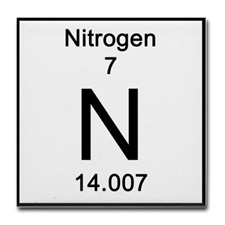
What is the number of electrons that the element in this image contain?
14
7
15
18

What is the smallest unit of an element that retains the properties of that element?
subatomic particles
atom
compound
nucleus


What is the atomic mass of "F"
9
9.9984
17
18.9984
How do you find out the number of neutrons in an atom?
atomic number
atomic mass
charge
atomic mass - atomic number


Why was Mendeleev considered to be a genius and "The Father of the Modern Periodic Table"?
He arranged atoms by increasing atomic number
He left spaces for elements that had yet to be discovered
He grouped elements as metals, nonmetals, and metalloids
He arranged elements alphabetically
What is an ion?
An atom with an equal number of protons and electrons
An atom with an equal number of protons and neutrons
An atom with an unequal number of protons and neutrons
An atom with an unequal number of protons and electrons.

