Wayground logo

Free Printable Worksheets

Font size

S
M
L
XL
Worksheets

Protein Synthesis and DNA replication

Total questions: 30

Worksheet time: 21mins

Name
Class
Date
1.
Which choice describes DNA after replication has taken place?
a)
one molecule with two original strands and one molecule with two new strands
b)
two molecules, each with one original and one new strand
c)
two molecules, each with two new strands
d)
 two molecules, each with two old strands
2.
The sequence of DNA below is part of a gene. How many amino acids are coded for by this segment? 
a)
4
b)
8
c)
12
d)
20
3.
Which of the following would most likely cause a mutation?
a)
 the placement of ribosomes on the endoplasmic reticulum
b)
the insertion of a nucleotide into DNA
c)
the movement of transfer RNA out of the nucleus
d)
 the release of messenger RNA from DNA
4.
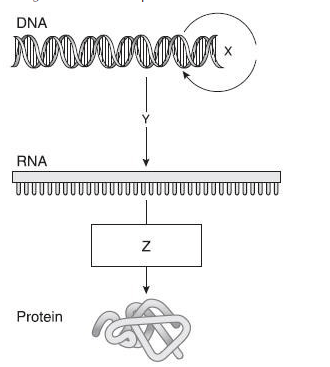
 A diagram of a cellular process is shown below. Which of the following identifies the process shown at point Z?
a)
Translation
b)
Translocation
c)
Replication
d)
Transcription
5.
Which of the following carries amino acids to the site of protein synthesis? 
a)
mRNA
b)
rRNA
c)
tRNA
d)
nRNA
6.
Base your answer to the following question on the structures represented in the diagram below. What is the relationship between these three structures?
a)
 DNA is made up of proteins that are synthesized in the cell.
b)
Protein is composed of DNA that is stored in the cell.
c)
DNA controls the production of protein in the cell.
d)
 The cell is composed only of DNA and protein.
7.
Genes for medically important proteins can be cloned and inserted into bacteria, as shown in the diagram below. Why can bacteria recognize a human gene and then produce a human protein?
a)
 DNA replication in bacteria and humans is the same.
b)
. Bacterial cells contain the same organelles as human cells. 
c)
The basic components of DNA are the same in humans and bacteria.
d)
Bacterial cells and human cells contain the same kind of chromosomes.
8.
The molecule represented is found in living things. Which statement describes one characteristic of this molecule?
a)
It is the template for the replication of genetic information
b)
Organic catalysts are made up of these molecules
c)
) It is different in each cell of an organism
d)
Cell membranes contain many of these molecules.
9.
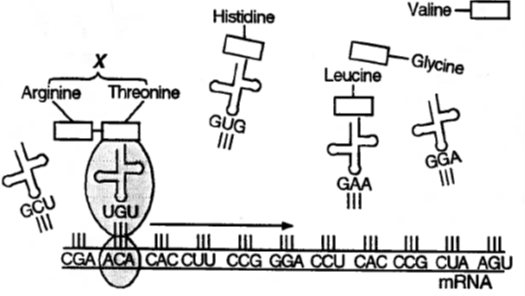
What process is going on in this photo? 
a)
Transcription 
b)
Translation 
c)
Replication 
d)
All the above 
10.
A portion of mRNA is coded CUG. The corresponding DNA is coded
a)
GAC
b)
GTC
c)
CTG
d)
CAG
11.
A portion of DNA reads GAG. The corresponding mRNA would be
a)
GUG
b)
GTG
c)
CTC
d)
CUC
12.
DNA polymerase and RNA polymerase are similar in that they
a)
are both enzymes
b)
both are involved in making new polymers
c)
both can be found doing work in the cell nucleus
d)
all of these things are true
13.
DNA polymerase and RNA polymerase are different in that they
a)
are involved in synthesis of different polymers
b)
DNA is a biological catalyst and RNA is not
c)
DNA polymerase synthesizes proteins and RNA polymerase synthesizes carbohydrates
d)
Stop trying to trick me; none of these are true!
14.
The process of creating RNA using DNA as the template is
a)
translation
b)
transcription
c)
translocation
d)
Transylvania
15.
In RNA, uracil takes the place of the DNA nitrogen base called
a)
guanine
b)
cytosine
c)
thymine
d)
adenine
16.
The main function of tRNA is to...
a)
carry a message that, when translated, forms proteins
b)
form a portion of ribosomes
c)
string together complementary RNA and DNA strands
d)
bring amino acids from the cytoplasm to the ribosomes
17.
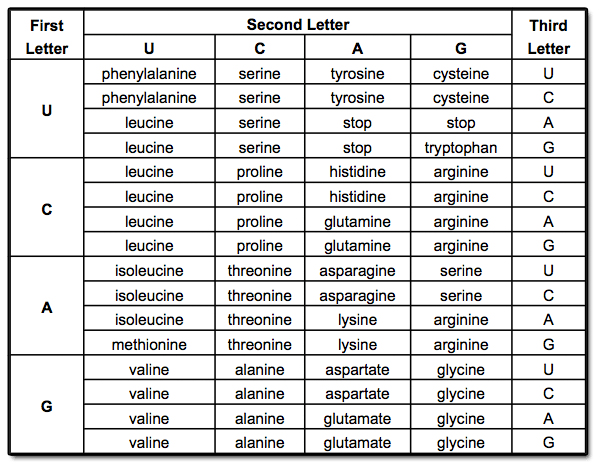
What amino acid is represented by the codon UUA?
a)
Phenylalanine
b)
Tyrosine
c)
Leucine
d)
Stop codon
18.
Which type of RNA binds to the small subunit on the ribosome?
a)
mRNA
b)
tRNA
c)
rRNA
19.
You have a DNA sequence that is 150 nucleotides long. How many amino acids will it code for?
a)
1,350
b)
50
c)
5
20.
Which type of bonds hold together the sugar phosphate backbone?
a)
covalent 
b)
hydrogen 
c)
peptide
21.
Which type of bond holds together complementary nitrogen bases?
a)
hydrogen
b)
covalent
c)
peptide
22.

Specifically, which type of bond holds together Amino acids?

a)

peptide

b)

ionic

c)

hydrogen

23.
Within the eukaryotic cell, where does transcription occur?
a)
Nucleus
b)
Cytoplasm
c)
Ribosome
24.
Which two processes are involved in protein synthesis?
a)
Replication and Transcription
b)
Replication and Translation
c)
Transcription and Translation
25.
Which of the following molecules is made during transcription?
a)
DNA
b)
tRNA
c)
protein
d)
mRNA
26.

Within the cell, where does translation occur?

a)

Nucleus

b)

Cytoplasm

c)

Golgi complex

d)

Mitochondria

27.
What is the correct amino acid sequence for the mRNA code AUG CCA GUA UGA
a)
Met-Pro-Ala-Val
b)
Met-Pro-Val-Stop
c)
Tyr-Gly-His-Stop
d)
Tyr-Gly-Arg-His
28.

Which statement best describes the relationship that exists among proteins, DNA, and cells?

a)

Proteins combine to produce cells, which produce DNA.

b)

Proteins are made up of DNA, which determines the cells that are produced.

c)

DNA is made up of proteins, which tell a cell how to function.

d)

Cells contain DNA, which controls the production of proteins.

29.

Which is the greatest consequence of transcription being blocked in the nucleus?

a)

The DNA would not be copied into RNA.

b)

The RNA would not be copied into DNA.

c)

The mRNA would not be transferred to rRNA.

d)

The protein would not be assembled in the cytoplasm.

30.

What determines the order of amino acids in a protein?

a)

the tRNA anti-codons

b)

the function of the protein

c)

the sequence of nucleotides in the DNA

d)

the percentage of each nucleotide in the gene