
 Worksheets
8.5E Evidence of Chemical Reactions
Total questions: 31
Worksheet time: 38mins
Name
Class
Date
1.
Which of the following is a sign that a chemical reaction has occurred?
a)
change in shape
b)
melting
c)
formation of a gas
d)
dissolving
2.

Is burning wood a chemical or physical change?
a)
chemical
b)
physical
3.
A change in the size, shape, or state of matter.
a)
chemical change
b)
physical change
c)
chemical reaction
d)
electron change
4.
Which of the following is NOT an example of a physical change?
a)
crumpled paper
b)
pencil sharpening
c)
shrunken clothing
d)
sour milk
5.

Four students performed four different investigations by combining different substances. Their results are shown in the table provided. In which experiment are new substances being formed?
a)
Experiment 1
b)
Experiment 2
c)
Experiment 3
d)
Experiment 4
6.
A clear liquid from a flask is poured into another clear liquid in a beaker. Which of the following results of this procedure would indicate a new substance was formed?
a)
The level of the substance in the beaker is higher after the other liquid is added.
b)
A yellow solid forms and then settles to the bottom of the beaker.
c)
Small white crystals are left behind in the flask that held the first liquid.
7.
Which of the following is an example that includes evidence of a chemical reaction?
a)
A sample of zinc is placed in water and it settles to the bottom
b)
A solid block of ice is heated and it completely melts into a liquid.
c)
Sugar that is burned gives off an odor and turns brown and then black.
d)
A tomato is placed into a blender and chopped up into smaller pieces.
8.
Evidence of a chemical reactions is anything that shows -
a)
a new substance has formed
b)
a solid dissolved in a liquid
c)
interaction between 2 gases
d)
a change in the state of matter
9.
A student observes some sugar as it is heated and burns. The student concludes that a chemical reaction has occurred. Which of the following observations about the burning sugar provides evidence of a chemical reaction?
a)
Heat is added to the sugar crystals.
b)
The sugar melts and becomes a liquid.
c)
Gas is produced as the sugar turns black.
d)
No evidence of chemical reaction is present.
10.

For an investigation a student poured a blue solution of CuSO4 into a beaker. The student placed a shiny, silver-colored strip of zinc metal in the solution and observed the changes.
The student inferred that a chemical reaction occurred. What evidence supports this inference?
The student inferred that a chemical reaction occurred. What evidence supports this inference?
a)
A dark solid formed on the zinc metal.
b)
The zinc metal remained silver-colored and shiny
The zinc metal remained silver-colored and shiny
c)
The CuSO4 solution turned blue when the zinc metal was added.
d)
None of these
11.

A scientist performed four investigations using eight different liquids. In each investigation, the scientist combined two of the liquids and recorded observations. In which investigation is it LEAST likely that the liquids reacted chemically?
a)
1
b)
2
c)
3
d)
4
12.

A copper penny turning greenish after a few years is an example of...
a)
Chemical Change
b)
Physical Change
13.
Which of the following IS a chemical change
a)
using chalk
b)
water freezing
c)
slicing cheese
d)
digestion
14.
How is a physical change different from a chemical change?
a)
There is absolutely no difference
b)
Chemical changes produce a new substance, physical changes stay the same substance
c)
Chemical changes create and destroy matter, physical changes don't
d)
Physical changes create and destroy matter, chemical changes dont
15.
A change in which NEW substances are formed.
a)
Chemical change
b)
Physical change
c)
Casual change
d)
Formal change
16.
The mass after a physical or chemical change stays the same
a)
True
b)
False
17.
Which of the following is a PHYSICAL change?
a)
Getting a haircut
b)
Rusty metal
c)
sour milk
d)
A compound
18.
A student places a piece of a potato into a container of hydrogen peroxide. One observation the student makes is that bubbles form around the potato. The presence of bubbles might indicate the formation of a new substance because bubbles -
a)
could show that a gas is forming
b)
always rise to the top of a liquid.
c)
are almost always perfectly spherical.
d)
usually burst after a few minutes.
19.
Hydrogen peroxide breaks down to form water and oxygen gas. Which observation is evidence that a chemical reaction has occurred?
a)
The mass of the solution remains the same.
b)
Phase changes are observed.
c)
The color of the solution remains clear.
d)
The temperature of the solution increases.
20.
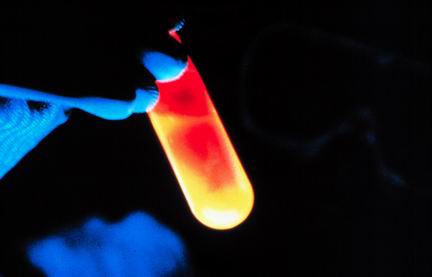
Which of the following is NOT evidence that that a chemical reaction has occurred?
a)
produces light/heat
b)
production of a gas
c)
formation of a precipitate
d)
melting
21.
If reaction starts with 20g of reactants it should produce
a)
a total of 40g of products
b)
a total of 10g of products
c)
a total of 80 g of products
d)
a total of 20g of products
22.
What is the Law of Conservation of mass?
a)
Mass is created in a chemical reaction
b)
Mass is created in a physical change
c)
New chemicals formed from a chemical reaction have a larger overall mass than the original reactants
d)
Mass is never created or destroyed
23.
In an experiment, two flasks of unknown, clear liquids are combined in a beaker and the following observations are obtained:
I. Solution color remains clear;
II. The amount of solution in the beaker increased;
III. Solution temperature changed from 10C to 20C; and
IV. Some of the liquid remained in the flasks.
How many of the listed observations indicate a new substance was formed?
a)
1
b)
2
c)
3
d)
4
24.
A precipitate is a
a)
liquid that forms when two solids are reacted
b)
a solid that forms when two liquids are mixed
c)
a gas that forms when vinegar and baking soda react
d)
a change of color in a solution
25.
Check every box that identifies evidence of chemical reactions?
a)
Changes the state of matter
b)
Color change (Unexpected)
c)
Gas, bubbles or fizzing
d)
Emits light, sound or heat
e)
Precipitate
26.
A granular substance is added to a liquid. Which of the following would provide evidence to suggest a chemical change has taken place?
a)
The liquid gives off heat.
b)
The granules dissolve completely.
c)
The volume of the liquid increases.
d)
The granules seem to get smaller.
27.

Which observation(s) might be used as evidence that a chemical reaction occurred?
a)
Color change
b)
Odor change
c)
Properties change
d)
All of the above
28.
When a scientist mixed two chemicals, an exothermic reaction takes place. Which of the following would be proof that the reaction was exothermic?
a)
a change of color
b)
a change of state
c)
a temperature decrease
d)
a temperature increase
29.
Which of the following is a chemical change?
a)
water freezes to form ice
b)
sugar dissolves in water
c)
gasoline burns in a car engine
d)
a piece of metal expands when it is heated
30.
In any chemical reaction, the mass of the products is always:
a)
slightly less than the mass of the reactants
b)
much less than the mass of the reactants
c)
the same as the mass of the reactants
d)
greater than the mass of the reactants
31.

Which is the name of the kind of solid substance formed in this figure?
a)
aqueous
b)
precipitate
c)
acid
d)
synthesis
100 %

