
 Worksheets
Heart and Blood Vessels Quiz 26
Total questions: 40
Worksheet time: 22mins
Which of the following are the smallest blood vessels?
artery
vein
venule
capillary
The function of valves in the human circulatory system is to
stimulate the heart beat.
accelerate the flow of blood.
prevent the backward flow of blood.
serve as a cushion to prevent friction
If a blood vessel has valves, it is probably a(n)
vein.
artery.
capillary
Blood vessels that carry blood away from the heart are called
veins.
arteries.
capillaries.

Aorta
1
2
4
5

Left ventricle
1
2
3
4

Name this part.
Right atrium
Left ventricle
Right ventricle
Left atrium
The _________ pumps blood to the lungs.
Right Atrium
Right Ventricle
Left Atrium
Left Ventricle

What is the name of structure n?
Semilunar valve
Atrioventricular valve
Mitral valve
Aortic valve
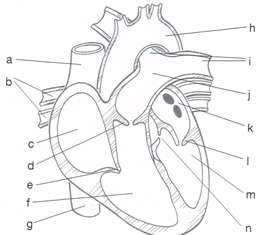
What is structure e?
Mitrial Valve
Tricuspid Valve
Aortic valve
Pulmonary valve
How many layers of cells make up the wall of a capillary?
1
2
3
4
Which of the following shows a correct route for the transport of substances in blood?
arteriole --> artery --> capillary --> vein --> venule
artery --> vein --> capillary --> venule --> arteriole
venule --> vein --> capillary --> artery --> arteriole
artery --> arteriole --> capillary --> venule --> vein
What is the name of the pacemaker of the heart?
SA node
AV node
SV node
AA node
Which wave in an ECG represents Ventricular Repolarization?
P wave
T wave
QRS complex
PQ segment
What is the name of the circuit that supplies blood to the body?
Systemic circuit
Pulmonary circuit
sympathetic circuit
Parasympathetic circuit
What do you call arteries that are thick-walled near the heart: ie.. the aorta and its major branches?
Cappillaries
Elastic Arteries
Muscular Arteries
Arterioles
What regulates the amount of blood going into a capillary bed?
Precapillary Sphincters
Vascular shunts
Venules
Arterioles
What are the three sources of resistance in blood vessels? (so check 3)
Blood Viscosity
Blood Vessel Length
Blood Vessel diameter
Cardiac Out Put
Heart Rate
Where in the circulatory system do you have the steepest change in blood pressure?
Aorta
Right Atrium
Arterioles
Veins
What causes the Lub sound ?(first sound the heart makes)
AV valves closing
SL valves closing
Ventricles relaxing
AV valves opening
What is the measurement for too LOW of blood pressure?
120/80
85/55
90/60
95/65
Blood pressure is recorded as
Hydrostatic /diastolic
Diastolic/ hydrostatic
Systolic/diastolic
Diastolic/systolic

What percentage of you blood is in your veins?
85
75
65
55
Bradycardia is when…
The heart speeds up to <100BPM
The heart speeds up to <120BPM
The heart slows down to >60BPM
The heart slows down to >40BPM
What does systole mean?
When a stimulation occurs
Removing waste from the body
When the heart relaxes
When the heart contracts
How many times does the SA node generate impulses a minute?
50 times/minute
65 times/minute
75 times/minute
45 times/minute
What two factors contribute to Cardiac Output? mark 2
Heart Rate
Blood Pressure
Stroke Volume
Blood Viscosity
Size of the Artery
What is the name of the muscles that help close your av valves?
Papillary
cardiac
Chordae
AV muscles
What structure comes after bundle branches?( I want to name my next dog this)
Purkinje Fibers
Bundle of His
AV node
Septum branches
If you have an enlarged heart which of the following decreases?
Stroke Volume
Heart Rate
Blood Pressure
Your will to live
Where is the Mitral valve located?
Between the R. Atrium and R. Ventricle
Between the L. Atrium and L. ventricle
Between the L. Ventricle and Aorta
Between the R. Ventricle and the Pulmonary Valve
Between the R. Atrium and L. Ventricle
Which of the following carries deoxygenated blood
Pulmonary Artery
Aorta
Pulmonary Veins
Carotid Artery
Put these in order starting at the heart and moving away
elastic arteries
muscular arteries
arteioles
venules
veins

What wave represents atrium repolarization?
P
QRS
T
None of these
Which of the following is not a fairy in Sleeping Beauty?
Flora
Fauna
Meryweather
Fila mina
The blood enters on the left side of the heart (from the lungs) through the ______________ and enters the left atrium. It then passes through the _____________to enter the left ventricle.
pulmonary artery, mitral valve
pulmonary vein, tricuspid valve
pulmonary artery, aortic valve
pulmonary vein, bicuspid valve

Place the pathway of blood through the heart in the correct sequence.
L-K-H-B-G-E-C-F-A-I-E-D
I-J-D-C-F-A-H-B-G-E-K-L
A-B-J-C-D-E-F-K-L-G-H-I
I-J-E-D-C-F-A-B-G-H-K-L

