
 Worksheets
BSCS- CH 7
Total questions: 18
Worksheet time: 14mins
Name
Class
Date
1.

The chewing and grinding of food into smaller pieces is an example of...
a)
Mechanical Digestion
b)
Chemical Digestion
2.
Muscles that oppose one another are
a)
synergist
b)
hateful
c)
prime movers
d)
antagonists
3.
Muscles are composed of which of the following?
a)
Lipids
b)
Protiens
c)
Carbohydrates
d)
Fats
4.
Proteins are made of monomers called ___________
a)
Nucleotides
b)
Monosaccharides
c)
Amino Acids
d)
Glycerol and fatty acids
5.
Waxes, oils and fats are examples of
a)
Carbohydrates
b)
Lipids
c)
Proteins
d)
Nucleic Acids
6.
What is the function of nucleic acids?
a)
store genetic information
b)
store energy (long-term)
c)
store energy (short-term)
d)
build skin, hair, nails, muscles
7.
Which of the following organic compounds is the main source of energy for living things?
a)
carbohydrates
b)
lipids
c)
nucleic acids
d)
proteins
8.
Lipids can be digested into what smaller subunits?
a)
nucleic acids
b)
amino acids
c)
fatty acids
d)
glucose
9.
All polymers are made up of...
a)
monosaccharides
b)
monomers
c)
proteins
d)
None of these
10.
All organic compounds contain the element
a)
carbon
b)
nitrogen
c)
phosphorus
d)
sulfur
11.
Where do substrates bind on an enzyme?
a)
voltage-gated channels
b)
surface receptor
c)
calcium channels
d)
active site
12.

What is structure A?
a)
Substrate
b)
Active site
c)
Enzyme
d)
Products
13.
At 40 degrees Celsius (104 degrees Fahrenheit), your biological enzymes will...
a)
Functional optimally
b)
Denature
c)
Wait until the temp. increases
d)
Wait until the temp. decreases
14.
What makes an enzyme substrate specific?
a)
Size
b)
Shape
c)
Name
d)
Location it is found in
15.
The bonds linking amino acids are called
a)
Peptide bonds
b)
Glycosidic bonds
c)
Ester bonds
16.

What type of fatty acid is this?
a)
Unsaturated
b)
Saturated
c)
Monounsaturated
17.
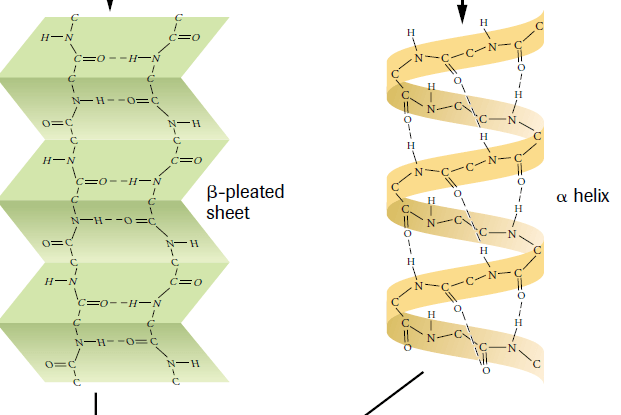
What level of protein structure is this?
a)
Primary
b)
Secondary
c)
Tertiary
d)
Quaternary
18.
Which type of macromolecule is used as a LAST resort to supply your body with energy?
a)
nucleic acid
b)
lipid
c)
carbohydrate
d)
protein
100 %

