
 Worksheets
Chemical equations and Stoichiometry
Total questions: 24
Worksheet time: 35mins
Name
Class
Date
1.
2H2 + O2 → 2H2O
How many moles of oxygen are consumed if 8 moles H2 are used?
How many moles of oxygen are consumed if 8 moles H2 are used?
a)
2
b)
4
c)
6
d)
8
2.
For the Balanced Reaction: 3 Mg + 1 Fe2O3 → 3 MgO + 2 Fe; What is the Ratio of moles of MgO to moles Fe?
a)
3mol Mg / 2 mol Fe
b)
2 mol Mg/ 3 mol Fe
c)
1 mol Fe/ 2 mol Fe
d)
3 mol MgO / 2 mol Fe
3.
2Na + 2H2O → 2NaOH+ H2
How many grams of hydrogen are produced if 120 g of Na are available?
How many grams of hydrogen are produced if 120 g of Na are available?
a)
5.2 g
b)
2.6 g
c)
690 g
d)
45 g
4.
If a chemist calculates the amount of product that could be obtained in a chemical reaction using stoichiometry, he or she is calculating the
a)
theoretical yield
b)
mole ratio
c)
actual yield
d)
percentage yield
5.
What is the measured amount of a product obtained from a chemical reaction?
a)
mole ratio
b)
theoretical yield
c)
percentage yield
d)
actual yield
6.
A chemist interested in the efficiency of a chemical reaction would calculate the
a)
mole ratio
b)
rate of reaction
c)
percent yield
d)
energy released
7.
What is a Excess Reagent?
a)
amount you end with
b)
what you run out of first
c)
what you have left over
d)
what you start with
8.
When does a chemical reaction stop?
a)
When the lab is finished
b)
When the excess reactant is used up
c)
When the limiting reactant is used up
d)
Chemical reactions never stop
9.
WO3 + H2 --> W + H2O
What coefficient goes in front of H2?
What coefficient goes in front of H2?
a)
1
b)
2
c)
3
d)
4
10.
Mole ratios are obtained from the
a)
balanced chemical equation
b)
periodic table
c)
molar mass
11.
What is the mole ratio of H2O to H3PO4 in the following chemical equation? P4O10 + 6 H2O --> 4 H3PO4
a)
6:4
b)
4:6
c)
1:3
d)
3:1
12.

9. Complete the equation for the percent yield of a chemical reaction:
Percent yield=(________)÷(________)×100%
Percent yield=(________)÷(________)×100%
a)
actual yield; theoretical yield
b)
theoretical yield; actual yield
13.
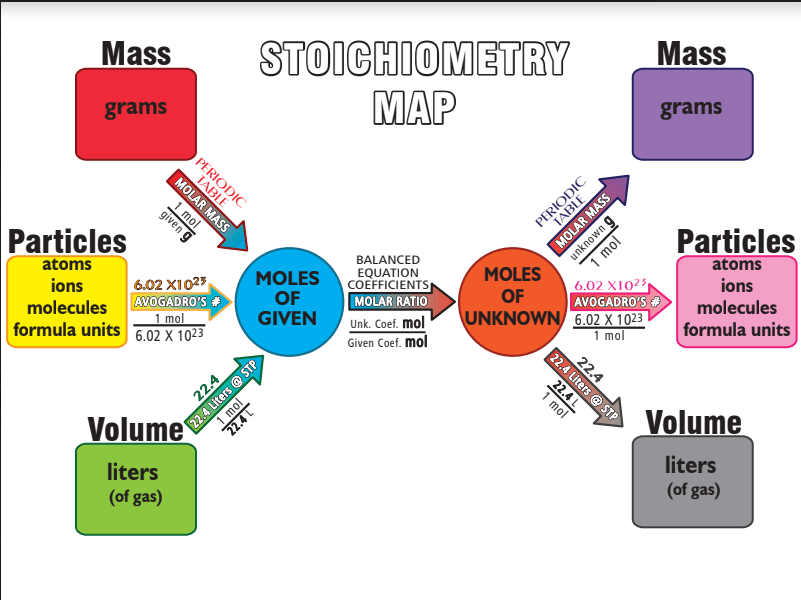
How many step will it take for me to go from moles of (A) to moles of (B) ?
a)
1
b)
2
c)
3
d)
4
14.
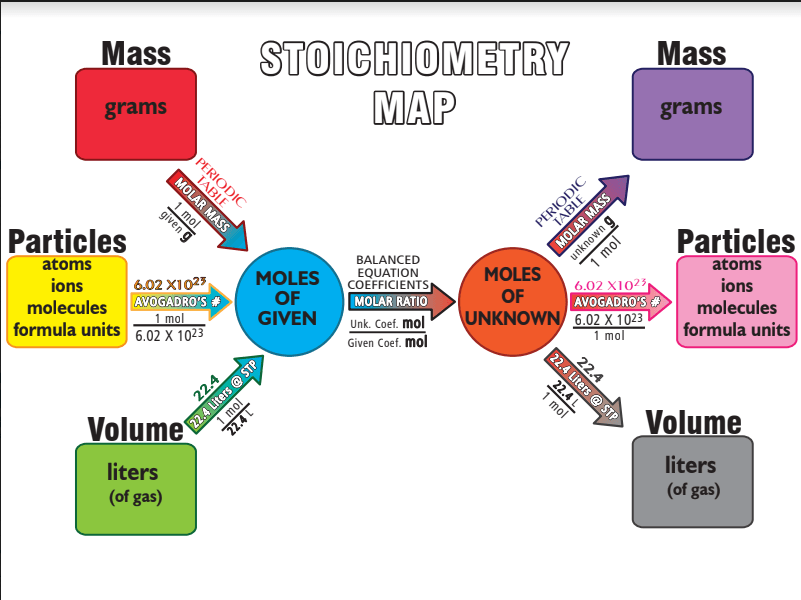
How many steps will it take me to go from grams to grams?
a)
4
b)
3
c)
2
d)
1
15.
I use molar mass when the problem gives me grams?
a)
False
b)
True
16.
I use 6.02 x 10²³ when the problem gives me molecules?
a)
True
b)
False
17.
What is the Law of Conservation of Mass?
a)
It states that matter cannot be created or destroyed.
b)
It states that energy cannot be created or destroyed.
c)
It states that matter can be created or destroyed.
d)
It states that sound can be created or destroyed.
18.
What is a coefficient?
a)
The small number on the right of the chemical symbol.
b)
The large number in front of a chemical formula.
c)
The number in between the chemical symbols.
d)
The number behind a chemical formula.
19.
What is the part of the chemical equation in green called?
Fe + S --> FeS
Fe + S --> FeS
a)
products
b)
reactants
c)
yield
d)
chemical formula
20.
What is the little number after an element in a chemical equation called.
Example: H2
Example: H2
a)
Coefficient
b)
Subscript
c)
Atom
d)
Equation
21.
What coefficient should be used to make the following equation balanced?
N2+O2--> _NO
N2+O2--> _NO
a)
1
b)
2
c)
3
d)
4
22.
Which problem is balanced?
(Check ALL answers)
(Check ALL answers)
a)
PbO2 + 2H2
b)
SO2 + H20 --> H2SO4
c)
2Na + 2H2O --> 2NaOH + H2
23.
What is the right part of a chemical equation called...
2H2 + O2 --> 2H2O
2H2 + O2 --> 2H2O
a)
Reactants
b)
Products
c)
Yields
d)
Chemical Equation
24.
Is the following reaction balanced?
2CH3OH + 3O2 --> 2CO2 + 4H2O
2CH3OH + 3O2 --> 2CO2 + 4H2O
a)
yes
b)
no
100 %

