
 Worksheets
evolution
Total questions: 20
Worksheet time: 10mins
Name
Class
Date
1.

Change over time...
a)
Evolution
b)
Nucleotide
2.

Charles Darwin came up with this theory
a)
Natural Selection
b)
Mutation
3.

To adjust to a changing environment
a)
Mutation
b)
Adapt
4.

Darwin wrote that organisms with traits that are best suited to the environment will ________________
a)
increase in number
b)
become extinct
5.

Another word for adapt is ____________.
a)
change
b)
create
6.
What characteristic did Darwin observe about the finches on the Galapagos Islands?
a)
Their feathers
b)
Genotypes
c)
Their beaks
d)
Their body sizes
7.
Which term refers to the process by which individuals that are better suited to the environment survive and reproduce therefore passing down their genes to their offspring?
a)
Evolution
b)
Variation
c)
Adaptation
d)
Natural Selection
8.
When an organism completely dies out, it is called.....
a)
Adaption
b)
Extinction
c)
Fossilization
d)
Mutation
9.
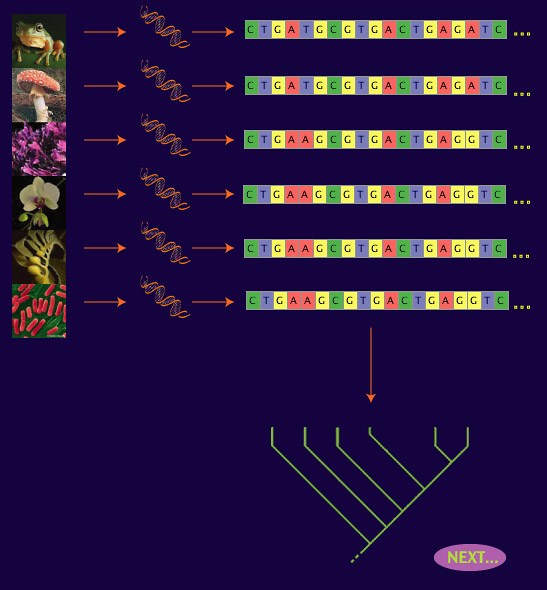
Two organisms that are closely related would have
a)
very similar DNA sequence
b)
exactly the same DNA sequences
c)
no proteins in common
d)
completely different DNA sequence
10.

The diagram illustrates an embryonic stage of two organisms.Which of the following can be determined by observing the embryos shown in the diagram?
a)
The organisms share a common ancestry.
b)
The organisms belong to the same genus.
c)
The organisms are native to the same geographic areas.
d)
The organisms will grow into anatomically similar adults.
11.

The diagram represents the relationship between beak structure and food in several species of finches found on the Galapagos Islands. The different beak structures observed in the diagram are evidence of
a)
different species of finches adapting to different environments over many generations
b)
finches changing their beak characteristics so that they could feed efficiently
c)
finch species with different beak structures coming to the Galapagos Islands from the mainland
d)
finches mating with birds of other species and acquiring some of their traits
12.
Natural selection is best described as
a)
a change in an organism in response to a need of that organism
b)
a process of nearly constant improvement that leads to an organism that is nearly perfect
c)
differences in survival rates as a result of different inherited characteristics
d)
inheritance of characteristics acquired during the life of an organism
13.
Individuals undergo evolution.
a)
True
b)
False
14.

The forelimbs of mammals have similar anatomy because these groups descended from a recent common ancestor. Their bone structure is an example of a(n) ______________ structure.
a)
vestigial
b)
analogous
c)
homologous
15.

Which of the following is a term for a group of similar organisms that can reproduce fertile offspring?
a)
individual
b)
population
c)
species
d)
fossil
16.

If an organism has a vestigial structure, that structure likely once had a function in a(n)
a)
close relative
b)
early ancestor
c)
unrelated organism
d)
embryological stage
17.
Mutations are important because they bring about
a)
death of the organism in which they develop
b)
genetic variation needed for a population to evolve
c)
benefits for the individual, not for the population
d)
Hardey-Weinberg equilibrium within a population
18.
Finches on the Galapagos Islands had different beaks in order to help them do what?
a)
Build nests
b)
Fight off predators
c)
Collect food sources
d)
Compete with rivals
19.
This scientist came up with the idea of natural selection.
a)
Jean Baptiste Lamarck
b)
Gregor Mendel
c)
Charles Darwin
d)
Thomas Malthus
20.
A remnant or trace of an organism from the past is called a _______.
a)
Ancestor
b)
Skeleton
c)
Fossil
d)
Imprints
100 %

