
Font size
 Worksheets
2.1 Carbon Compounds
Total questions: 25
Worksheet time: 12mins
Potassium cyanide, KCN is a
Organic compound
Inorganic compound
Cellulose, (C6H10O5)n is a
Organic compound
Inorganic compound
Natural rubber is a
Organic compound
Inorganic compound
Calcium carbide, CaC2 is a
Organic compound
Inorganic compound
Urea, CH₄N₂O is a
Organic compound
Inorganic compound
Carbon compounds are compounds that
are made only with carbon atoms
contain carbon as their constituent element.
contain carbon atom bonded to hydrogen atom
contain only oxygen atoms
Which property of carbon is important in the forming of many types of organic compounds
carbon has 6 electrons
carbon has 6 protons
carbon has 4 valence electrons
carbon can only bond with hydrogen

How many covalent bonds does each carbon have in the molecule shown?
4
2
8
6

The structure of some hydrocarbon are shown above. The hydrocarbon that classified into saturated compound are ....
F, G, H
F, G, I
G, I, K
F & G
Hydrocarbons are compounds that contain
Carbon and Nitrogen atoms only
Carbon and Hydrogen atoms only
Carbon and Oxygen atoms only
Carbon, Oxygen and Hydrogen atoms.
How many covalent bonds are there between the carbon atoms in unsaturated hydrocarbons?
1
2
3
2 or 3
Fractional distillation separates crude oil based on the different __________ of the molecules in the mixture
melting point
boiling point
freezing point
chemical reactivity
Molecules collected at the bottom of the fractionating column tend to be...
more viscous, less flammable and less volatile
less viscous, more flammable and more volatile
more viscous, more flammable and less volatile
less viscous, less flammable and more volatile
Molecules collected at the top of the fractionating column tend to be...
more viscous, less flammable and less volatile
less viscous, more flammable and more volatile
more viscous, more flammable and less volatile
less viscous, less flammable and more volatile
What are the 2 products of complete combustion?
carbon dioxide + hydrogen
carbon dioxide + water
carbon monoxide + water
carbon monoxide + hydrogen
What are the products of incomplete combustion?
carbon monoxide
water
carbon
hydrogen
Which of these isn't a fraction produce through fractional distillation?
Bitumen
Naptha
Fuel oil
Ethanol
What is crude oil formed from?
Remains of shale gas trapped under the sea bed
Remains of gases trapped in the ozone layer
Remains of plants and animals that died millions of years ago
Remains of animal faeces from millions of years ago
Which bond breaks during cracking?
C-C bond
C-C double bond
C-H bond
C-OH bond
What is cracking?
Process of breaking long chain alkenes into shorter chain alkanes, alkenes and hydrogen
Process of breaking long chain alkanes into shorter chain alkanes, alkenes and hydrogen
Process of separating long chain alkanes into shorter chain alkanes, alkenes and hydrogen
Process of breaking long chain haloalkanes into shorter chain haloalkenes
Crude oil is made up of:
Ethane
Butane
A mixture of different hydrocarbons
Extremely large hydrocarbons which are broken up once extracted
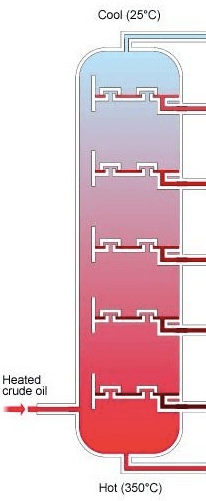
What process happens at each level in the fractionating column?
Evaporation
Condensation
Combustion

