
 Worksheets
production csec
Total questions: 35
Worksheet time: 18mins
Which of the following is not a factor of production?
food
land
labour
capital
In a subsistence economy the main source of production is:
exports
manufacturing
agriculture
mining
Fixed capital includes:
buildings
stocks
bank balance
stationery
Land includes...
The "gifts of nature" or natural resources not created by human effort.
the tools, equipment, and factories used in production of goods and services
people with all their efforts and abilities
individuals who start a new business or bring a product to market.
Capital refers to...
The "gifts of nature" or natural resources not created by human effort.
people with all their efforts and abilities
the tools, equipment, and factories used in production of goods and services
individuals who start a new business or bring a product to market.
Labor refers to...
people with all their efforts and abilities
individuals who start a new business or bring a product to market.
the tools, equipment, and factories used in production of goods and services.
The "gifts of nature" or natural resources not created by human effort.
WHAT ARE THE 4 FACTORS OF PRODUCTION?
Land, Capital, Need & Want
Land, Labor, Capital, Entrepreneurs
Water, Air, Food & Shelter
Land, Capital, Good & Service

Which of the factors of production is this?
capital
entrepreneur
land
labor
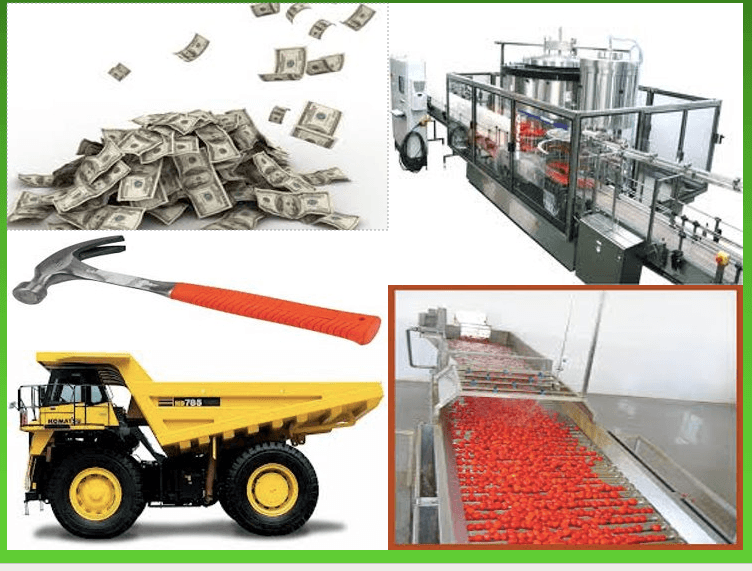
Which one of the factors of production is this?
capital
entrepreneur
land
labor
The labour force of a country is:
all people below retirement age
all persons who are employed or are available for work
the total population
all persons over the school leaving age
Capital refers to...
The "gifts of nature" or natural resources not created by human effort.
people with all their efforts and abilities
the tools, equipment, and factories used in production of goods and services
individuals who start a new business or bring a product to market.
Labour refers to...
people with all their efforts and abilities
individuals who start a new business or bring a product to market.
the tools, equipment, and factories used in production of goods and services.
The "gifts of nature" or natural resources not created by human effort.
During production process inputs are converted into ______________.
store
machines
raw materials
outputs
Which of these is a service?
beverage factory
plumbing
readymade dresses
birthday cakes baked by a supermarket
Which of the following is true for productivity?
productivity is how products are made
productivity is a measure of how many workers a business has
productivity measures efficiency
productivity measures effectiveness
Which of these isn't a method of improving productivity?
employing more staff
providing pay incentives
investing in up-to-date machinery
training staff
The mining of minerals is called...
drilling
manufacturing
servicing
extracting
Secondary industry is also known as _____________ industry
manufacturing
extractive
mining
Making soaps, carpets, sugar, etc is an example of _________ industry
primary / extractive
secondary / manufacturing
tertiary
Banking is an example of ____________ industry
Primary / Extractive
Secondary / Manufacturing
Tertiary
The industry that includes the process of making goods from raw materials is called ____________
Primary / extractive
Secondary / manufacturing
tertiary
What are levels of production?
Primary Production
Producing at the secondary level
The amount of goods produced
Producing only enough to meet the basic needs of the family is called?
Domestic Production
Subsistence Production
Surplus Production
This level of production allows a country to earn foreign exchange from the selling of its products.
Subsistence Production
Domestic Production
Surplus/Export Production
Selling goods at your local market is which level of production?
Domestic Production
Export/Surplus Production
Subsistence Production
If Jamaica is able to produce enough goods to satisfy the needs of persons in the country, Jamaica is practicing which level of production?
Domestic Production
Export Production
Subsistence Production
When China sells its products to other countries, this is which level of production?
Subsistence Level of Production
Domestic Level of Production
Surplus/Export Level of Production
Which of the following is not one one of the key features of a cottage industry?
Carried out in persons homes
Typically use traditional or small scales technology
Often use local raw material
Usually hire employees from the community
Which of the following is NOT a disadvantage of operating a cottage industry?
Operators may lack marketing skills
Raw materials may be hard to obtain
Cottage industry usually offers low and attractive prices
Long hours of work usually required
Which is NOT a characteristic of cottage industry?
Based at home
Labour- intensive production
Use of readily available resources
Highly trained employees
A cottage industry can BEST be described as
A business with one person responsible for all aspects
A business that builds homes
A business carrying out production at home
A business catering to the needs of the local community
Linkage Industries are ______
closely connected to each other
part of the public sector
capital intensive
engaged in mass production
Which of the following is a forward linkage?
A farmer providing manure for other farmers
A farmer buying fertiliser from garden store
Oil manufacturer buying bottles from bottle manufacturer
Bottle manufacturer buying petroleum from crude oil industry
Forward linkage is where_______
one industry provides raw materials for another
one industry depends on another for their raw materials
one industry sells their product to the public
one industry buys their materials from a manufacturer

