
 Worksheets
Sound Waves and Charateristics
Total questions: 20
Worksheet time: 21mins

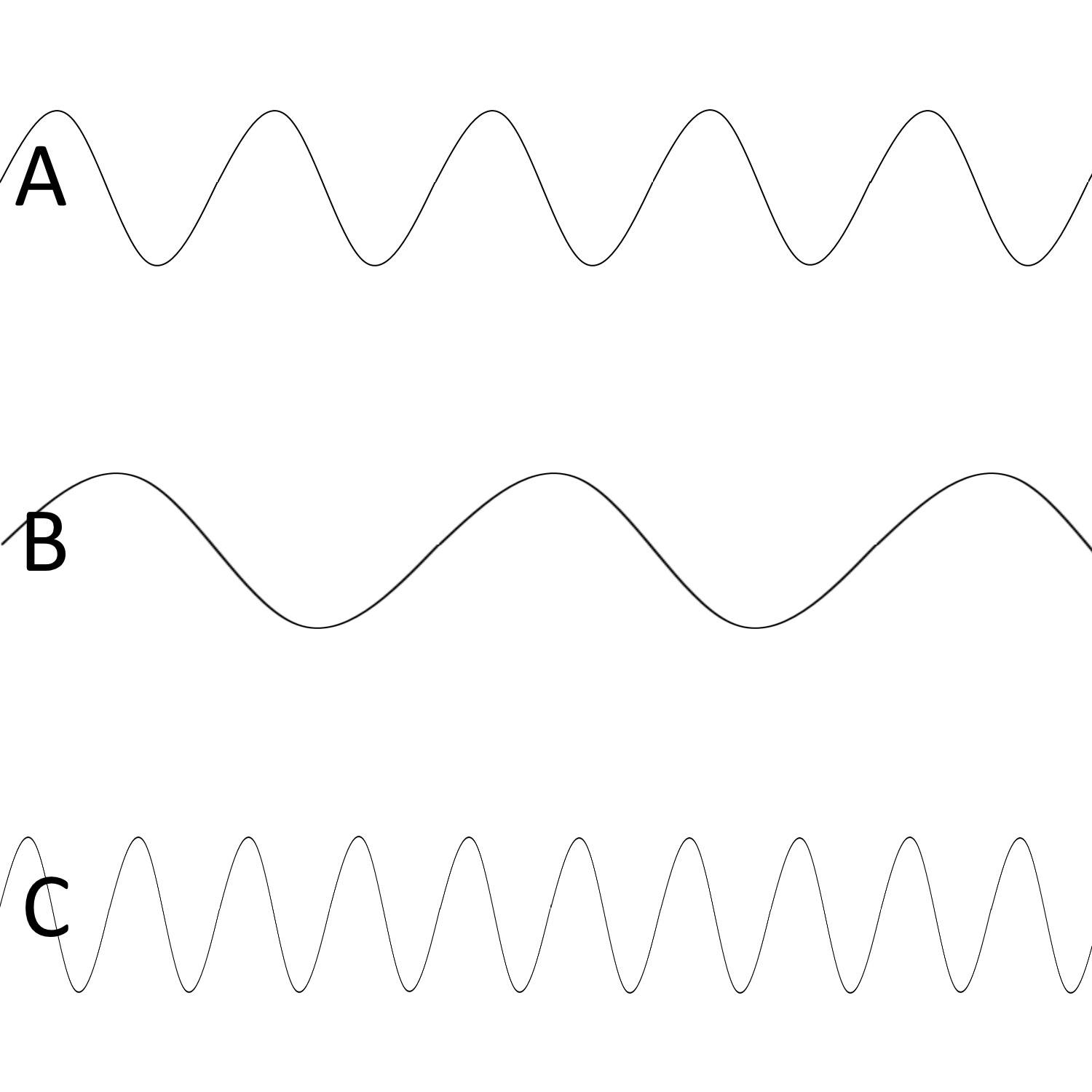

Which wave has the highest frequency?
A
B
C
None (same frequency)
none of these are correct
Waves that have vibrations that move perpendicular to the direction the wave are called:
Electromagnetic Spectrum
Transverse Waves
Medium
Light Waves


Of the 4 waves, which is low pitch and quiet?
red
yellow
green
blue

The part of a longitudinal wave where the particles of the medium are close together.
rarefaction
compression
crest
trough
The highest point on a wave
wavelength
crest
trough
amplitude
The lowest point on a wave
crest
frequency
wavelength
trough
The horizontal distance between crests
amplitude
frequency
crest
wavelength
Why can't sound travel through outer space?
There is almost no matter in outer space, so the vibrations have no way to travel through the atmosphere. There is nothing to carry the sound waves through space.
Sound actually travels very quickly through outer space because there is no matter to slow down the sound waves.
There are too many planets and stars in outer space that absorb all of the sound waves, so they cannot travel to the human ear.
Because outer space is a "vacuum," the vibrations are irregular and travel in too many directions for us to detect the sound.
If you pluck a guitar string, it vibrates and creates a sound. In order to stop the sound, you could...
blow on the string.
pluck a different string.
place your hand on the string to stop the vibration.
pluck the same string again.

Which of these waves would produce a high pitch sound?
Low frequency wave
High frequency wave
If you pull a guitar string tighter, what will happen to the sound it creates?
The pitch will become higher because the string will vibrate more quickly.
The pitch will become lower because the string will vibrate more slowly.
The sound will get louder because more energy will be in the string.
The sound will get quieter because less energy will be in the string.

