
 Worksheets
The Great Depression
Total questions: 30
Worksheet time: 30mins
Farmers left the Dust Bowl states during the 1930s because
they were unable to farm the land.
they wanted to go find gold.
they wanted to be movie stars in California.
of the Homestead Act's promise of fertile land.
How did "bank runs" impact the American people during the Great Depression?
Banks eventually ran out of money to loan, and people's life savings were gone.
Banks made loans throughout the Great Depression, helping people pays bills until they could find work.
Banks were able to keep people's deposits safe, but they could not loan out any more money.
Banks were not at all involved in the Great Depression because people did not use them.

The purpose of the New Deal program was to...
improve working conditions in factories.
stop the sale of alcohol in states.
end discrimination against African Americans.
help the nation recover from the Great Depression.
The day the stock market crashed is known as:
Black Monday
Black Tuesday
Black Wednesday
Black Thursday


How did the Great Depression affect workers?
One-half of workers were unemployed.
Workers’ incomes rose to high levels.
One-fourth of workers were unemployed.
Workers were able to afford luxury items.

"The Life of Franklin D. Roosevelt"
What chapter would most likely be found in this book?
“Invention of the Airplane”
“Invention of the Light Bulb”
“The Development of the League of Nations”
“The Development of the New Deal”
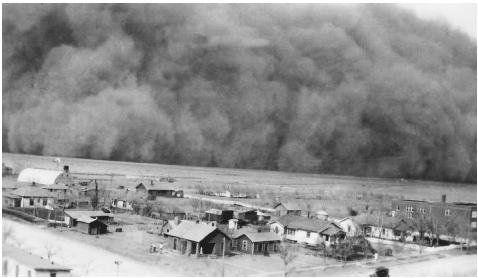
During the 1930s, poor land management and severe drought conditions across parts of the Midwest resulted in the...
formation of the United States Department of Agriculture.
creation of wheat surpluses.
growth of the Populist movement.
development of Dust Bowl conditions on the Great Plains.
A major difference between the philosophies of President Herbert Hoover and President Franklin D. Roosevelt in responding to the Great Depression is that Roosevelt...
wanted to rely on private charities to provide assistance.
stressed the need for individualism.
supported direct relief for people out of work.
thought the government should not be involved in economic reform.
Which New Deal program gave jobs to young men between the ages of 18-25? The employees built roads, planted forests, and worked on irrigation and national park projects.
CCC
UGA
WPA
TVA
FDR addressed the American public in weekly broadcasts known as...
FDR Hour.
Hangin' With Franklin.
Fireside Chats.
Around the Fire.
The TVA is significant because it hired people to...
deliver food to the poverty-stricken Dust Bowl residents.
build dams and generators that provided electricity.
work on farms to help stabilize agriculture.
publish important facts about businesses.
The Civilian Conservation Corps (CCC) and the Works Progress Administration (WPA) were both New Deal programs developed to address the problem of...
excessive stock market speculation.
high unemployment.
increased use of credit.
limited income of senior citizens.
Who was an Atlanta native who won a Pulitzer Prize for Gone With the Wind, a novel set in the South during the Civil War?
Langston Huges
Jesse Owens
Margaret Mitchell
Robert E. Lee
How did the WPA help with employment?
It employed millions to work in factories.
It employed millions to build public buildings.
It employed millions to work for car companies.
It employed millions to work for the military.
What decade did the Great Depression take place?
1920s
1930s
1940s
1950s
Why did the Tennessee Valley Authority build dams? Choose ALL answers that apply.
to provide irrigation to the people in the Tennessee River Valley
to attract tourists to the Tennessee River Valley
to help control flooding in the Tennessee River Valley
to generate low-cost electricity in the Tennessee River Valley
to improve transportation in the Tennessee River Valley
Which of the following BEST describes the Great Depression?
Many countries around the world experienced the negative effects of the Great Depression.
The Great Depression caused revolutions all around the world.
Governments acted quickly and the Great Depression only lasted two years.
The Depression was severe, but ONLY in the United States.

