Wayground logo

Free Printable Worksheets

Font size

S
M
L
XL
Worksheets

Wave review

Total questions: 25

Worksheet time: 19mins
Name
Class
Date
1.
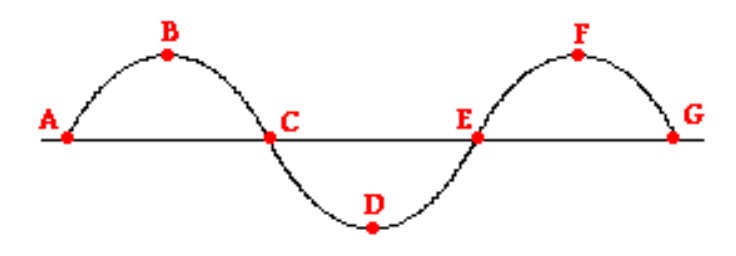
What property of the wave is represented by the letter "B"?
a)

amplitude

b)

crest

c)

trough

d)

wavelength

2.
The highest point on a wave is:
a)
the crest
b)
the trough
c)
the top
d)
the coast 
3.
Which vocabulary term is used to identify the distance between points C & G?
a)
Amplitude
b)
Crest
c)
Frequency
d)
Wavelength
4.
Which letter(s) represent the trough of the wave?
a)
A
b)
B & D
c)
D
d)
C & G
5.

Amplitude is the distance between

a)

the crest and the trough

b)

each wave

c)

the middle point of a wave and the clouds

d)

the crest or trough and the middle point of the wave

6.
Waves that require a medium are called 
a)
mechanical waves
b)
transverse waves
c)
light waves
d)
gamma rays
7.
What happens when you increase the amplitude of a sound?
a)
it makes the sound louder
b)
it makes the sound travel faster
c)
it increases the wavelength of the sound
d)
it increases the frequency of the sound
8.

What kind of wave is pictured below?

a)

compressional wave

b)

transverse wave

c)

sound wave

d)

mechanical wave

9.
What can electromagnetic waves travel through?
a)

mediums

b)

empty space

c)

solely solids

d)

both media and empty space

10.
What do waves carry from place to place?
a)
Energy, but not matter or particles
b)
Energy and matter or particles
c)
Matter or particles but not energy
d)
Neither energy nor matter or particles
11.
Which wave is pictured?
a)
Transverse
b)
Longitudinal
c)
Both
d)
Neither
12.
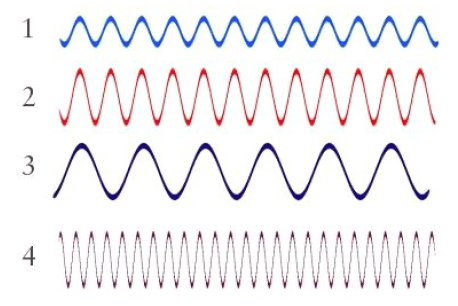
Which wave in the diagram has the greatest frequency?
a)
1
b)
2
c)
3
d)
4
13.
Which wave in the diagram has the greatest wavelength?
a)
1
b)
2
c)
3
d)
4
14.
Which of the following can sound travel through?
a)
solid
b)
liquid
c)
gas
d)
all of the above
15.

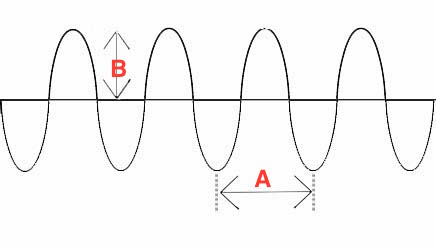
Which diagram shows the wavelength of a wave?

a)
b)
c)
16.

If the wavelength of a wave increased, what would happen to the frequency?

a)

decrease

b)

increase

c)

stay the same

17.
Which of the following is NOT a mechanical wave?
a)
sound
b)
light
c)
ocean
d)
seismic
18.
How would a person measure the wavelength on this sound wave?
a)
dense to less dense
b)
trough to crest
c)
compression to compression
d)
beginning of illustration to the end
19.

You can't hear sounds in outer space because there is no

a)

medium

b)

light

c)

energy

d)

heat

20.
In longitudinal waves, the parts where the coils are spread apart are called what?
a)
rarefactions
b)
compressions
c)
mechanicals
d)
longitudes
21.
In what type of wave does the medium move perpendicular to the movement of the wave?
a)
Transverse
b)
Longitudinal
c)
Electromagnetic
d)
Radio
22.
In a longitudinal wave, the parts where the coils are close together are called what?
a)
longitudes
b)
rarefactions
c)
compressions
d)
contractions
23.
Which type of wave does sound travel in?
a)
Transverse
b)
Longitudinal
24.

Electromagnetic waves travel around 300,000,000 meters per second. This is known as the speed of ______.

a)

Rays

b)

Light

c)

Sound

d)

Traveling

25.

As wavelength shrinks on the electromagnetic spectrum, the frequency...

a)

Increases

b)

Decreases

c)

Stays the same

d)

Disappears