
 Worksheets
Mid Term Exam 2025 Caribbean Studies
Total questions: 60
Worksheet time: 55mins
Which definition of the Caribbean typically includes territories based on their coastlines being washed by the Caribbean Sea?
Geographical
Geological
Historical
Political
The definition of the Caribbean that is concerned with the shared tectonic plate on which the territories lie is the:
Geographical
Historical
Political
Geological
The historical definition of the Caribbean is based primarily on which shared experience?
Membership in CARICOM
High levels of seismic activity
Similar physical landscapes
Slavery, colonialism, and the plantation system
Which concept acknowledges the presence and cultural ties of Caribbean people living outside the geographical region?
Globalisation
Diasporic definition
Supranationalism
Geological inclusion
The Greater Antilles primarily include which group of islands?
Trinidad, Tobago, Barbados
Martinique, Dominica, St. Vincent
Cuba, Hispaniola, Jamaica, Puerto Rico
The Bahamas, Turks and Caicos
The earliest theory for the migration of the first peoples into the Americas suggests they crossed a land bridge called:
Bering Strait
Strait of Gibraltar
Panama Isthmus
Yucatán Channel
The indigenous groups who eventually settled in the Caribbean migrated primarily from which continental landmass?
Asia
North America
Africa
South America
Which indigenous group's settlement was concentrated in the Greater Antilles at the time of Columbus's arrival?
Kalinago
Maya
Taino
Ciboney
The indigenous group that settled mainly in the Lesser Antilles and were known for their seafaring and resistance were the:
Taino
Arawak
Kalinago
Maya
The Kalinago word for their communal meeting house, which also served as the men's sleeping quarters and a workshop, was the:
Bohio
Carbet
Caneye
Conuco
The Taino spiritual figures or deities, which were often represented by carved wooden or stone objects, were called:
Cacique
Zemi
Ouboutou
Duho
The Taino staple crop, cultivated using the conuco system, was:
Corn
Sweet potato
Tobacco
Cassava
Which feature distinguished Kalinago housing from that of the Taino?
Kalinago used thatched roofs, while Taino used stone.
Kalinago houses were large rectangular 'bohíos'.
Kalinago men and women slept in separate structures (the men in the carbet).
Kalinago houses were exclusively built on stilts
Which activity was a key form of Taino entertainment and community ritual, often performed in the central village square (batey)?
Warfare and raiding
A ceremonial ball game
Human sacrifice
Weaving hammocks
Which of the following was a primary economic reason for Christopher Columbus's voyages in 1492?
To prove the world was round.
To find a direct sea route to Asia for the spice trade.
To establish permanent colonies for Spain.
To spread protestant Christianity
The main religious reason for Columbus’s voyages, supported by the Spanish monarchy, was to:
Study Amerindian spirituality.
Convert Indigenous peoples to Islam.
Spread Catholicism (Christianity).
Establish religious freedom
The term for the widespread transfer of plants, animals, culture, human populations, technology, and ideas between the Americas (New World) and the Old World in the 15th and 16th centuries is the:
Middle Passage
Triangular Trade
Columbian Exchange
Encomienda System
What was the primary method of agriculture used by the Taino people to cultivate their crops?
Conuco system
Terracing
Hydroponics
Slash-and-burn agriculture
Which of the following was a significant cultural practice among the Taino that involved music and dance?
Hunting strategies
Pottery making
Fishing techniques
Ritualistic ceremonies
The Taino term for their chief or leader, who held political and spiritual authority, was:
Duho
Ouboutou
Cacique
Zemi
Which of the following was an effect of the Columbian Exchange on the Caribbean?
Introduction of potatoes and tomatoes.
Increased population due to new food crops.
Massive population decline of Indigenous peoples due to Old World diseases.
Introduction of horses for warfare against Europeans.
Which commodity was introduced from the Old World to the New World during the Columbian Exchange, becoming central to the Caribbean plantation economy?
Cocoa
Tobacco
Sugar Cane
Maize
What was one of the main motivations behind the Spanish colonization of the Caribbean?
To find gold and other resources.
To establish trade routes with Africa.
To convert Indigenous peoples to Christianity.
To promote cultural exchange.
The Taino used which of the following methods for fishing?
Spearfishing
Net fishing
All of the above
Traps and weirs
Which New World commodity had a significant impact on European diets and population growth following the Columbian Exchange?
Coffee
Potatoes
Wheat
Rice
The earliest commercial crop grown by European settlers in the Caribbean, which was eventually surpassed by sugar, was:
Cotton
Tobacco
Indigo
Cocoa
The shift from tobacco cultivation to sugar in the British and French Caribbean during the mid-17th century was primarily due to:
Stiff competition from better-quality North American tobacco and the growing demand for sugar in Europe.
The greater labour requirements of tobacco
Indigenous people's refusal to grow tobacco
A lack of suitable land for tobacco
The transition to sugar cultivation led to the introduction of the Plantation System, characterized by:
Large scale mono crop culture with a heavy labour requirement
Small, diversified family farms
Industrialized factories on the coast.
Nomadic farming practices
The second, and most brutal, leg of the Triangular Trade, involving the forced shipment of millions of enslaved Africans across the Atlantic to the Americas, is known as the:
Great migration
Westward Passage
Middle Passage
Atlantic Exchange
What was the primary form of transportation used by the Taino for trade and communication between islands?
Walking
Wagons
Canoes
Horseback
The Taino's traditional method of creating pottery was characterized by which of the following techniques?
Hand-building
3D printing
Wheel-throwing
Slip-casting
Which of the following BEST describes the goods transported from Europe to Africa on the first leg of the Triangular Trade?
Raw sugar, molasses, and rum
Slaves, gold, and ivory
Manufactured goods like textiles, guns, and rum
Cotton, indigo, and tobacco
The cargo transported from the Caribbean/Americas to Europe on the third leg of the Triangular Trade consisted mainly of:
Gold and silver bullion
Enslaved Africans
Raw materials and produce like sugar, molasses, rum, and tobacco.
European made manufactured goods
A significant consequence of the Middle Passage was:
An increase in European population in the Caribbean.
A high mortality rate among the enslaved Africans.
The development of indigenous resistance movements.
The decline of the European sugar industry
The primary reason for replacing Indigenous and indentured European labour with enslaved African labour was the:
Perceived suitability of Africans for hard labour in the tropical climate and their partial immunity to certain Old World diseases.
Higher cost of African labour compared to European.
Africans' existing knowledge of sugar production
The small population of Europe
Which of the following best describes the impact of colonialism on the cultural identity of Caribbean nations?
It promoted only European cultural practices.
It had no significant impact on cultural identity.
It resulted in a blend of African, European, and Indigenous cultures.
It led to the complete erasure of Indigenous cultures.
Which event marked the beginning of the transatlantic slave trade that significantly affected the Caribbean population?
The establishment of sugar plantations
The signing of the Treaty of Tordesillas
The abolition of slavery in Europe
The discovery of the Americas by Columbus
In the area of language, a major African contribution to the Caribbean is the development of:
Standard English
Creole languages and dialects
Spanish patois
Indigenous Arawakan
African cultural retention is evident in Caribbean religion through the practices of:
Catholicism
Revivalism, Shango and Kumina
Presbyterianism
Hinduism and Islam
Which of the following was a primary reason for the decline of the Taino population after European contact?
Old World diseases
Introduction of new agricultural practices
Increased trade with Europeans
Migration to other islands
What was the primary crop that the Taino cultivated and relied on for sustenance?
Barley
Rice
Cassava
Wheat
Which European country was the first to establish a permanent settlement in the Caribbean?
France
England
Spain
The Netherlands
The Geological definition of the Caribbean typically excludes:
Dominica
Jamaica
The Bahamas
Trinidad
Which of the following correctly orders the stages of the British Triangular Slave Trade?
Caribbean to Africa → Africa to Europe → Europe to Caribbean
Africa to Europe → Europe to Caribbean → Caribbean to Africa
Europe to Africa → Africa to Caribbean → Caribbean to Europe
Europe to Caribbean → Caribbean to Africa → Africa to Europe
The primary religious characteristic of both Taino and Kalinago societies was:
Monotheism
Belief in only one evil spirit
Animism (belief in spirits residing in nature)
Atheism
The appearance of the Kalinago was often noted by Europeans due to their practice of:
Wearing elaborate gold jewellery.
Body painting and scarification (often using annatto/roucou)
Shaving all body hair.
Wearing full European clothing
Which European motivation for Columbus's voyages is BEST described as imperial?
The desire to find medicinal herbs.
The quest for glory, national prestige, and territorial expansion for the Crown
The wish to document New World flora and fauna.
The need to escape religious persecution in Europe.
What was a common agricultural practice used by the Taino to enhance soil fertility?
Slash-and-burn techniques
Hydroponic farming
Fertilization with animal manure
Crop rotation
Which of the following was a major consequence of the arrival of Europeans in the Caribbean for Indigenous populations?
Significant loss of life due to disease
Introduction of new technologies
Establishment of democratic governance
Increased trade with Europe
Which of the following best describes the role of the Taino's spiritual beliefs in their daily life?
They were only relevant during ceremonial events.
They were primarily focused on warfare and conquest.
They had no influence on daily activities.
They were central to their agricultural practices and rituals.
A diaspora is BEST described as normally associated with
people who live and work in the countryside
communities developed away from their original homelands
Food
A system of total slavery
Which of the following indigenous groups did NOT settle in the pre-Columbian Caribbean?
Incas
Maya
Taino
Kalinago
Which of the following terms BEST describes the near extermination of the indigenous population caused by European exploration and settlement in the Caribbean region?
Suicide
Homicide
Genocide
Infanticide
Which of the following Amerindian groups settled in Central America in Pre-Columbian times?
Maya
Ciboney
Taino
Kalinago
The practice of using indigenous labour in the Caribbean in exchange for conversion to Christianity is referred to as
Asiento
Encomienda
Genocide
Indentureship
The Caribbean is faced with a high risk of tectonic activities because the
Caribbean rests on several active tectonic plates which are easily triggered by natural occurences
The Caribbean is bordered by several water bodies which cause various seismic and volcanic activities
the Caribbean plate interacts with the North and South American plates which have high intense seismic activities
The Caribbean plate is isolated from the North and South American plates, which cause instability
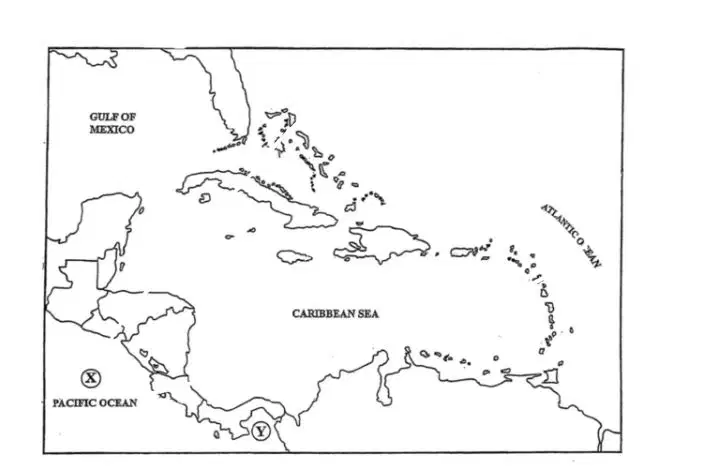
The tectonic plates labelled X and Y, respectively, are the
Cocos Plate and Nazca Plate
Nazca Plate and Cocos Plate
South American Plate and North American Plate
North American and South American Plate
The movements that impact and influence the earth's surface are also known as
Oceanic activities
Plate boundaries
Plate tectonics
Caribbean activities
Which of the following describes a historical feature of the Caribbean?
Archipelago
Commonwealth
Enslavement
Caribbean basin
Which of the following countries is located
outside the Caribbean Sea?
Jamaica
Barbados
Grenada
St. Vincent and the Grenadines

