
 Worksheets
Motion, Energy, Work, and Power
Total questions: 32
Worksheet time: 8hrs 0mins
The ability to do work or cause change:
work
energy
momentum
power
Energy in the form of motion.
mechanical energy
potential energy
kinetic energy
momentum
Stored energy in the form of position or condition.
potential energy
kinetic energy
momentum
mechanical energy
A student needs 10 Newtons of force to lift a box to the top of a 2 meter shelf. How much work do they do?
12 J
8 J
20 J
5 J
A worker climbs a ladder and does 8 J of work on a 2 N object. What is the distance they lift the object?
18 m
4 m
10 m
6 m
What is mechanical energy?
total kinetic energy
the energy of motion
total kinetic and potential energy
temperature plus heat
Two workers use 100 N of force to move a sofa 2 meters in 2 seconds. How much power is required?
100 watts
400 watts
104 watts
50 watts
Which does not illustrate kinetic energy?
It is expressed in Joule.
It depends upon the objects’ mass and speed.
It is the energy an object possesses due to its motion.
It depends upon the objects’ mass and objects’ height.
What is the potential energy of a 3kg ball that is on the ground?
0 J
3 J
9.8 J
29.4 J
The equation for POTENTIAL ENERGY is
PE = mass x gravity x height
PE = gravity x weight
PE = height / work
PE = work / time
The equation for KINETIC ENERGY is
KE = mass x gravity
KE = 1/2 height x speed
KE = mass2
KE = 1/2 mass x speed2
The equation for POWER is
power = mass x time
power = work / time
power = time / work
power = work x time
The equation for work is
work = power x mass
work = power / time
work = force x distance
work = distance x time
The product of the net force on an object and the distance through which the object is moved
joule
power
work
energy
_______________ is done when a force acts on an object and the object moves in the direction of the force.
Work
Kinetic energy
Watt
Joule
The unit for work (aka Newton-meter)
Watt
Power
Work
Joule
________________ is the rate at which work is done.
Power
Work
Time
Energy
The unit of power (aka Joule per second)
Joule
Minute
Watt
Pound
Energy can be transformed from one form into another, but the total amount of energy never changes.
Work-energy theorem
Law of conservation of energy
Newton's second law of motion
King's theorem of energy

At which point of this roller coaster is the energy 1/2 kinetic and 1/2 potential?
A
B
C
D
How does conservation of energy explain why something that is falling should speed up?
It gains kinetic energy because it gains potential energy.
It loses kinetic energy because no work was done on it.
It gains kinetic energy because it loses potential energy.
It loses kinetic energy because the Earth gains potential energy.
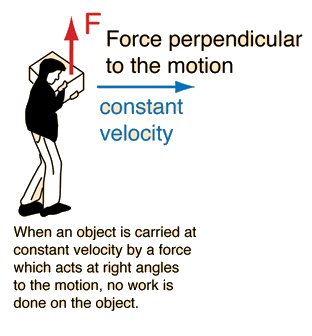
If you carry a 5 kg box across the room at a constant velocity
you do no work.
you do some work.
you do negative work.
Cannot be determined.
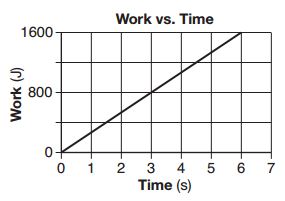
How much power was generated from 0-4 seconds?
1100 W
4 W
267 W
1600 W
What is the kinetic energy of a 10 kg ball moving at 3 m/s?
15 J
30 J
45 J
90 J
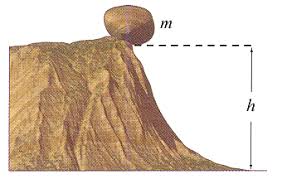
What is the mass of an object with 1200 J of PE when it is 5 meters above the ground?
10 kg
24 kg
100 kg
240 kg

