wayground logo

Free Printable Worksheets

Font size

S
M
L
XL
Worksheets

IIT-JEE & NEET FOUNDATION LEVEL- 13 (6-O)

Total questions: 100

Worksheet time: 2hrs 40mins

Name
Class
Date
1.

Can sand pass through filter paper?

a)

Yes

b)

No

2.

Which of these particles is NOT able to pass through a sand, gravel, and charcoal filter?

a)

bacteria

b)

water

c)

viruses

d)

large piece of dirt

3.

During the purification process, filtration separates the

a)

Solid purities

b)

Solid impurities

4.

Th components of filtration are separated based on

a)

boiling point

b)

solubility

c)

particle size

5.
What does chlorination do to the water?
a)
Removes microorganisms
b)
Cleans the water
c)
Makes the water taste nice
d)
Removes twigs and sediment
6.
What are two things that water treatment plants need to do?
a)
Clean and disinfect the water
b)
Boil and evaporate the water
c)
Remove the animals and plants
d)
Add chemicals and remove pesticides
7.

Used to separate an insoluble solid from liquid or soluble solid

a)

Filtration

b)

Distillation

c)

Crystallisation

d)

Evaporation

8.

Used to separate a dissolved solid from its solution

a)

Filtration

b)

Evaporation

c)

Crystallisation

d)

Sublimation

9.

Used to separate liquid mixtures for identification

a)

Filtration

b)

Distillation

c)

Fractional distillation

d)

Chromatography

10.
The diagram shows the apparatus for separating soil and water. What are the labelled parts?
a)
A = distillate, B = filtrate
b)
A = filtrate, B = residue
c)
A = residue, B = filtrate
d)
A = residue, B = distillate
11.
What does chlorination do to the water?
a)
Removes microorganisms
b)
Cleans the water
c)
Makes the water taste nice
d)
Removes twigs and sediment
12.

Used to separate an insoluble solid from liquid or soluble solid

a)

Filtration

b)

Distillation

c)

Crystallisation

d)

Evaporation

13.

Which one of the following solids is insoluble in water?

a)

sugar

b)

copper sulfate

c)

sand

d)

salt

14.

A Leibeg condenser is used in

a)

filtration

b)

evaporation

c)

chromatography

d)

distillation

15.

In filtration, the clear liquid which passes through the filter paper is called

a)

filter paper

b)

filtrate

c)

filter

d)

filtration

16.

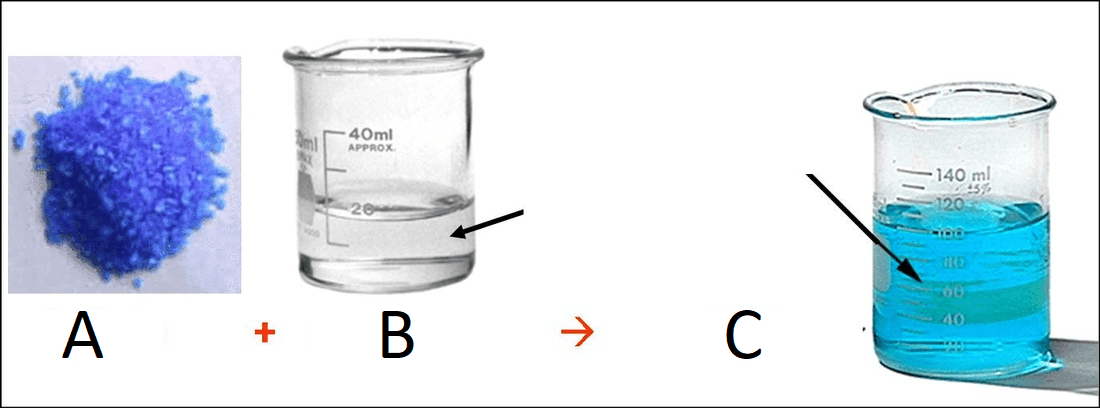
What is A?

a)

solute

b)

solvent

c)

solution

d)

solid

17.

What is C?

a)

solute

b)

solvent

c)

solution

d)

solid

18.

What is B?

a)

solute

b)

solvent

c)

solution

d)

solid

19.

A hinge joint allows

a)

A wide range of movements

b)

Circumduction

c)

Rotation

d)

Movement in only one direction (ie. backwards & forwards)

20.

An example of a Saddle joint is in the

a)

Knee

b)

Hip

c)

Thumb

d)

Vertebral column

21.
Identify the joint action being performed.
a)
Extension
b)
Flexion
c)
Abduction
d)
Adduction
22.
Identify the joint action being performed.
a)
Extension
b)
Flexion
c)
Abduction
d)
Adduction
23.

What type of joints is used to protect your soft organs?

a)

movable joints

b)

fixed joints

c)

slightly movable joints

24.

Which type of joint gives you the largest range of motion?

a)

Pivot joint

b)

Ball-and-socket joint

c)

Hinge joint

d)

Gliding joint

25.

The joint in your knees is most similar to:

a)

The pendulum in a grandfather clock

b)

The wheels on an office chair

c)

The sliding mechanism on a drawer

d)

The hinge on a cupboard door

26.

Which pair of joints has the most in common?

a)

Your ankle joints and shoulder joints

b)

The joints in your spine and hip joints

c)

Your elbow joints and knee joints

d)

Your wrist joints and shoulder joints

27.

What might happen if you snapped or tore one of your ligaments?

a)

Your joints would not be able to move

b)

Your bones would be in danger of breaking

c)

Your joints might slide out of place easily

d)

You would become double-jointed

28.

The joint that allows you to chew food is most similar to a:

a)

Ball-and-socket joint

b)

Hinge joint

c)

Pivot joint

d)

Immovable joint

29.

A disease called osteoarthritis occurs when the cartilage between joints wears away. What can you infer about osteoarthritis?

a)

It prevents joints from moving smoothly

b)

It causes joints to dislocate easily

c)

It causes bones to become more brittle

d)

It reduces joints' range of motion

30.

Where can you find this joint?

a)

Between femur and tibia

b)

Between humerus and ulna

c)

Between pelvic girdle and femur

d)

Between carpals

31.

What is the name of this joint?

a)

Ball and socket joint

b)

Hinge joint

c)

Fixed joint

d)

Slightly movable joint

32.

What is the slippery surface that cover the bones?

a)

synovial membrane

b)

synovial fluid

c)

ligament

d)

cartilage

33.
What are joints
a)
A place where one bone meets 
b)
A place where  two  bones meet 
c)
Bones don't meet 
d)
A place where three bones meet 
34.
This type of joint allows the your first two vertebrate to rotate as in shaking your head no
a)
condyloid
b)
gliding
c)
pivot
d)
saddle
35.
The knee joint is
a)
Hinge
b)
Gliding
c)
Ball and socket
d)
Pivot
36.
Fibrous joints are?
a)
freely moveable
b)
partially moveable
c)
immovable
37.

What is the study of joints called?

a)

Myology

b)

Biology

c)

Anatomy

d)

Arthology

38.
Name this joint
a)
gliding
b)
saddle
c)
condyloid
d)
pivot
39.
What is a force?
a)
a push or a pull
b)
a force that slows or stops an object in motion
40.
What is the unit used to measure work?
a)
Joule
b)
Watt
c)
Newton
d)
Pascal
41.
 Work done = Force x _________
a)
a. distance
b)
b. acceleration
c)
c. velocity
d)
d. speed
42.
What kind of energy is in a moving skateboard?
a)
Potential
b)
Kinetic
43.
What kind of energy is in a rock at the edge of a cliff?
a)
Potential
b)
Kinetic
44.
If W=Fd
Then how much work is done if it takes 20N to move a box 10 meters
a)
0
b)
2
c)
20
d)
200
45.
When work is done, there is always a(n) _______.
a)
constant rate
b)
single movement involved
c)
transfer of energy
d)
increase in the mechanical advantage
46.
The _______ is the SI unit of energy.
a)
watt
b)
joule
c)
ampere
d)
volt
47.
The ability to do work is....
a)
work
b)
power
c)
acceleration
d)
energy
48.
What is energy?
a)
The ability to do work
b)
Heat and Electricity
c)
A force that causes motion
d)
None of these
49.
What is work?
a)
The product of force and displacement
b)
Causes a change in potential energy of an object
c)
Does not depend on the path traveled, but only starting and ending position
d)
All of these are true
50.

The work done on an object does not depend upon the

a)

(a) displacement

b)

(b) force applied

c)

(c) angle between force and displacement

d)

(d) initial velocity of the object

51.

Water stored in a dam possesses

a)

(a) no energy

b)

(b) electrical energy

c)

(c) kinetic energy

d)

(d) potential energy

52.

Mechanical energy of a body includes

a)

Kinetic energy only

b)

Potential energy only

c)

kinetic energy and potential energy

d)

None of these

53.

Commercial unit of energy is

a)

Joule

b)

kWh

c)

Watt

d)

Newton

54.

In which scenario is work = 0 J ?

a)

Pushing a stationary wall

b)

Pulling a trolley car

c)

Pushing a book across the table

d)

Dropping a set of keys from a height, h.

55.

Power depends on force and speed.

a)

True

b)

False

56.

If the net work done on an object is positive, what can you conclude about the object's motion?

a)

The object is speeding up.

b)

The object is moving with a constant velocity.

c)

The object is slowing down.

d)

The object is at rest; its position is constant.

57.
Energy due to motion is ____________ energy. 
a)
Potential 
b)
Energy
c)
Kinetic
d)
Friction
58.

a man is pushing a table. Now the man is applying ____ on the table.

a)

work

b)

force

c)

energy

d)

muscles

59.
Which choice lists all the factors for the number 24?
a)
2, 3, 4, 6, 8, 12, 24
b)
2, 3, 4, 6, 8, 12, 24, 36
c)
1, 2, 3, 4, 6, 8, 12, 24
d)
1, 2, 4, 5, 6, 8, 12 ,24
60.
A prime number is...
a)
a number that has only one factor.
b)
a number that has at least two factors.
c)
a number that has more than two factors.
d)
a number that has only two factors.
(1 and itself)
61.
List the first 5 multiples of 8
a)
1, 2, 4, 8
b)
8, 16, 25, 32, 40
c)
8, 16, 24, 32, 40
d)
8, 16, 24, 31, 40
62.
What are the next three multiples?6, 12, 18, ___ ,___ ,___
a)
24, 30, 34
b)
24, 36, 42
c)
24, 30, 36
d)
22, 28, 34
63.
Which number is prime?
a)
25
b)
11
c)
36
d)
14
64.
Which number is composite?
a)
17
b)
7
c)
5
d)
20
65.
Which number is NOT a multiple of 3?
a)
12
b)
33
c)
14
d)
21
66.
Which number is NOT a multiple of 3?
a)
12
b)
33
c)
14
d)
21
67.

Write the SUM 12 + 18 as the PRODUCT of the GCF and another sum

a)

12 + 18 = 30

b)

6(2 + 3)

c)

3(4 + 6)

68.

Use the distributive property to simplify 8(10 +2)

a)

810 +82

b)

8(10) + 8(2)

69.

Use the distributive property to multiply mentally 8(26).

a)

8(26) = 826

b)

8(26) = 8(20 + 6) = 8(20) + 8(6)

70.

Use the distributive property to calculate mentally 9(17)

a)

917

b)

90 + 63

71.

FACTOR the SUM 12 + 8 as product of GCF and a new sum

a)

20

b)

4(3+2)

72.

TRUE or FALSE?

A MULTIPLE is greater than the number you are multiplying

a)

True

b)

False

73.

List the first (4) multiples of 8

a)

1, 2, 4, 8

b)

8, 16, 24, 32

74.

Find the Least Common Multiple (LCM) of 2, 3 and 4

a)

234

b)

9

c)

12

d)

24

75.

Find the Least Common Multiple (LCM) of 2, 3 and 4

a)

234

b)

9

c)

12

d)

24

76.

Find the Least Common Multiple (LCM) of 8 and 12

a)

812

b)

20

c)

96

d)

24

77.

What is the new denominator (Least common denominator/multiple) for the SUM of the fraction 3/4 + 5/6


HINT: Find LCM of 4 and 6

a)

4

b)

6

c)

8

d)

12

78.

TRUE or FALSE?


A FACTOR is greater than the number you are factoring

a)

TRUE

b)

FALSE

79.
What are the arrows pointing to?
a)
Ray
b)
Endpoints
c)
Midpoint
d)
Vertex
80.
Consists of 2 endpoints and all the points in between.
a)
Ray
b)
Line
c)
Line Segment
d)
Angle
81.

which of these have only have one end point

a)

point

b)

ray

c)

line

d)

polygn

82.
A location in space that is represented by a dot and has no dimensions
a)
Point
b)
Line
c)
Plane
d)
Angle
83.

a straight path that has no thickness and extends forever

a)

point

b)

line

c)

ray

d)

plane

84.

one end point is is also

a)

ray

b)

line

c)

point

85.

On this line, there are two letters. These letters name something. What are they naming?

a)

Points

b)

A ray

c)

The line

d)

An angle

86.

What is between A and B? (named ab\overline{ab} )

a)

A line

b)

A line segment

c)

A ray

d)

A right angle

87.

What kind of angle is this?

a)

Acute angle

b)

Right Angle

c)

Obtuse angle

d)

Reflex angle

88.

what is 90 degree angle called ?

a)

point

b)

acute angle

c)

right angle

d)

straight angle

89.
Consists of 2 endpoints and all the points in between.
a)
Ray
b)
Line
c)
Line Segment
d)
Angle
90.
A line is named by...
a)
Any 2 points on the line, or a lowercase script letter.
b)
Any 3 points on the line.
c)
Any 1 point on the line.
d)
Any 3 points on the line, or a uppercase script letter.
91.
A plane is named by...
a)
Any 1 point on the plane.
b)
Any 3 collinear points on the plane or a lowercase script letter.
c)
Any 3 non-collinear points on the plane or an uppercase script letter.
d)
All points on the plane that aren't part of a line.
92.

What is the name of this shape?

a)

Triangle

b)

Pentagon

c)

Square

d)

Hexagon

93.

How many sides does this shape have?

a)

2

b)

3

c)

4

d)

5

94.

Is this a 2D shape or a 3D shape?

a)

2D

b)

3D

95.
Polygon or non-polygon?
a)
Polygon
b)
Non-Polygon
96.
Name the figure.
a)
ray
b)
line
c)
line segment
d)
point
97.
What is the term for a part of a line with two endpoints?
a)
point
b)
ray
c)
angle
d)
line segment
98.
A right angle is ____ degrees.
a)
180
b)
100
c)
85
d)
90
99.
Euclid divided his famous treatise 'The Elements' into___
a)
13 chapters
b)
12 chapters
c)
11 chapters 
d)
9 chapters
100.

Use geometric terms to describe what is shown.

a)

plane

b)

parallel lines

c)

perpendicular lines

d)

point