Wayground logo

Free Printable Worksheets

Font size

S
M
L
XL
Worksheets

Periodic Table/Elements/Compound Review

Total questions: 44

Worksheet time: 29mins

Name
Class
Date
1.
Water is an example of a(n) 
a)
element 
b)
compound 
2.

What is a substance that is made of only one atom?

a)

element

b)

solution

c)

compound

3.

Carbon and oxygen combine chemically to form carbon dioxide. Carbon dioxide is

a)

an ion

b)

a nucleus

c)

a compound

d)

an atom

4.

2 atoms of hydrogen and 1 atom of oxygen combine to form water. What is the chemical formula for water?

a)

H₂O

b)

H₂O₂

c)

HO₂

5.

Subscripts are used to identify the number of atoms in a compound. How many atoms of carbon are in C₆H₈O₆? (Better known as Vitamin C.)

a)

8

b)

6

c)

12

d)

20

6.

Hydrogen Peroxide has a chemical formula of H₂O₂. Which atoms make up this compound?

a)

2 atoms of hydrogen and 1 atom of oxygen

b)

1 atom of hydrogen and 2 atoms of oxygen

c)

2 atoms of hydrogen and 2 atoms of oxygen

7.
The smallest particles of an element that still have the element’s properties are
a)
quarks
b)
gluons
c)
protons
d)
atoms
8.
The mass number of an atom is its number of
a)
electrons
b)
protons
c)
neutrons
d)
protons + neutrons
9.
Atoms of a given element all have the same number of
a)
protons
b)
neutrons
c)
electrons
d)
two of the above
10.
In the modern periodic table, atomic number
a)
increases from top to bottom within each period
b)
increases from left to right within each group.
c)
two of the above
d)
none of the above
11.
All but one of the elements on the left side of the periodic table are
a)
metalloids
b)
nonmetals
c)
metals
d)
gases
12.
Which statement is true about any group in the periodic table?
a)
It includes metals, metalloids, and nonmetals
b)
It includes elements with similar properties.
c)
It includes gases, liquids, and solids
d)
It contains 18 different elements
13.
Mendeleev left spaces in his periodic table for unknown elements
a)
True
b)
False
14.

Elements in the same period of the periodic table have similar properties.

a)

True

b)

False

15.
A nonmetal is an element that
a)
exists only as a gas or liquid
b)
is completely unreactive
c)
cannot conduct electricity
d)
is shiny and malleable
16.

If an element is malleable, this means that it can

a)

be formed into long thin shapes like wires

b)

be formed into thin sheets without breaking

c)

be used to conduct electric current

d)

used as an electric insulator

17.
Elements with eight valence electron are unreactive
a)
True
b)
False
18.

What are the vertical columns on the periodic called?

a)

groups

b)

periods

c)

nonmetals

d)

metals

e)

metalloids

19.

What do the vertical columns on the periodic table tell us?

a)

The number of orbitals

b)

The number of valence electrons (electrons on the outer most shell)
20.
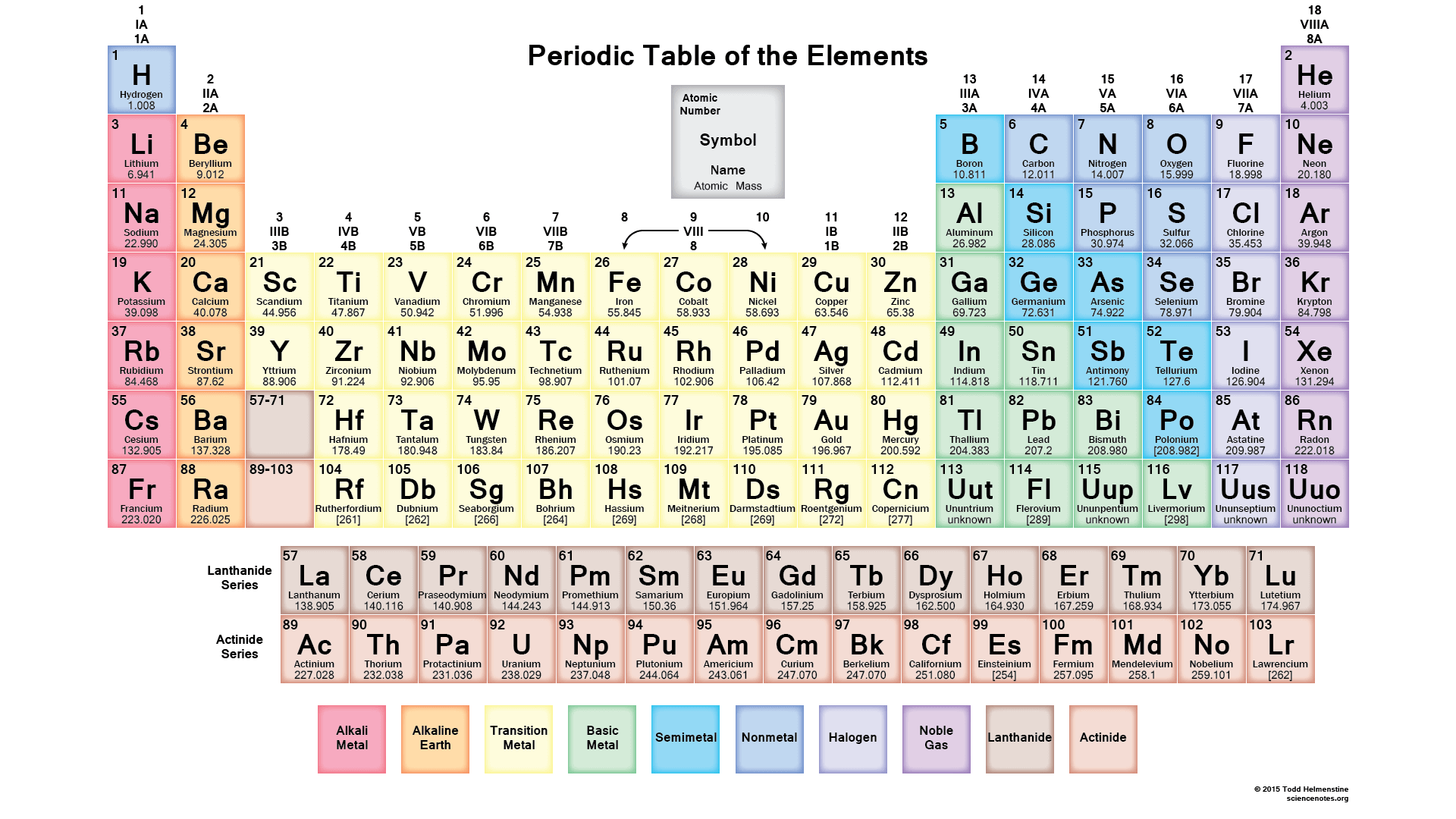
Sodium (Na) is found in group 
a)
1
b)
2
c)
3
d)
4
21.

These are found on the Periodic Table.

a)

Compounds

b)

Elements

c)

Mixtures

22.

Which elements have properties in common?

a)

elements in a group

b)

elements in a period

23.

Which elements have 1 valence electron?

a)

period 1

b)

group 1

c)

group 4

24.
Elements in the same ________ are more chemically similar.
a)
group
b)
period
c)
club
d)
table
25.
Which elements have the most similar chemical properties?
a)
K and Na
b)
K and Ca
c)
K and Cl
d)
K and S
26.
Beryllium is in group number______.
a)
Group 2
b)
Group 3
c)
Group 4
d)
Group 7
27.

The electrons in the outermost shell (main energy level) of an atom; these are the electrons involved in forming bonds

a)

alkali metals (group 1)

b)

Halogens (Group 17)

c)

atomic number

d)

valence electrons

28.

A subatomic particle that has a positive charge and that is found in the nucleus of an atom

a)

Proton

b)

elecrtron

c)

groups

d)

neutrons

29.
The Modern Periodic Table of Elements is arranged by
a)
atomic mass
b)
atomic number
c)
valence electrons
d)
number of isotopes
30.
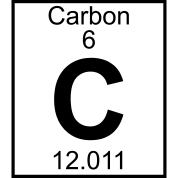
What does the 6 represent?
a)
atomic mass
b)
atomic number
c)
element name
d)
chemical symbol 
31.
What does 12.011 represent?
a)
atomic mass
b)
atomic number
c)
element name
d)
chemical symbol 
32.
What does the C represent?
a)
atomic mass
b)
atomic number
c)
element name
d)
chemical symbol 
33.

Which of the following would be elements that are found in the same period?

a)

Sn and Rb

b)

F and Cl

c)

K and Ba

d)

Se and Te

34.

Which element is in period 5?

a)

Vanadium

b)

Rubidium

c)

Tungsten

d)

Lithium

35.

Which family of elements are the most reactive?

a)

Alkali Metals

b)

Alkaline Metals

c)

Halogens

d)

Nobel Gases

36.

Which family of elements is the least reactive?

a)

Alkali metals

b)

Alkaline Metals

c)

Halogens

d)

Nobel Gases

37.

A row on the periodic table is called?

a)

Period

b)

Group

c)

Family

d)

Element

38.

A column on the periodic table is called a ___________

a)

Period

b)

Group

c)

Family

d)

Element

39.
How Many Valence Electrons are in the element above?
a)
1
b)
3
c)
5
d)
7
40.
Which element shares chemical properties of Chlorine?
a)
Na
b)
Br
c)
Ar
d)
S
41.

Metalloids have ___________________

a)

Only properties of a metal

b)

Only properties of a non-metal

c)

have properties of both metals and non-metals

42.
Which element is not a metal?
a)

He

b)
Re
c)
Al
d)
B
43.

Which noble gas does not have 8 valence electrons?

a)

Krypton

b)

Argon

c)

Neon

d)

Helium

44.

Which compound contains ionic bonds?

a)

H2O

b)

CH4

c)

CO2

d)

KI