wayground logo

Free Printable Worksheets

Font size

S
M
L
XL
Worksheets

Ionic Bonding

Total questions: 25

Worksheet time: 18mins

Name
Class
Date
1.

Atoms form ions because they want to have a (a)   outer shell.

2.

Ionic bonds are formed between...

a)

Non - metals

b)

A metal and a non-metal

c)

Metals

3.

How is an ionic bond formed?

a)

Sharing of electrons

b)

Delocalised electrons

c)

Transfer of electrons

4.

An example of an ionic compound is Sodium Chloride, which is made from Na+ and Cl- ions. Why do these ions form an ionic bond?

a)

They have like charges

b)

They are from the same group

c)

They are from the same period

d)

They have opposite charges

5.

Which of the below is an ionic compounds?

a)

Ni

b)

MgCl2

c)

H2O

d)

CH4

6.

Lithium is in group 1 of the periodic table, which ion would it form?

a)

Li-

b)

Li2-

c)

Li+

d)

Li2+

7.

Oxygen is in group 6 of the periodic table, which ion would it form?

a)

O-

b)

O+

c)

O2-

d)

O2+

8.

Lead Chloride is an ionic compound, made up from Pb2+ ions and Cl- ions. Which is the correct formula for this compound?

a)

PbCl3

b)

PbCl

c)

PbCl4

d)

PbCl2

9.

Magnesium Hydroxide is an ionic compound made up from Mg2+ and OH- ions. Which is its correct formula?

a)

MgOH

b)

MgOH2

c)

Mg(OH)2

d)

MgO

10.
What is the charge on a noble gas & why?
a)
0; they don't exchange electrons
b)
+1; they give away an electron
c)
-1; they gain an electron
d)
1; they form only single bonds
11.
What type of elements will form an ionic bond?
a)
Metals + Metals
b)
Nonmetals + Nonmetals
c)
Metals + Nonmetals
d)
None of the above
12.
To form a charge of +2 an atom must _ electrons.  To form -3 it must _ electrons.
a)
Gain 2; Lose 3
b)
Gain 3; Lose 2
c)
Lose 2; Gain 3
d)
Lose 3; Gain 2
13.

Oxygen has (a)   valence electrons.

14.
Metals tend to 
a)
gain electrons
b)
lose electrons
15.
A charged particle that has gained or lost electrons is called a _____.
a)
molecule
b)
ion
c)
isotope
d)
element
16.
A cation is a ____ ion.
a)
negative
b)
positive
c)
neutral
d)
ficticious
17.
A anion will be a ____ ion.
a)
negative
b)
positive
c)
neutral
d)
ficticious
18.
Ionic bonds form between metals and ____.
a)
metalloids
b)
metals
c)
nonmetals
19.
In the chemical formula for an ionic compound, which item is written first?
a)
positive ion
b)
negative ion
c)
subscript
d)
the female
20.

What will be the charge of a bromine ion?

a)

+7

b)

-7

c)

-1

d)

+1

21.
What is the name for LiF?
a)
Lithium Fluoride
b)
Lithium Fluorine
c)
Fluorine Lithide
22.
A charged particle that has gained or lost electrons is called a _____.
a)
molecule
b)
ion
c)
isotope
d)
element
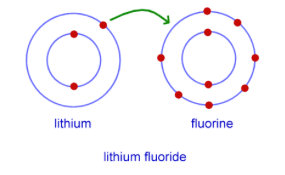
23.
What type of bond is this?
a)
ionic
b)
covalent
24.

Which of the below is an ionic compounds?

a)

Ni

b)

MgCl2

c)

H2O

d)

CH4

25.

An example of an ionic compound is Sodium Chloride, which is made from Na+ and Cl- ions. Why do these ions form an ionic bond?

a)

They have like charges

b)

They are from the same group

c)

They are from the same period

d)

They have opposite charges