

Wayground logo

Free Printable Worksheets

Font size

S
M
L
XL
Worksheets

Heat

Total questions: 16

Worksheet time: 50mins

Name
Class
Date
1.
What  is the formula to calculate heat energy required to raise the temperature of any substance?
a)

Q = m S ∆T

b)

Q = m S

c)

Q =  ½ m v

d)

m = Q S

2.

There are four cups of hot cocoa. The cup sizes are shown. The temperature of the cocoa in each cup is 55 degrees celsius. Which cup has the MOST thermal energy?

a)

Large cup (Trenta)

b)

Small cup (Tall)

c)

Venti

d)

All three are the same temperature so they have same thermal energy

3.
If the specific heat of water is 4,186 J/kg∙°C, how much heat is required to increase the temperature of 1.2 kg of water from 23 °C to 39 °C? 
a)
-80,371.2 J
b)
44,938.6 J
c)
80,371.2 J
d)
112,575.9 K
4.
What would be the effect on the particles if more heat is supplied to the system?
a)
They would slow down
b)
They would stop moving
c)
They would speed up
d)
There would be no effect
5.
Select the correct formula to calculate linear change in length...
a)
ΔL = LαΔT
b)
ΔT = ΔL/Lα
c)
σ = F/A
d)
ε = ΔL/L
6.
A sample of iron receives 50.J of heat energy that raises the temperature of the iron 25.0°C. If iron has a specific heat of  0.10 J/g°C, what is the mass of the iron sample?
a)
25 g
b)
30 g
c)
20 g
d)
50 g
7.
The specific heat is the amount of energy needed to raise the temperature one degree Celsius of 1 gram of a substance.
a)
True
b)
False
8.
Using the heat equation, what would the formula look like if we were solving for change in temperature?
a)

Q m = ∆T S

b)

Q / (m S)  =  ∆T

c)

Q m / S  =  ∆T

d)
m c Q  =  ∆T
9.
A high specific heat means...
a)
It heats up quickly with energy added
b)
It requires more energy to change temperature
10.

Which of the following statements is correct?

a)

The unit of heat capacity is J kg-1 °C-1.

b)

Specific heat capacity measures the temperature variations when 1J of energy is absorbed.

c)

The unit of specific heat capacity is J kg-1 K-1.

d)

Specific heat capacity equals to the heat content of an object.

11.

When an electric heater is supplied with an electric power of 2.0 kW to heat 4.0 kg of water for 1 minute, calculate the increase in temperature of the water. Assume that the specific heat capacity of water is 4200 J kg-1 0C-1 and there is no heat loss to the surroundings.

a)

3.050C

b)

7.10C

c)

140C

d)

300C

12.

Given that the specific latent heat of fusion of a sample is 550 kJ kg-1. Which of the following is correct?

a)

The mass of this sample is 1 kg.

b)

The energy needed to increase the temperature of 1 kg of this sample in solid state through 1oC is 550 kJ.

c)

The energy needed to increase the temperature of 1 kg of this sample in liquid state through 1oC is 550 kJ.

d)

The energy needed to change 1 kg of the material from solid state to liquid state is 550 kJ.
13.
Specific heat is....
a)
The measure of kinetic energy of an objects particles
b)
A measure of the energy needed to increase the average kinetic energy of the particles
c)
The heating caused by the motion of flluid due to temperature difference
d)
The transfer of energy by electromagnetic radiation
14.
How does heat flow?
a)
Always from cold to warm
b)
Always from warm to cold
c)
Both warm to cold & cold to warm
d)
It depends on the temperature
15.
The amount of energy required to raise the temperature 1ºC for every kilogram is called____?
a)
Thermal Energy
b)
Specific Heat
c)
Temperature
d)
Kinetic Energy
16.
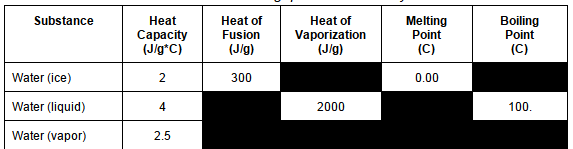
How many Joules of energy are required to change 10 gram of ice at -2 C to water at 20 C?
a)
440 J
b)

11340 J

c)

3,840 J

d)
66,000 J
