
 Worksheets
Optics Review
Total questions: 28
Worksheet time: 47mins
The distance between the focal point and the lens is
raduis
diameter
focal point
focal length
The axis that goes through the focal point and the centre of the lens is called
focal axis
optical axis
principle axis
light ray
All rays that are parallel to the principle axis in a concave lens refract
Towards the focal point
Away from the focal point
Towards the center of curvature
Away from the center of curvature

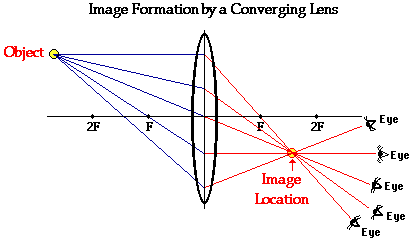
Compared to the object in front the lens, its image is.....
inverted and smaller
inverted and larger
upright and smaller
upright and larger
An object is placed 30.0 m from a convex lens, which has a focal length of 5.0 m. What is the distance of the image?
6 m
7 m
8 m
9 m
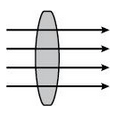
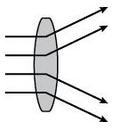
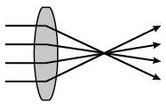
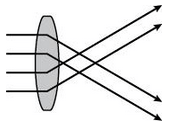
Which figure represents the path light takes through a converging lens?

A convex lens is a __________ device.
Converging
Diverging
Reflecting
None of the above
A Concave lens is a __________ device.
Converging
Diverging
Reflecting
None of the above
A pencil submerged in a clear glass of water may appear broken or bent when observed from the side of the glass. Which of the following characteristics describes this broken or bent appearance?
refraction
diffraction
reflection
amplitude
What part of the electromagnetic spectrum can penetrate all human skin and soft tissue?
microwave
visible light
ultraviolet
xray
If an object placed 10.0 cm in front of the lens produces an image 15 cm from the lens on the opposite side, what is the focal length for the lens?
5.00 cm
6.00 cm
25.0 cm
30.0 cm
The production of light energy when an object is heated describes which source of light?
Fluorescence
Incandescence
Chemiluminescence
Triboluminescence

What source of light is shown in the image above?
Incadescence
Fluorescence
Bioluminescence
Triboluminescence
The angle of reflection is always equal to the angle of incidence.
True
False
SILT is an acronym used to describe characteristics of an image. What does SILT stand for?
Size, Inversion, Location, Time
Size, Inversion, Location, Type
Size, Intent, Location, Type
Smell, Indication, Location, Type
Which statement does not properly compare the refractive index of water and air?
Light moves slower in water than air.
Water is more dense than air.
Air has a higher refractive index than water.
Light moves fastest in air.
The speed of light in leaded glass is 1.72 X10⁸ m/s. What is the index of refraction of this type of glass?
1.47
1.53
1.67
1.74
What is the speed of light in gallium phosphide given that gallium phosphide has a refractive index of 3.50?
8.75 X10⁸ m/s
8.75 X 10⁷ m/s
8.57 X 10⁷ m/s
8.75 X 10⁸ m/s
Which of the following statements about total internal reflection is true? Check all that apply!
Total internal reflection can occur when light moves from a less dense medium to a more dense medium.
Total internal reflection occurs when the angle of incidence is the same as the critical angle.
When the angle of incidence is greater than the critical angle, total internal reflection occurs.
Total internal reflection can occur when light moves from a more dense medium to a less dense medium.
A magnifying glass (convex) is held 3.00 cm above a page to magnify the print. If the image produced by the lens is 4.20 cm away and virtual, what is the focal length of the magnifying glass?
9.5 cm
10 cm
10.5 cm
11 cm
Myopia is when...
Images of distant objects form in front of the retina
Images of distant objects form behind the retina
Images of close objects form behind the retina
Images of close objects form in front of the retina
The path light takes through the eye to form an image is...
Cornea, lens, pupil, retina, optic nerve, brain
Pupil, cornea, lens, optic nerve, retina, brain
Cornea, pupil, lens, retina, optic nerve, brain
Lens, cornea, pupil, optic nerve, retina, brain

