
NEW
Font size
 Worksheets
CHHS Electrochemistry 9.7-9.8 Quiz
Total questions: 10
Worksheet time: 11mins
What is an anode?
It is the electrode where oxidation takes place.
It is the electrode where reduction takes place.
It is an aqueous solution containing an electrode.
It is the salt bridge that connects half-cells.
What is a cathode?
It is the electrode where oxidation takes place.
It is the electrode where reduction takes place.
It is an aqueous solution containing an electrode.
It is the salt bridge that connects half-cells.

Which of the following statements applies to the change in mass of the electrodes involved in this electrochemical cell?
Electrode A is the anode and it gains mass
since metal ions are being converted to metal
atoms which often adhere to the electrode.
Electrode B is the anode and it gains mass
since metal ions are being converted to metal
atoms which often adhere to the electrode.
Electrode A is the cathode and it gains mass since metal ions are being converted to metal atoms which often adhere to the electrode.
Electrode B is the cathode and it gains mass since metal ions are
being converted to metal atoms which often adhere to the electrode.
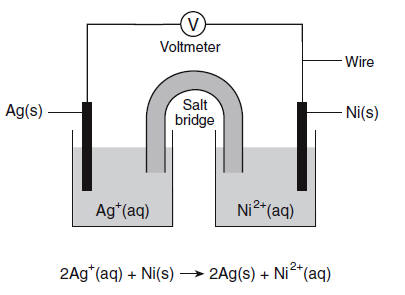
What reaction occurs at the cathode of a voltaic cell?
Ag+/Ag = 0.80V
Ni2+/Ni = -0.25V
Ag+ + e- →Ag
Ag → Ag+ + e-
Ni2+ + 2e- → Ni
Ni → Ni2+ + 2e-
In which direction do the electrons flow?
Ag+/Ag = 0.80V
Ni2+/Ni = -0.25V
electrons flow from the Ni2+/Ni cell to the Ag+/Ag cell
electrons flow from the Ag+/Ag cell to the Ni2+/Ni cell
as the reaction reaches an equilibrium, the electrons flow in both directions
the electrons do not move
Into what cell (beaker) does the cation from the salt bridge migrate?
Ag+/Ag = 0.80V
Ni2+/Ni = -0.25V
it migrates into both cells
it migrates into the Ag+/Ag cell
it migrates into the Ni2+/Ni cell
the ions in the salt bridge do not migrate
What would be the theoretical cell potential of the voltaic cell involving these chemicals?
Ag+/Ag = 0.80V
Ni2+/Ni = -0.25V
.55 V
-.55 V
1.05 V
-1.05 V
Calculate the ΔG⁰ of the voltaic cell involving these chemicals. Is the reaction favorable or not favorable? (Ƒ = 96485 C/mol e-) (Ecell = 1.05 V)
Ag+/Ag = 0.80V
Ni2+/Ni = -0.25V
-202618.5 J, favorable
-101309.3 J, favorable
-154376.0 J, favorable
+48242.5 J, favorable
Calculate the K value of the voltaic cell involving these chemicals. (Assume 25⁰ C) (ΔG⁰ = -202618.5 J)
Ag+/Ag = 0.80V
Ni2+/Ni = -0.25V
e975
3.3 x 1035
2.6 x 10³
3.0 x 10-36

