wayground logo

Free Printable Worksheets

Font size

S
M
L
XL
Worksheets

FIW

Total questions: 50

Worksheet time: 41mins

Name
Class
Date
1.
What was stated in the Proclamation of 1763?
a)
Colonists were banned from settling west of the Appalachian Mountains.
b)
Colonists were encouraged to begin settling west of the Appalachian Mountains.
c)
The Proclamation ended the French and Indian War. 
d)
The Proclamation proclaimed independence for the American colonists. 
2.
What was one effect of the Treaty of Paris?
a)
The French gained a huge amount of land in North American had had been claimed by the British.
b)
The British gained a huge amount of land in North American had had been claimed by the French.
c)
The Native American Indians were able to take control of their land.
d)
The Treaty formally ended the American Revolution. 
3.
  What was the purpose of the Treaty of Paris in 1763?
a)
The purpose of the Treaty of Paris in 1763 was to end the Revolutionary War. 
b)
The purpose of the Treaty of Paris in 1763 was to create an agreement between Chief Pontiac and the British colonists. 
c)
The purpose of the Treaty of Paris in 1763 was to end the French and Indian War.   
d)
The purpose of the Treaty of Paris in 1763 was to recognize America as a free and independent nation.
4.
This created a temporary border at the Appalachian Mountains, restricting the movement of the colonists
a)
Appalachian Line of 1769
b)
Proclamation of 1763
c)
Northwest Ordinance of 1767
d)
Colonial Border of 17
5.
During the French and Indian War, the British and French were fighting over control of which area?
a)
Mississippi River Valley
b)
Ohio River Valley
c)
Connecticut River Valley
d)
Pennsylvania River Valley
6.
Why do you suppose the Indians helped the French?
a)
The French forced them to fight because the Indians were enslaved by them.
b)
The British attacked the Indians first, and the French decided to help the Indians.
c)
The French and Indians cooperated with one another often; traded with one another and taught each other many techniques for survival.
d)
The French were fighting the Indians in the war.... The Indians didn't help the French at all.
7.
Who fought in the French and Indian War?
a)
French vs. Indians
b)
British vs. French
c)
British vs. French and Indians
d)
Indians vs. British
8.
Who was the young military leader from Virginia who was sent to western Pennsylvania to fight the French?
a)
William Pitt
b)
Edward Braddock
c)
King George II
d)
George Washington 
9.
The land fought over was the
a)
Ohio River Valley
b)
Appalachian Mountains
c)
Florida
d)
Canada
10.
Both French & British set up ____________ in the Ohio River Valley that led to conflict.
a)
forts
b)
communities
c)
farms
d)
traps
11.
The French and Indian War included 
a)
French, British, Native Americans
b)
French, British, African Americans
c)
Ohio, Spain, Canada
d)
Ohio, Native Americans, French
12.
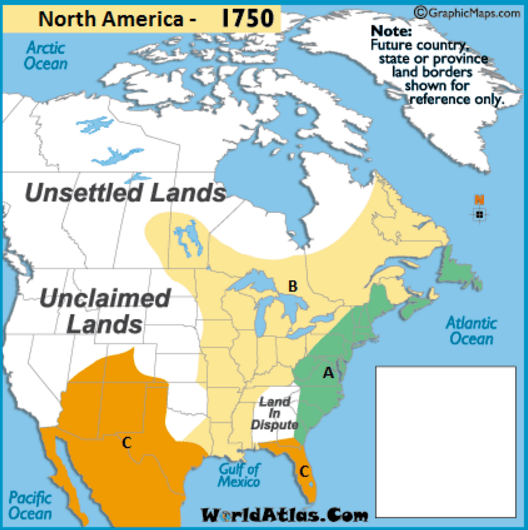
Which European power controlled territory A?
a)
England
b)
France
c)
Spain
13.
Which European power controlled territory B?
a)
England
b)
France
c)
Spain
14.
What the result of the French and Indian War
a)
France lost its territory in North America to the British 
b)
France took over all of Canada 
c)
Native-Americans succesfully kicked out the British and French from North America 
d)
France defeated the British 
15.
Where did the French and Indian War take place?
a)
England
b)
France
c)
America
d)
Africa
16.
Who was the King of England during this time?
a)
King Ferdinand and Queen Isabella
b)
King Henry VIII
c)
Queen Elizabeth
d)
King George III
17.
Who won the French and Indian War?
a)
England
b)
France
c)
Indians
d)
Spain
18.
The French and Indian War, unfair taxes in the colonies, along with many other events all led to what eventually?
a)
World War I
b)
American Revolution
c)
World War II
d)
Civil War
19.

Who won the French & Indian War?

a)

French

b)

British

c)

American Indians

20.

Which 2 reasons started the French & Indian War?

a)

Wanting to control beaver fur and trading

b)

The British started a rumor

c)

The French did not like the American Indians

d)

Wanting to control the land

21.

What was the purpose of the Proclamation of 1763?

a)

To keep the peace and the British from going WEST of the Appalachian Mountains

b)

To keep the peace and the British from going EAST of the Appalachian Mountains

c)

To move the American Indians off the land completely

22.

What was the result of the Proclamation of 1763?

a)

The Proclamation of 1763 worked

b)

The Proclamation of 1763 caused bad feelings between the colonists and the British government

c)

The French did not like it

23.

How many British colonies were in North America?

a)

11

b)

50

c)

13

d)

7

24.

What was a reason that the Colonists disliked the new taxes?

a)

Colonists had no representation in Parliament/government

b)

Colonists gained more than the British

c)

Colonists' taxes were going to the French

d)

Everyone hates paying taxes

25.

Who led the first attack on the French in the Ohio River Valley?

a)

George Washington

b)

Jonathan Edwards

c)

William Pitt

d)

Les Claypool

26.

What was the reason the F-I War occurred?

a)

French building a Navy on Lake Michigan

b)

French building forts on Atlantic coast

c)

NA control of the Mississippi River Valley

d)

French building forts in Ohio River Valley

27.

Why was the Ohio River Valley so important?

a)

NA trading posts

b)

Prosperous Fur trade

c)

Connected trade routes via the Ohio River and Mississippi River

d)

Connected trade routes between the Mississippi River and the Pacific Ocean

28.
As a result of the cost of the war, what did King George III do to the colonists?
a)
Killed them
b)
Removed them from the land in the colonies just like the Indians.
c)
Imposed taxes to pay for the war
d)
Paid for the war out of his own pocket
29.
What slogan did the colonists begin to use in order to express their frustrations with the British government?
a)
"No Taxation!"
b)
"We Need Representation!"
c)
"No Taxation without Representation!"
d)
"We Want Freedom!"
30.
What is an alliance?
a)
A disagreement 
b)
A partnership
c)
A treaty
d)
A farming machine
31.
Who had more support from the Native Americans?
a)
French
b)
British
32.

What other name was the French and Indian War called?

a)

The Good War

b)

The Seven Years War

c)

The Big War

d)

The Only War

33.

Which native American tribe allied with the British in the French and Indian War?

a)

Iroquois

b)

Shawnee

c)

Huron

d)

Erie

34.

Which native American tribe allied with the French in the French and Indian War?

a)

Iroquois

b)

Shawnee

c)

Huron

d)

Erie

35.

How is the French and Indian War different from the 7 Years War?

a)

The 7 Years War was fought throughout the world

b)

The 7 Years War was fought only in America

c)

The 7 Years War was the American Revolution

d)

The 7 Years War actually took 9 years to fight

36.

Which French Fort was located in the Ohio River Valley

a)

Fort Duquesne

b)

Fort Necessity

c)

Fort Jackson

d)

Fort Walton

37.

Which British Fort was built by Major George Washington?

a)

Fort Duquesne

b)

Fort Necessity

c)

Fort Jackson

d)

Fort Walton

38.

Who claimed the Mississippi River and all of its tributaries for France?

a)

La Salle

b)

De Soto

c)

Columbus

d)

Cabot

39.

Which Battle was considered the turning point of the war?

a)

Battle of Quebec

b)

Battle of Montreal

c)

Battle of Mexico

d)

Battle of Fort William Henry

40.

What was the last major battle of the war?

a)

Battle of Quebec

b)

Battle of Montreal

c)

Battle of Mexico

d)

Battle of Fort William Henry

41.

At which fort were the British defeated twice?

a)

Fort Duquesne

b)

Fort Necessity

c)

Fort Sumpter

d)

Fort Walton

42.

British Major During the war; Forced to surrender once during his military career, Military leader in the Revolutionary War; 1st President of the US

a)

George Washington

b)

William Pitt

c)

Jeffrey Amherst

d)

Edward Braddock

43.

British Secretary of State during the war; Advocate for colonists' rights; Opposed the Treaty of Paris and the Stamp Act

a)

William Pitt

b)

Jeffrey Amherst

c)

Joseph Broussard

d)

Edward Braddock

44.

Led British victories; Led the siege at Montreal; Made a knight and governor of Canada; Helped Britain win the war

a)

William Pitt

b)

George Washington

c)

Jeffrey Amherst

d)

Edward Braddock

45.

British General who defeated Louis-Joseph de Montcalm at the Battle of Quebec City

a)

General James Wolfe

b)

Edward Braddock

c)

George Washington

d)

Joseph Broussard

46.

Commander-in-chief at the British Army; Attempted to attack and capture Fort Duquesne; Surrendered and died during the attack during the second attempt

a)

General James Wolfe

b)

Edward Braddock

c)

Joseph Broussard

d)

William Pitt

47.

Commander of the French forces; Led victories against the British; Leader during the Battle of Quebec and Battle of Fort William Henry

a)

Louis-Joseph de Montcalm

b)

Joseph Broussard

c)

Edward Braddock

d)

William Pitt

48.

Leader of the Acadian people in New France; Organized militias against British; Led the first Acadians to Louisiana

a)

Joseph Broussard

b)

William Pitt

c)

Jeffrey Amherst

d)

Edward Braddock

49.

Governor-general of New France before the French and Indian war; Had forts built along the Ohio River Valley

a)

Michel-Ange Duquesne

b)

Joseph Broussard

c)

Edward Braddock

d)

William Pitt

50.

Governor of French Louisiana; Last governor-general of New France; Surrendered to the British at the Siege of Montreal

a)

Pierre de Rigaud

b)

Michel-Ange Duquesne

c)

Edward Braddock

d)

General James Wolfe