wayground logo

Free Printable Worksheets

NEW

Font size

S
M
L
XL
Worksheets

Q3 review

Total questions: 72

Worksheet time: 55mins

Name
Class
Date
1.
What is the job of the mitochondria?
a)
Makes Energy
b)
Uses Sunlight in Plants
c)
Creates Protein
d)
Protects the cell
2.
Where can you find the chloroplast? 
a)
Only Plants
b)
Only Animals
c)
Plants & Animals
d)
Animals & Bacteria
3.
Where in the cell are proteins made? 
a)
Ribosome
b)
Cell Membrane
c)
Chloroplast
d)
Nucleus
4.
Why is the nucleus important? 
a)
It give the cell its energy
b)
It stores genetic information
c)
It uses sunlight for food
d)
It makes the proteins
5.
What does the cell membrane do for cells? 
a)
Allows things in and out
b)
Protection & structure for plant cells
c)
Controls the cell
d)
Holds DNA 
6.
What is an organelle?
a)
Different types of cells
b)
Different parts of a cell
c)
Different types of organisms
d)
Different places that make energy for cell
7.
What is another term for "selectively permeable"?
a)
porous
b)
completely permeable
c)
permanent
d)
semipermeable
8.
Most of the cell membrane is made of...
a)
Lipids
b)
Carbohydrates
c)
Proteins
d)
Nucleic acids
9.
What is embedded in the phospholipid bilayer?
a)
proteins
b)
salt
c)
water
d)
trapped animals
10.
Most of the cell membrane is made of...
a)
Lipids
b)
Carbohydrates
c)
Proteins
d)
Nucleic acids
11.

Identify the cellular structure that diffusion occurs across.

a)

ribosome

b)

mitochondria

c)

cytoplasm

d)

cell membrane

e)

chloroplast

12.

Identify the cellular structure that is mostly water and is the jelly-like fluid in the cell.

a)

ribosome

b)

mitochondria

c)

cytoplasm

d)

cell membrane

e)

chloroplast

13.

Identify the substance/molecule that will not diffuse.

a)

Starch

b)

Glucose

c)

Iodine

14.

What is the starch indicator?

a)

Iodine

b)

Bromothymol Blue

c)

Benedict's Solution

d)

Glucose

15.

What color does the starch indicator turn when it comes in contact with starch?

a)

blue-black

b)

blue

c)

orange-red

d)

yellow

16.
Sugar Molecule
a)
Glucose
b)
Benedicts solution
c)
Net Movement
d)
Indicator
17.

Which of the following is an example of an ORGANISM?

a)

Chloroplast

b)

Stomach

c)

Human

d)

Nucleus

18.

Which of the following is an example of an ORGAN?

a)

Mitochondria

b)

Heart

c)

Human

d)

Nucleus

19.

Which of the following is an example of an ORGANELLE?

a)

Chloroplast

b)

Stomach

c)

Liver

d)

Human

20.

Which of the following is the SMALLEST?

a)

Atom

b)

Cell

c)

Organ

d)

Organ System

21.

Which of the following are INSIDE of all cells?

a)

Organs

b)

Organelles

c)

Organisms

d)

Shrek

22.

What's the correct order from SMALLEST to LARGEST?

a)

Organ -> Organ system -> Cell

b)

Cell -> Organelle -> Organ

c)

Organelle -> Cell -> Organ

d)

Organ system -> Tissue -> Organ

23.

Which is the correct order of the levels of complexity, from largest to smallest?

a)

Organism-Organ System-Organs-Tissues-Cells-Cell Structure-Molecules-Atoms

b)

Organs-Cells-Cells Structure-Tissues-Organism

c)

Atoms-Molecules-Cell Structure-Cells-Tissues-Organs-Organ System-Organism

d)

Organism-Organs-Cells-Atoms

24.

What is the smallest part of the levels of complexity?

a)

Organ

b)

Organism

c)

Atoms

d)

Molecules

25.

The menstrual cycle repeats every?

a)

Month

b)

28 days

c)

Week

d)

Year

26.

Ovulation typically occurs on what day of the cycle?

a)

1

b)

14

c)

20

d)

7

27.
What does ovulation mean?
a)
A sperm is released
b)
The lining of the uterus breaks down
c)
An egg is released
d)
Menstruation occurs
28.

In which part of the female reproductive system does a baby develop?

a)

Ovaries

b)

Vagina

c)

Cervix

d)

Uterus

29.

The loss of the uterus lining through the vagina is called

a)

menstruation

b)

period

c)

ovulation

d)

menstruation or period

30.

The egg cell develops in the

a)

vagina

b)

ovary

c)

oviduct

d)

uterus

31.

The lining of the uterus starts to grow thicker after

a)

menstruation

b)

ovulation

32.

The uterus lining is filled with

a)

juice

b)

milky liquid

c)

blood

33.

The female reproductive structure that serves as a passageway for the ova to the uterus is the:

a)

fallopian tube

b)

perineum

c)

vaginal canal

d)

ureter

34.

The fetus develops in the:

a)

cervix

b)

fallopian tube

c)

perineum

d)

uterus

35.

A muscular tube leading from the cervix to the outside of the body is the:

a)

fallopian tube

b)

labia majora

c)

vagina

d)

vulva

36.
Structure 4 is the
a)
cervix
b)
vagina
c)
uterus
d)
ovary
37.
Structure 5 is the
a)
cervix
b)
Fallopian tube
c)
uterus
d)
ovary
38.
Structure 2 is the 
a)
cervix
b)
vagina
c)
uterus
d)
ovary
39.
Structure 7 is the 
a)
cervix
b)
vagina
c)
uterus
d)
ovary
40.
The structure that draws the mature egg into the Fallopian tube is the 
a)
fimbriae
b)
cervix
c)
vagina
d)
corpus luteum
41.
Identify structure number 4 which is used to transport sperm.
a)
testis
b)
urethra
c)
vas deferens
d)
prostate
42.
What is the name of the structure labeled #3 where sperm is stored?
a)
testis
b)
epididymis
c)
scrotum
d)
seminal vesicle
43.
What type of division do primary spermatocytes go through?
a)
mitosis
b)
meiosis
44.

Sperm are produced in the :

a)

prostate

b)

seminal vesicles

c)

testes

d)

vas deferens

45.
The primary male hormone is
a)
testosterone
b)
estrogen
c)
progesterone
d)
FSH
46.

Mitosis occurs in a:

a)

Sex cell

b)

Somatic cell

47.

Meiosis occurs in a:

a)

Sex cell

b)

Somatic cell

48.

How many chromosomes are there in a somatic cell?

a)

23

b)

26

c)

43

d)

46

49.

How many chromosome pairs are there in a somatic cell?

a)

23

b)

26

c)

43

d)

46

50.

How many divisions take place in mitosis?

a)

1

b)

2

c)

3

d)

4

51.

How many divisions take place in meiosis?

a)

1

b)

2

c)

3

d)

4

52.

How many cells are created at the end of mitosis?

a)

1

b)

2

c)

3

d)

4

53.

How many cells are created at the end of meiosis?

a)

1

b)

2

c)

3

d)

4

54.

How many chromosomes are in a cell at the end of mitosis?

a)

23

b)

26

c)

43

d)

46

55.

Two daughter cells are produced.

a)

Meiosis

b)

Mitosis

56.

Associated with growth and asexual reproduction.

a)

Meiosis

b)

Mitosis

57.

Four daughter cells are produced.

a)

Meiosis

b)

Mitosis

58.

Chromosome number is halved.

a)

Meiosis

b)

Mitosis

59.
All Offspring of Asexual reproduction are identical
a)
True
b)
False
60.
How many parent(s)are needed for asexual?
a)
4
b)
1
c)
9
d)
100
61.
Which process is considered to be faster? 
a)
Asexual
b)
Sexual 
62.
All of the offspring of an organism have the same genetic material, which is identical to the parent organism?
a)
makes its own food
b)
goes away
c)
live in a marine habitat
d)
reproduces asexually
63.
Which of the following is the nervous system’s main control center?  
a)
the brain
b)
the peripheral nerve
c)
the neuron
d)
the spinal cord, which is made up of peripheral nerves
64.
The nervous system sends electrical messages.  What type of message does the endocrine  system send?  
a)
electrical
b)
fluid
c)
chemical
d)
repetitive signal
65.

Long nerve fibers that send electrical impulses away from the nerve cell body to other cells are

a)

axons

b)

dendrites

c)

organelles

66.

Part of brain where we think and store memories

a)

cerebrum

b)

cerebellum

c)

medulla

67.

Group of cells that make special chemicals in your body

a)

receptors

b)

glands

c)

hormone makers

68.

Part of brain that helps you keep your balance.

a)

cerebrum

b)

cerebellum

c)

medulla

d)

brain stem

69.
A goiter is an enlargement of what gland?
a)
Pituitary
b)
Adrenal
c)
Mammary
d)
Thyroid
70.
The gland(s) most responsible for controlling your growth is
a)
The endocrine gland.
b)
The pituitary gland.
c)
The adrenal glands.
d)
The thymus gland.
71.

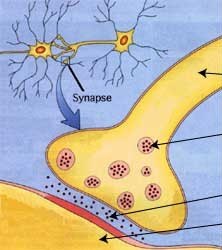
The location of neurotransmitters

a)

axon terminals

b)

dendrites

c)

Schwann cells

d)

cell body

72.

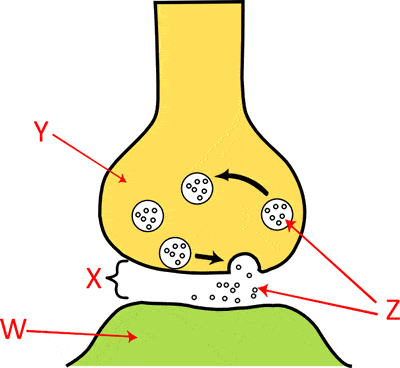
X

a)

Axon Terminal Button

b)

Neurotransmitters

c)

Dendrite

d)

Synapse