wayground logo

Free Printable Worksheets

NEW

Font size

S
M
L
XL
Worksheets

separation techniques

Total questions: 15

Worksheet time: 10mins
Name
Class
Date
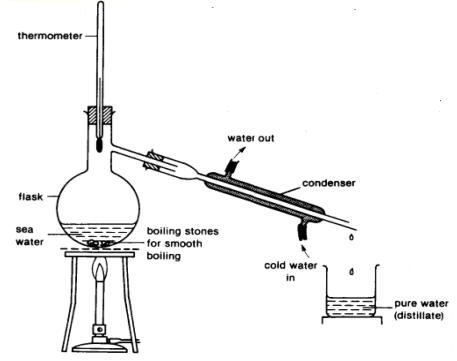
1.

What is the name of this separation technique?

a)

Simple distillation

b)

Fractional distillation

c)

Boiling

d)

Evaporation

2.

Which of the following statements tells us that a sample of liquid is pure water?

a)

It is colourless.

b)

It leaves no residue when filtered.

c)

It boils at 100oC.

d)

It is odourless.

3.

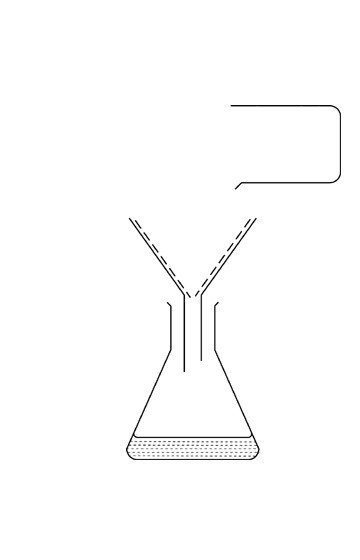
What is the name of this separation technique?

a)

distillation

b)

filtration

c)

evaporation

d)

chromatography

4.

Which separation technique is used to obtain salt from seawater?

a)

Simple distillation

b)

Filtration

c)

Chromatography

d)

Evaporation

5.

Name the separation technique

a)

Centrifuge

b)

Bunsen burner

c)

Distillation

d)

Evaporation

6.

In a salt water solution ...

a)

Salt is the solute and water is the solvent

b)

Salt is the solvent and water is the solute
7.
What is the boiling point of water?
a)
0oC
b)
100oC
c)
80oC
d)
95oC
8.
Water and alcohol are easily separated by distillation because of their
a)
different densities
b)
different boiling points
c)
different colours
d)
different melting points
9.
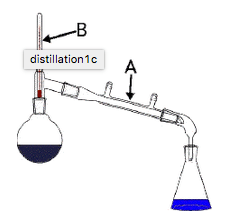
In the distillation apparatus shown, what are the parts labelled A and B?
a)
A = funnel, B = thermometer
b)
A = thermometer, B = funnel
c)
A = condenser, B = flask
d)
A = condenser, B = thermometer
10.
Filtration can be used to separate...
a)
an insoluble solid from a solution
b)
a soluble solid from a solution
c)
a dissolved solid from a solution
11.
Look at the apparatus setup. It cannot be used to separate which of the following mixtures? 
a)
Marble chips from oil 
b)
Alcohol and water
c)
Chalk from sugar solution
d)
Sand and sea water
12.
Which one of the following is a disadvantage of evaporation?
a)
It always requires heat
b)
It cannot be used for insoluble solids
c)
All of the solute is recovered
d)
The solvent (liquid part) is not recovered
13.
The drops of water that appear on the outside of a glass of cold water on a warm day are an example of?
a)
sublimation
b)
condensation
c)
evaporation
14.

What are mixtures?

a)

2 or more elements chemically combined together

b)

2 or more different substances that are not chemically combined

c)

Cannot be broken down into simpler substances by chemical methods

d)

Substances that can be separated through filtration

15.

Sand is ________________ in water.

a)

soluble

b)

insoluble