
NEW
Font size
 Worksheets
Rotational Dynamics and Equilibrium
Total questions: 20
Worksheet time: 38mins
What does the symbol Δω mean?
angular acceleration
angular velocity
change in angular acceleration
change in angular velocity
Does a bridge anchored resting on two pillars have any torque?
Yes, but it will soon break because of the torque
No, it isn't moving
No, Bridges can't have torque
Yes, but it is at equilibrium

A person stands a distance r from a door’s hinges and pushes with a force F directed perpendicular to its surface, rotating the door at its hinge with a torque τ . What is the applied torque if the person’s position and force change to 2r and 2F , respectively?
τ
2τ
4τ
4τ
Signs are suspended from rods of equal length on the side of a building. For each case, the mass of the rod can be ignored. The mass of the sign is given in each figure. Which case has the greatest magnitude of the torque that the sign exerts about the point at which the rod is attached to the side of the building.


A 2-m long massless rod supports a 12-Newton weight. The left end of each rod is held in place by a frictionless pin. In each case, a vertical force F is holding the rods and the weights at rest. The rods are marked at half-meter
intervals. Which case has a force F with the greatest magnitude?


Torques cause changes in _______.
velocity
moment of inertia
lever arm
angular velocity
The lever arm is the ________ distance from the axis of rotation to the point where the force is exerted.
angular
displaced
perpendicular
none of these
What is the point at which all of the mass of the body and be considered to be concentrated?
Center of Mass
Moment of Inertia
Rotational Equilibrium
Torque
An ice skater is spinning in a circle with his arms extended out. He then brings his arms in, what happens to his rotational velocity?
It increases
It decreases
It stays the same
He stops spinning immediately
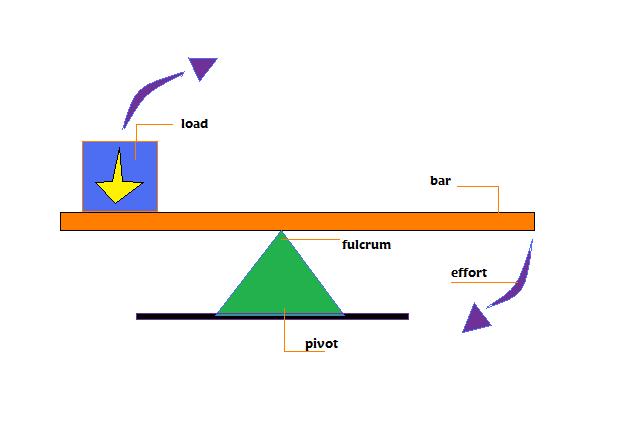
What force does not cause any torque?
Force perpendicular to the fulcrum.
Force horizontal to the planck.
Force slightly off center of the fulcrum
Forces at a 45 degree angle to the fulcrum, and not on the fulcrum

The number of complete revolutions per second is:
frequency
period
torque
rotational inertia
The time required for one complete revolution is:
torque
frequency
period
rotational kinetic energy

If the radius of the string is .3 meters long and the stopper makes 5 revolutions per second, what is the speed of the stopper? (T = period = time for ONE revolution, not 5)
9.4 m/s
6.8 m/s
11.7 m/s
3.5 m/s
Condition for maximum torque is
θ = 90 degree
θ =180 degree
θ = 0 degree
not defined
Find liner velocity of an object on Earth’s equator moves as a result of Earth’s rotation (Earth’s radius=6.4X10⁶m)
400 m/s
100 m/s
10m/s

