
 Worksheets
Plate Tectonics and boundaries
Total questions: 19
Worksheet time: 41mins
Boundary between two colliding plates, often associated with mountain building, ocean trenches and volcanic islands
plate boundary
magma
divergent boundary
convergent boundary
the region where an oceanic plate sinks down into the asthenosphere at a convergent boundary, usually between continental and oceanic plates
subduction zone
lava zone
nitrogen zone
continental zone
THE PLATE BOUNDARY where two plates are moving apart, magma comes up to create new CRUST
ridge
divergent boundary
convergent boundary
plate boundary
The geographic feature where two plates are moving apart, magma comes up to create new crust
lithosphere
trench
ridge
magma
A long narrow deep depression in the ocean bed
ridge
fault
trench
rift
A deep crack in the Earth's surface associated with divergent boundary
lava
rift
ridge
trench
Circular currents in the mantle caused by the magma being heated by the core off the Earth.
convection currents
lava
magma
hot air
formed by two continental plates colliding and forcing each other upwards during convergent boundary
grassland
mountain ranges
snow
trench
Three Types of Plate Boundaries
Transform (slide past)
Convergent (collision)
Divergent (pull apart)
All the above

Transform Boundary
Where two plates slide past each other.
when two plates collide
when two plates are pulling apart
None of the above

boundary zones are characterized by deep-ocean trenches, shallow to deep earthquakes, and mountain ranges containing active volcanoes.
Convergent
Divergent
Transform
All the above
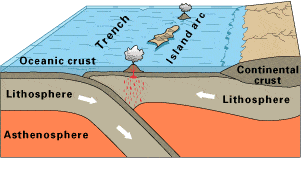
Observe this diagram of a plate boundary. One statement BEST describes what is happening. It is that
the oceanic crust is melting.
the denser ceanic crust is subducting under the less dense oceanic crust
volcanic islands are forming.
the tectonic plates are moving away from each other.
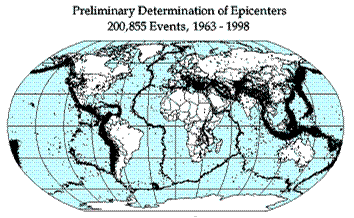
Earthquake epicenters (center of where the earthquakes started) were mapped for a 35 year period in the diagram above. The black dots indicate these epicenters. The black dots appear along what feature on Earth?
hot spots
plate boundaries
rift zones
sea floor spreading
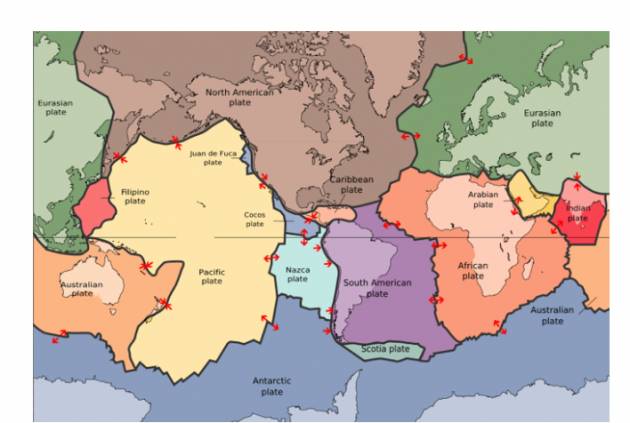
Where are earthquakes MOST LIKELY to occur?
close to the equator
close to the center of tectonic plates
at divergent or convergent plate boundaries
at transform plate boundaries
___________ currents in the Earth's asthenosphere cause plate to shift at their boundaries. This movement also causes earthquakes and volcanic activity.
conduction
convection
radiation
ocean
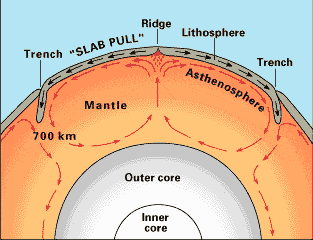
What is the source of energy that drives plate movement?
the subducton of the sea floor
the different densities of the oceanic and crustal plates
convection currents in the asthenosphere
the friction force between the plates that move past each other
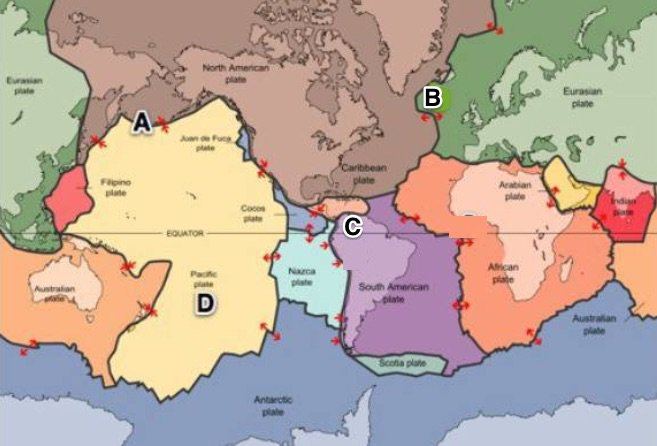
Where would sea floor spreading most likely occur?
At convergent boundaries (oceanic vs. oceanic)
At convergent boundaries (oceanic vs. continental)
At divergent plate boundaries (oceanic vs. oceanic)
At transform plate boundaries

