
NEW
Font size
S
M
L
XL
 Worksheets
Reproduction Quiz
Total questions: 25
Worksheet time: 6hrs 15mins
Name
Class
Date
1.
Which type(s) of reproduction involves only ONE parent?
a)
asexual
b)
sexual
c)
both
2.
Which type(s) of reproduction involves TWO parents?
a)
asexual
b)
sexual
c)
both
3.
Which type(s) of reproduction involves offspring identical to the parent?
a)
asexual
b)
sexual
c)
both
4.
Which type(s) of reproduction involves genetically unique offspring - a variety?
a)
asexual
b)
sexual
c)
both
5.
Male and female reproductive cells are collectively known as:
a)
spores
b)
pollen
c)
gametes
d)
offspring
6.
Where is all the genetic material inside a cell?
a)
nucleus
b)
vacuole
c)
cell membrane
d)
ribosome
7.
How are genetic traits passed down from generation to generation?
a)
Chromosomes
b)
Reproduction
c)
DNA
d)
Genes
8.
A specific characteristic of an individual organism.
a)
Trait
b)
Feature
c)
Mutation
d)
Gene
9.
How do organisms get their traits?
a)
They get thier traits from their environment.
b)
They inherit one copy of a gene from their mother.
c)
They inherit copy of a gene version from their mother and father.
d)
They get their traits from the proteins they eat.
10.

A _______ is a segment of DNA that codes for a specific protein or RNA molecule.
a)
gene
b)
gamete
c)
chromosome
d)
chromatid
11.

A _________ is DNA tightly coiled around proteins.
a)
gene
b)
chromosome
c)
trait
d)
mutation
12.
What are the nucleotides made of?
a)
Sugar, Phosphate, nitrogen base
b)
Phosphate, Adenine, nitrogen base
c)
Thymine, Adenine, Cytomine
d)
Phosphate, Nitrogen, Adenine
13.
Adenine bonds with ______________.
a)
Guanine
b)
Thymine
c)
Cytosine
d)
Adenine
14.
Guanine bonds with ______________.
a)
Adenine
b)
Guanine
c)
Cytosine
d)
Thymine
15.
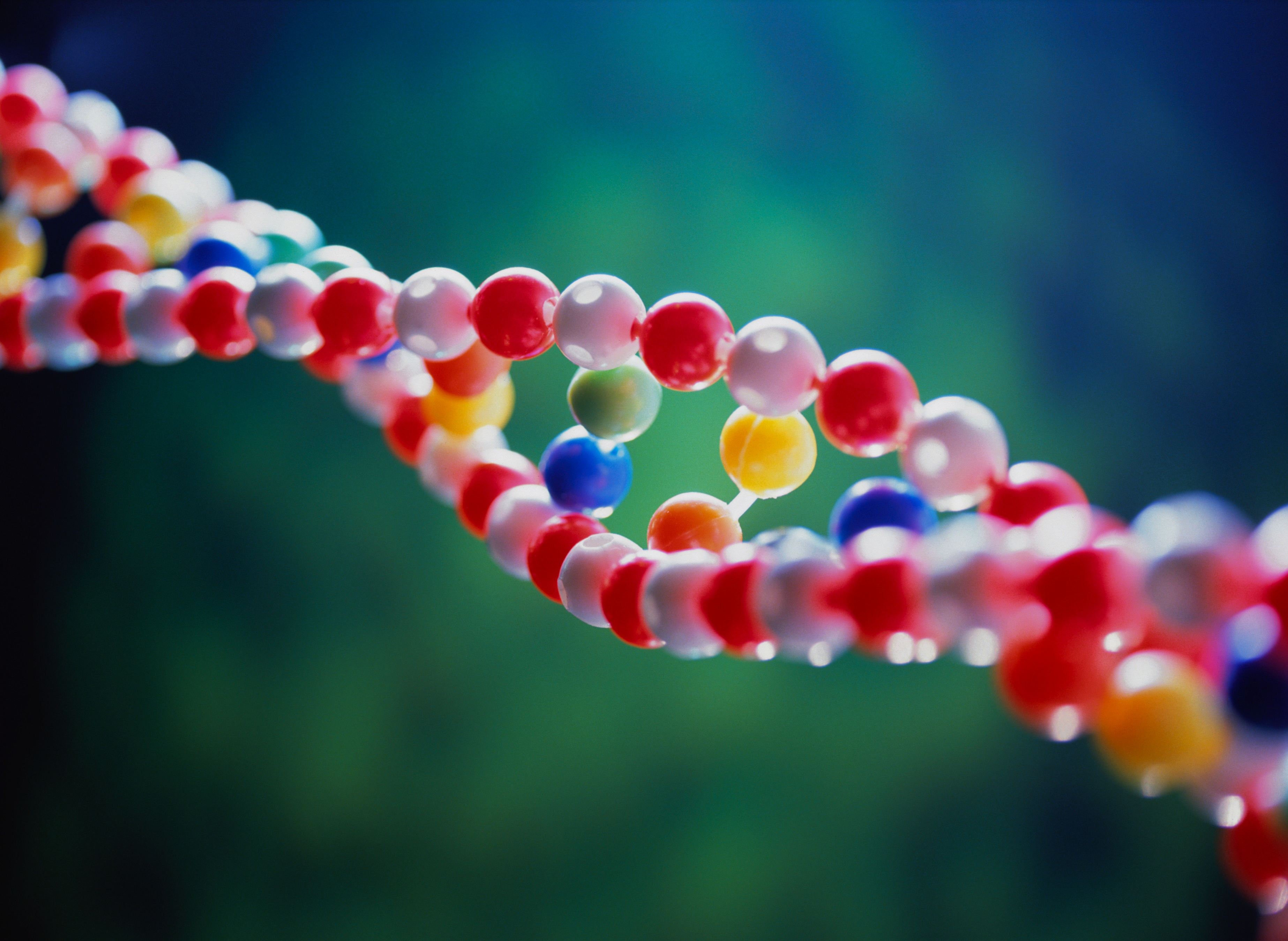
Why is DNA important?
a)
it is very small and very complicated
b)
it's in everything
c)
it serves as the blueprint for traits of all living things
d)
because we eat it every day for energy
16.
What are the 4 nitrogen bases?
a)
adenine, thymine, cytoplasm, and guanine
b)
adenine, thymine cytosine, and guanine
c)
adenine, thymine, cytosine, and gylcerol
d)
adenine, thymine, cytosine, and glucose
17.
How many pairs of chromosomes are in a human being?
a)
23
b)
44
c)
89
d)
72
18.
After meiosis is complete, the new cells:
a)
are all identical
b)
are all different
c)
are half identical and half different
d)
are all stretched out
19.
Most of the cells in the human body are produced by
a)
mitosis
b)
meiosis
20.

Variation in the cells/organisms produced...
a)
Mitosis
b)
Meiosis
21.
Which of the following does NOT describe meiosis?
a)
sexual reproduction
b)
reduction division
c)
increases genetic variation
d)
produces identical copies
22.

The allele combinations
a)
genetics
b)
mitosis
c)
genotype
d)
phenotype
23.

The physical appearance of an organism based on traits
a)
Genotype
b)
Phenotype
c)
Meiosis
d)
Genetics
24.

Having the genes for baldness is an example of
a)
genotype
b)
phenotype
25.

The process on the left is:
The process on the right is:
The process on the right is:
a)
Left: meiosis
Right: meiosis
Right: meiosis
b)
Left: meiosis
Right: cloning
Right: cloning
c)
Left: mitosis
Right: meiosis
Right: meiosis
d)
Left: mitosis
Right: mitosis
Right: mitosis
Reset

