wayground logo

Free Printable Worksheets

NEW

Font size

S
M
L
XL
Worksheets

Wave motion

Total questions: 37

Worksheet time: 2hrs 51mins

Name
Class
Date
1.

The number of waves that pass a fixed point in one second is...

a)

frequency

b)

wave speed

c)

amplitude

d)

wavelength

2.

The length of one complete wave cycle is...

a)

frequency

b)

wave speed

c)

amplitude

d)

wavelength

3.

What is the amplitude of the wave?

a)

3 cm

b)

8 cm

c)

16 cm

d)

24 cm

4.

What is the wavelength of the wave?

a)

3 cm

b)

8 cm

c)

16 cm

d)

24 cm

5.
What type of wave is this?
a)
Transverse
b)
Longitudinal
6.
What type of wave is this?
a)
Transverse
b)
Longitudinal
7.
What is represented by the letter 'x'?
a)
Crest
b)
Compression
c)
Rarefaction
d)
Wavelength
8.
What part is the arrow pointing to?
a)
Crest
b)
Trough
c)
Amplitude
d)
Wavelength
9.
A wave that requires a medium through which to travel
a)
mechanical wave
b)
chemical wave
c)
electromagnetic wave
d)
pitch
10.
If a wave is traveling at 260 m/s and has a wavelength of 0.8 m/s, what is its frequency?
a)
208 Hz
b)
325 Hz
c)
430 Hz
d)
160 Hz
11.
Sound travels FASTEST through which of these materials?
a)
Air
b)
Empty space
c)
Metal
d)
Water
12.
 A wave has frequency of 5 Hz and a speed of 25 m/s. What is the wavelength of the wave?
a)
25 m
b)
125 m
c)
5 m
d)
25 m/s
13.

A guitar string vibrates with a frequency of 320 hz. If the wavelength of the vibration is 0.23 meters what is the speed of the wave?

a)

320.23 m/s

b)

1391.3 hz

c)

73.6 m/hz

d)

73.6 m/s

14.

............. is ( are) mechanical waves

a)

water wave only

b)

Sound wave only

c)

Light wave only

d)

Sound wave and water wave

15.

Radio waves ...........

a)

are transverse mechanical waves

b)

are longitudinal waves

c)

Propagate through vacuum ( space )

d)

need medium to propagate through

16.

All of the following are electromagnetic waves except. ............ waves

a)

Light

b)

Sound

c)

Microwave

d)

Radio

17.

Transverse waves consists of .............

a)

Compressions and rarefactions

b)

Troughs and rarefactions

c)

Crests and troughs

d)

Compressions and crest

18.

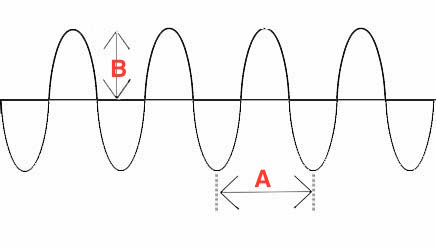
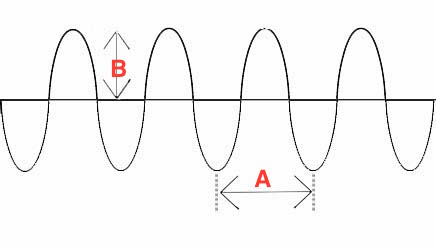
What property of this wave is represented by the letter "A"

a)

amplitude

b)

crest

c)

trough

d)

wavelength

19.
What property of the wave is represented by the letter "B"?
a)
amplitude
b)
crest
c)
trough
d)
wavelength
20.
The lowest point on a wave is the:
a)
Amplitude
b)
Crest
c)
Trough
d)
Wavelength
21.
The highest point on a wave is:
a)
the crest
b)
the trough
c)
the top
d)
the coast 
22.
A mechanical wave cannot travel through...
a)
a vacuum(empty space).
b)
water.
c)
air. 
d)
glass.
23.
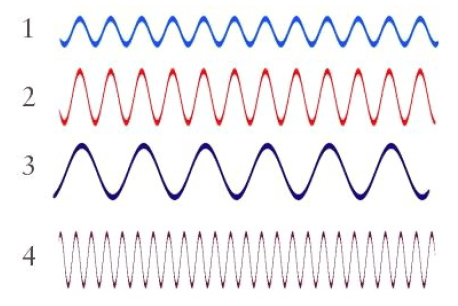
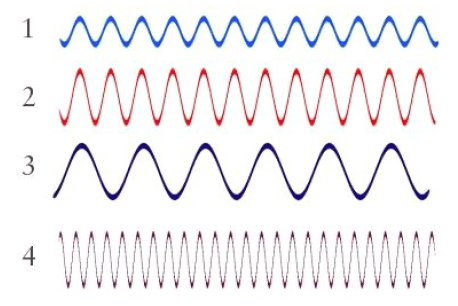
Which wave in the diagram has the greatest frequency?
a)
1
b)
2
c)
3
d)
4
24.
Which wave in the diagram has the greatest wavelength?
a)
1
b)
2
c)
3
d)
4
25.
Which type of wave has movement that is parallel to the direction of the wave (pulse wave)?
a)
transverse wave
b)
longitudinal wave
c)
both
d)
none
26.
What waves have movement that is perpendicular to the direction of the wave(up/down, left/right)?
a)
Transverse wave
b)
longitudinal wave
c)
both
d)
none
27.
The units for frequency are measured in _____________.
a)
hertz
b)
seconds
c)
m/s
d)
grams
28.
Which is an example of a longitudinal wave?
a)
light wave
b)
sound wave
c)
visible wave
d)
radio wave
29.

What is the relationship between period(T) and frequency(f)?

a)

directly proportional

b)

inversely proportional

c)

equal to

30.

An x-ray is an example of what type of wave?

a)

electromagnetic wave

b)

mechanical wave

31.
How many cycles are in this wave?
a)
1
b)
2
c)
3
d)
4
32.
What is the wave's amplitude?
a)
4 cm
b)
5 cm
c)
6 cm
d)
8 cm
33.
What is the wave's frequency?
a)
0.25 Hz
b)
0.5 Hz
c)
0.75 Hz
d)
1 Hz
34.

What is the wave's periodic time?

a)

1 s

b)

2 s

c)

3 s

d)

4 s

35.

What is the frequency of a mechanical wave that has a velocity of 1.77 m/s and a wavelength of 12.05 m ?

a)

0.15 Hz

b)

0.51 Hz

c)

1.15 Hz

d)

2.0 Hz

36.

Letter G represents...

a)

Compression

b)

Rarefaction

c)

Wavelength

d)

Amplitude.

37.

Transverse waves consists of .............

a)

Compressions and rarefactions

b)

Troughs and rarefactions

c)

Crests and troughs

d)

Compressions and crest