wayground logo

Free Printable Worksheets

Font size

S
M
L
XL
Worksheets

Geometrical Optics

Total questions: 22

Worksheet time: 50mins

Name
Class
Date
1.

When a ray of light enters a glass slab from air

a)

its wavelength decreases

b)

its wavelength increases

c)

its frequency increases

d)

neither its wavelength nor its frequency changes.

2.

The distance from center of mirror, C to the pole of mirror is given as

a)

2f

b)

v

c)

u

d)

2R

3.

To determine the characteristics of image formed we need to a draw ray diagram that uses

a)

at least 2 rays that overlap each other

b)

at least 3 rays out of 4 rays

c)

plane mirror or lens

d)

rays that passes through biconcave or biconvex mirror

4.

An image that is formed at the back of the mirror is said to be

a)

real image

b)

virtual image

c)

inverted image

d)

magnified image

5.
An index of refraction less than one for a medium would imply
a)
that the speed of light in the medium is the same as the speed of light in vacuum.
b)
that the speed of light in the medium is greater than the speed of light in vacuum.
c)
refraction is not possible.
d)
reflection is not possible.
6.
Light travels fastest
a)
in a vacuum.
b)
through water.
c)
through glass.
d)
through diamond.
7.
A negative magnification for a mirror means
a)
the image is inverted, and the mirror is concave.
b)
the image is inverted, and the mirror is convex.
c)
the image is inverted, and the mirror may be concave or convex.
d)
the image is upright, and the mirror is convex.
8.
The principle on which mirrors work is
a)
refraction.
b)
polarization.
c)
dispersion.
d)
reflection.
9.
An image formed when the light rays do not actually pass through the image location, and would not appear on paper or film placed at that location is referred to as a
a)
real image.
b)
virtual image.
c)
source image.
d)
original image.
10.
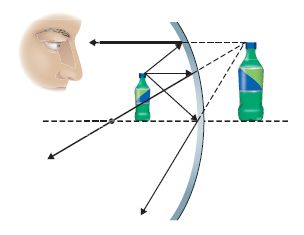
Which terms describe the reflection seen in this image?
a)
virtual, upright
b)
virtual, inverted
c)
real, upright
d)
real, inverted
11.

If R1 and R2 are the radii of curvature of a plano convex lens,

a)

R1 is positive and R2 is negative.

b)

Both R1 and R2 are negative.

c)

R1 is positive and R2 is infinity.

d)

R1 is negative and R2 is infinity.

12.

State the characteristic of image foremd

a)

real, inverted and diminished

b)

virtual, upright and diminished

c)

virtual, upright and magnified

d)

real, upright and diminished

13.
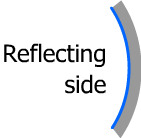
The following is a picture of what type of mirror? 
a)
Convex Mirror
b)
Concave Mirror
c)
Plane Mirror
d)
Flat Mirror
14.
The following is a picture of what type of mirror? 
a)
Convex Mirror
b)
Concave Mirror
c)
Plane Mirror
d)
Flat Mirror
15.

which type of lens

a)

concave

b)

convex

c)

opaque

d)

plano

16.

what type of mirror is this

a)

concave

b)

convex

c)

translucent

d)

plano

17.

a convex lens does what to rays

a)

diverges

b)

converges

c)

implodes

d)

merges

18.

a convex mirror does what to rays

a)

diverges

b)

converges

c)

implodes

d)

merges

19.
The pencil in the glass of water appears bent due to ....
a)
reflection
b)
refraction
c)
mirrors
d)
focal point
20.
What type of image does this lens form?
a)
Virtual image
b)
Real Image
c)
No Image
21.

When light travels from a higher index (water) to a lower index (air), light will bend...

a)

toward the normal

b)

away from the normal

22.

Total internal reflection only occurs when light tries to travels from a medium with a _____ index to ____ index

a)

lower to higher

b)

higher to lower

c)

same to same