wayground logo

Free Printable Worksheets

Font size

S
M
L
XL
Worksheets

Chemistry 1 Gas Laws Review

Total questions: 25

Worksheet time: 4hrs 21mins
Name
Class
Date
1.
Charles' Law States...
a)
As Pressure goes up volume goes down
b)
As Pressure goes up temperature goes up
c)
As Volume goes up temperature goes up 
d)
As Pressure goes down volume goes down 
2.
Whose law states that as pressure goes up, volume goes down?
a)
Charles 
b)
Boyle
c)
Aglow
d)
Mazias 
3.
A balloon will pop in the atmosphere because..
a)
Pressure goes down volume goes up
b)
Pressure goes up volume goes down
c)
temperature goes down volume goes up
d)
volume goes down temperature goes down
4.
When the temperature of matter increases the particles...
a)
speed up and move closer
b)
speed up and move farther apart
c)
slow down and move closer together
d)
slow down and move farther apart
5.
What type of relationship is Charles' Law?
a)
Inverse
b)
Direct
c)
Not enough information
d)
#goals
6.
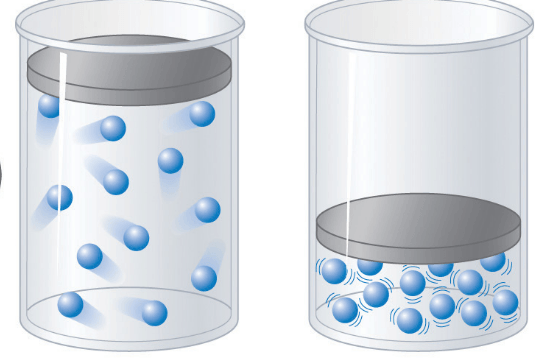
Which container will have a lower pressure?
a)
left
b)
right
c)
they both have the same pressure
d)
I don't know
7.
You have a gas that has a pressure of 2 ATM and a volume of 10L.  What would be the new volume if the pressure was changed to 1 ATM?
a)
5 L
b)
20 L
c)
It would stay at 10L
d)
1 L
8.
What is 50 °C in Kelvin?
a)
223
b)
323
c)
100
d)
50
9.
If 200 mL of a gas at 27°C is cooled to -33°C at a constant pressure, the volume will be
a)
250 mL
b)
204 mL
c)
196 mL
d)
160 mL
10.
Which of the following would increase the (gas) pressure of a system?
a)
Increase the Temperature
b)
Pump in more gas
c)
Decrease the volume
d)
All of these
11.

Calculate the volume that a 0.323-mol sample of a gas will occupy at 265 K and a pressure of 0.900 atm

a)

7.18 L 

b)

7.81 L

c)

4.63 L

d)

4.36 L

12.
Determine the Kelvin temperature required for 0.0470 mol of gas to fill a balloon to 1.20 L under .998 atm pressure. 
a)
0 K 
b)
107 K 
c)
207 K 
d)
307 K 
13.
Determine the number of moles in a container of gas at STP with a volume of 99.2 L. 
a)
2222.08 moles
b)
4.43 moles
c)
22.4 moles 
d)
76.8 moles
14.
Determine the initial temperature of a random gas when the initial volume is 2.2 L and it is cooled to 88K with a volume of 0.85 L. 
a)
0.029 K
b)
0.021 K
c)
227.76 K
d)
34 K
15.

A sample of He gas (2.35 mol) occupies 57.9 L at 300.0 K and 1.00 atm. The volume of this sample is ___L at 423 K and 1.00 atm.

a)

0.709 L

b)

57.9 L

c)

41.1 L

d)

81.6 L

e)

1.41 L

16.
Neon occupies a volume of 2.80 L at -35°C. What volume will it occupy at 43°C?
a)
3.44 L
b)
4.1 L
c)
2.65 L
d)
3.7 L
17.
If the pressure in a balloon remains constant what happens to the balloon's volume as the temperature of the air increases?
a)
the balloon shrivels up
b)
balloon expands
c)
balloon stays the same size
d)
balloon shrinks
18.

The escape of a gas through a small hole in a container.

a)

effusion

b)

diffusion

c)

compressibliity

d)

partial pressure

19.

Why does the pressure inside a container of gas increase if more gas is added to the container?

a)

there is an increase in the number of collisions between particles and the walls of the container.

b)

there is an increase in temperature of the gas.

c)

there is a decrease in volume of the gas.

d)

there is an increase of force of the collisions between the particles and the walls of the container.

20.

What does the ideal gas law allow scientists to calculate that the other gas laws do not?

a)

number of moles

b)

pressure

c)

volume

d)

temperature

21.
In order to solve gas law calculations, temperature must be measured in:
a)
Fahrenheit
b)
Celsius
c)
Kelvin
d)
It doesn't matter 
22.
At STP, what is pressure in atmospheres?
a)
1 atm
b)
10 atm
c)
0 atm
d)
100 atm
23.

Solve the following problem:

What is the volume of a balloon if it contains 3.2 moles of helium at a temperature of 20⁰C and 1.2 atm?

a)

106.55 K

b)

53.3 L

c)

293 K

d)

64.15 L

24.

What does the variable "n" represent in the ideal gas law?

a)

pressure

b)

volume

c)

moles

d)

the gas constant

e)

temperature

25.

What does the variable "R" represent in the ideal gas law?

a)

pressure

b)

volume

c)

moles

d)

the gas constant

e)

temperature