wayground logo

Free Printable Worksheets

NEW

Font size

S
M
L
XL
Worksheets

overall review(mid-term)

Total questions: 65

Worksheet time: 3hrs 1mins

Name
Class
Date
1.
Describe the relationship between the terms in the arithmetic sequence 
4, 8, 12, 16
a)
Subtracting 4 to the previous term
b)
Adding 4 to the previous term
c)
Multiplying by 2 to the previous term
d)
Dividing each term by 2
2.
Describe the relationship between the terms in the geometric sequence
2, 4, 8, 16
a)
Multiplying the previous term by 2. 
b)
Adding by 2 to the previous term. 
c)
Subtracting the previous term by 4
d)
Multiplying the previous term by 4
3.
What 3 terms come next in the sequence? 
4, 8, 12, 16
a)
20, 24, 28
b)
12, 8, 4
c)
24, 28, 20
d)
20, 22, 24
4.

Which one is not arithmetic sequence

a)

3/2, 2, 5/2, 3, ...

b)

5/4, 1, 3/4, 1/4, ...

c)

7/2, 3, 2, 1/2, ...

d)

11/3, 9/3, 7/3, 5/3, ...

5.

1) Calculate the 16th of arithmetic sequence ;

1, 3, 5, 7, …

a)

29

b)

31

c)

33

d)

35

6.

Find the first term of arithmetic sequence is given a6 = -19 and a10 = -31

a)

-4

b)

-3

c)

-2

d)

-1

7.

Find the common difference of an arithmetic sequence ; -2a + 3, -3a + 2, -4a + 1, …

a)

-a + 1

b)

-a – 1

c)

a + 1

d)

a – 1

8.

Given that nth term , Tn = 2n+5, find the 5th term

a)

20

b)

15

c)

7

d)

27

9.

The nth term, Tn = 6n-1. Is 329 a term of a sequence?

a)

True

b)

False

10.

Form the general term for 7, 13, 19, 25, 31, ...

a)

Tn=6n+1

b)

Tn=3n+4

c)

Tn=6n

d)

Tn=3n

11.

The general formula for the sequence -4, -1, 2, 5, 8 is Tn=3n+1

a)

True

b)

False

12.

The nth term of a sequence is given by Tn = 6n-1, given that Tk=167, what is the value of k.

a)

28

b)

20

c)

6

d)

12

13.
23  24  _____
a)
27
b)
25
14.
_____  22    23   24
a)
21
b)
25
15.

12, ..........., 32, 42, 52. The missing number is;

a)

22

b)

23

c)

24

16.
Is the sequence 2, 4, 12, 48,... geometric?
a)
yes
b)
no
17.
Is the sequence arithmetic: 37, 31, 25, 19, ...
a)
Yes
b)
No
18.

Write a formula for the following sequence:

2, 8, 14, ...

a)

an = 2 + 6n

b)

an = - 6 + 6n

c)

an = 6n - 4

d)

an = 4 - 6n

19.

Write a formula for the following sequence:

4, 12, 36, 108...

a)

an = 4(3n-1)

b)

an = 4(3n)

c)

an = 4+3n

d)

an = 4(3n)

20.

Find a18 for the following geometric sequence,

-3, 6, -12, 24,,,

a)

-37

b)

-786,432

c)

393,216

d)

258,280,326

21.

Evaluate the sum of the geometric sequence 1 + 2 + 4 + 8..., n = 6

a)

63

b)

60

c)

46

d)

56

22.
Given the recursive formula, find the first four terms:
an = an-1 + 5
a1 = -16
a)
-16, -21, -26, -31
b)
5, -11, -27, -43
c)
-16, -80, -500, -200
d)
-16, -11, -6, -1
23.
Write a recursive rule for the sequence 17, 1, -15, -31 . . .
a)
an = an-1 + 16
a1=17
b)
an = an-1 - 17
a1=17
c)
an = an-1 - 15
a1=17
d)
an = an-1 - 16
a1=17
24.

Write the recursive formula of 13, 9, 5...

a)

an=an-1-4

b)

an=an-1+3

c)

an=an-1-5

d)

an=an-1+4

25.

What is the 7th term in the series? 15, 35, 55... (the first term is 15)

a)

155

b)

135

c)

132

d)

75

26.

Identify the starting value and the recursive rule for the sequence in the table:

a)

Starting value 2, Recursive Rule: Add 4

b)

Starting value 0, Recursive Rule: Add 4

c)

Starting value 2, Recursive Rule: Multiply by 3

d)

Starting value 0, Recursive Rule: Multiply by 3

27.

Identify the starting value and the recursive rule for the sequence in the table:

a)

Starting value 2, Recursive Rule: Add 6

b)

Starting value 0, Recursive Rule: Multiply by 2

c)

Starting value 2, Recursive Rule: Multiply by 4

d)

Starting value 0, Recursive Rule: Divide by 4

28.
Find the common ratio for the geometric sequence:
64, 16, 4,...
a)
4
b)
-4
c)
¼
d)
29.
Write the recursive rule for the geometric sequence:
64, 16, 4,...
a)
a1 = 64; an = an-1 - ¼
b)
a1 = 4; an = 4(an-1)
c)
a1 = 64; an = 4(an-1)
d)
a1 = 64; an =   1/4(an-1)
30.
Given the rule:  an = 7(½)n-1
Identify the first term.
a)
an
b)
7
c)
½
d)
n
31.
A geometric sequence models what type of function?
a)
linear
b)
quadratic
c)
exponential
d)
absolute value
32.
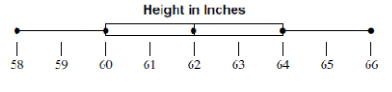
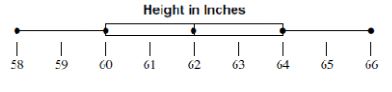
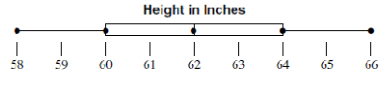
What is the minimum value?
a)
64
b)
58
c)
66
d)
60
33.
What data value is the upper quartile (Q3)?
a)
64
b)
62
c)
66
d)
58
34.
What percent of the data is between 25 and 30 on the number line?
a)
25%
b)
`50%
c)
75%
d)
100%
35.
What value is the lower quartile?
a)
66
b)
58
c)
60
d)
64
36.
Which box and whisker plot has the smallest lower quartile?
a)
Top plot
b)
Bottom plot
37.
What is the median of the data?
a)
200
b)
100
c)
90
d)
140
38.
What percent of students have heights between 60 inches and 66 inches?
a)
75%
b)
50%
c)
100%
d)
25%
39.
6. Which city has a higher median?
a)
Millersburg
b)
Arcadia
40.
True of false, 75% of the data values are greater than 18?
a)
True
b)
False, 75% of the values are greater than 16
c)
False, 50 % of the values are greater than 18
d)
False, 25% of the values are greater than 18
41.
Does the graph represent an exponential growth or an exponential decay function?
a)
Exponential Growth
b)
Exponential Decay
42.
What does the y-intercept of the graph represent?
a)
The amount of grams the material is gaining.
b)
The amount of grams the material is losing.
c)
The amount of grams remaining after so many years.
d)
The initial amount of grams.
43.
The amount of ants in a colony, f, that is decaying can be modeled by                      f(x) = 800(.87)x, where x is the number of days since the decay started. By what percentage is the colony decaying?
a)
87%
b)
13%
c)
800%
d)
8.7%
44.

The amount of downloads for an album on iTunes, g(d), where d is the number of days since the album was first uploaded can be represented as

g(d) = 5d

How many downloads will the album have after 3 days?

a)

125

b)

11

c)

1398

d)

140

45.
A collectible car has been going up in price by 10% each year. If the car is already worth $29,000, how much will the car be worth in 5 years?
a)
$0.29
b)
$2,900,000,000
c)
$46,704.79
d)
$145,000
46.
Simplify the expression x(3x)2
a)
3x2
b)
9x2
c)
3x2 + x
d)
9x3
47.
Is the following function exponential growth, exponential decay, linear, or none of the above.
g(x) = 740(.001)3x
a)
Exponential growth
b)
Exponential decay
c)
Linear
d)
None of the above
48.
Is the following function exponential growth, exponential decay, linear, or none of the above?
p(x) = 13x - 5
a)
Exponential growth
b)
Exponential decay
c)
Linear
d)
None of the above
49.

What type of pattern do exponential functions have?

a)

Adds by the same number every time

b)

Multiplies by the same number every time

c)

Square roots all the inputs

d)

Squares all the inputs

50.
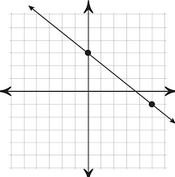
Is the graph linear, exponential or neither?
a)
Linear
b)
Exponential
c)
Neither
51.

Is the table linear, exponential, or neither?

a)

Linear

b)

Exponential

c)

Neither

52.

Is the table linear, exponential, or neither?

a)

Linear

b)

Exponential

c)

Nether

53.

Which form represents slope-intercept form?

a)

y=bx+my=bx+m

b)

Ax+By=CAx+By=C

c)

y2y1=m(x2x1)y_2-y_1=m\left(x_2-x_1\right)

d)

y=mx+by=mx+b

54.

In the equation, y = mx + b, the letter m is the ___________.

a)

y-intercept

b)

x-intercept

c)

slope

d)

multiplier

55.
Which of the following functions shows an initial amount of $15 and an increase of 35% each year?
a)
y = 15(35)x
b)
y = 15(1.35)x
c)
y = 15(0.35)x
d)
y = 35(1.15)x
56.
Write an equation that models the following situation:
Samantha's hair was known to grow very rapidly. It began at a length of 6 in and grew at a rate of 14% a week.
a)
y=6(0.14)x
b)
y=6(1+14)x
c)
y=6(1.14)x
d)
y=6(0.86)x
57.

Identify the initial value:

y = 6.87 (4)x

a)

a = 4

b)

a = 6.87

c)

a = 3

d)

a = 1

58.
The function y = 125(1.13)represents Mr. Gantz's recent investments where x is measured in years.  Which is NOT true?
a)
Mr. Gantz initial invested $125
b)
Mr. Gantz's money grows by 13% per year
c)
After 4 years Mr. Gantz will have about $203.81
d)
Mr. Gantz earns more money in year one than in year 5
59.

What type of function is

 f(x)=(17)xf\left(x\right)=\left(\frac{1}{7}\right)^x 

a)

Exponential Growth

b)

Linear

c)

Exponential Decay

60.

Which function represents the table of values?

a)

f(x) = 4x

b)

f(x) = x3

c)

f(x) = 4x

d)

f(x) = 4x-1

61.

Which table represents the following equation?

a)
b)
c)
d)
62.

Which table represents the following equation?

a)
b)
c)
d)
63.

What is the asymptote for this function:

f(x) = 4(3)x - 2

a)

4

b)

3

c)

2

d)

-2

64.

What transformations have occurred to the following function?

f(x) = 2x + 4

a)

Shifted 4 places right

b)

Shifted 4 places up

c)

Shifted 4 places left

d)

Shifted 4 places down

65.

What is the asymptote for the following function:

f(x) = 4(1.5)x-3

a)

There isn't one

b)

x-3

c)

1.5

d)

0