Wayground logo

Free Printable Worksheets

Font size

S
M
L
XL
Worksheets

8th Grade History Review

Total questions: 129

Worksheet time: 3hrs 49mins

Name
Class
Date
1.

Who wrote the Charter allowing for the settlement and exploration of Jamestown?

a)

King James

b)

Queen Elizabeth

c)

VA Company of London

d)

House of Burgesses

2.

What were the TWO main reasons for exploration?

a)

Natural Resources

b)

Gold

c)

Power

d)

Beat Spain

3.

Who decide the "Work or Die" policy?

a)

John Rolfe

b)

King James

c)

John Smith

d)

VA Company of London

4.

Winter 1609-1610, there was not enough food, colonists died, homes were used as firewood.

a)

Golden Times

b)

Hunger Times

c)

Black Death Times

d)

Starving Times

5.

The first elective body of Virginia is known as the

a)

VA Company of London

b)

Parliament

c)

House of Burgesses

d)

Congress

6.
Who was the leader of the Powhatan Indian Tribe?
a)
Crazy Horse
b)
Powhatan
c)
Pocahontas
d)
Sitting Bull
7.
Who is a famous Powhatan Indian that was the daughter of Chief Powhatan?
a)
Pocahontas
b)
George Washington
c)
Chief Powhatan
d)
She Who Is Alone
8.

Why can Squanto speak English?

a)

learned English from father

b)

learned English from mother

c)

learned English from the pilgrims

d)

learned English from visitors

9.

What was the name of the first settlers in Europe?

a)

Patriots

b)

Indians

c)

Settlers

d)

Pilgrims

10.

The ____________________________ was a set of self-governing rules for the settlers in Plymouth.

a)

William Penn

b)

Theocracy

c)

Jamestown

d)

Mayflower Compact

11.

________________________was a Puritan spiritual advisor and religious reformer who challenged male authority figures in the Massachusetts Bay Colony.

a)

Roger Williams

b)

Anne Hutchinson

c)

Thomas Hooker

d)

Mayflower Compact

12.

___________________ was the founder of Rhode Island.

a)

Thomas Hooker

b)

William Penn

c)

Roger Williams

d)

Anne Hutchinson

13.

_________________ was the founder of Connecticut.

a)

Roger Williams

b)

Anne Hutchinson

c)

William Penn

d)

Thomas Hooker

14.

_____________________________ founded Pennsylvania as a place for Quakers to have religious freedom and tolerance.

a)

William Penn

b)

Theocracy

c)

Roger Williams

d)

Anne Hutchinson

15.

___________________ was the last of the 13 colonies to form. It formed for debtor to have a fresh start and served as a buffer for other colonies.

a)

South Carolina

b)

North Carolina

c)

Georgia

d)

Virginia

16.

________________________________ was located in present day Manhattan, New York.

a)

New Netherland

b)

Georgia

c)

Plymouth

d)

Mayflower Compact

17.
What is the Middle Passage?
a)
Water Route Through North America
b)
European slave trade with India
c)
European Slave trade with North America
d)
European slave trade with the Americas
18.

The middle passage was apart of what trading system

a)

Triangular Trade

b)

African Trade

c)

Square Trade

d)

Gold Mine Trade

19.

Navigation Acts

a)

A person or company who sells goods/products (merchandise)

b)

In: goods coming into a country

c)

Exit: goods going out of a country (selling)

d)

The specific laws passed by England to control the trade

20.

Imports

a)

A person or company who sells goods/products (merchandise)

b)

In: goods coming into a country

c)

Exit: goods going out of a country (selling)

d)

The specific laws passed by England to control the trade

21.

Mercantilism

a)

Being angry with England-The colonists were not accustomed to British control

b)

The specific laws passedy by England to control trade

c)

Mother Country Controls Trade-Colonys role is to serve the mother country

d)

Exit: goods going out into a country (selling)

22.
Which of the following best explains the effect of the Scientific Revolution on traditional religious beliefs?
a)
People now looked to religion to explain the world around them.
b)
People now looked to their kings to explain the world around them.
c)
People used reason and logic to explain the world
d)
Momney makes the world go round
23.

Religious meetings drew

a)

no crowds

b)

small crowds

c)

medium crowds

d)

large crowds

24.
George Whitefield and Jonathan Edwards gave sermons about
a)
the existence of many gods.
b)
helplessness and sinfulness of humankind.
c)
importance of government.
d)
importance of other religions.
25.
A snowball fight between the colonists and soldiers in Boston that ended in 5 colonists being killed was called
a)
Boston Tea Party
b)
Boston Massacre
c)
Boston Party
d)
Boston Parliament
26.
A secret organization formed to protest the Stamp Act was called
a)
Congress
b)
Sons of Liberty
c)
Parliament
d)
Loyalists
27.
The Sons of Liberty dumped tea into the Boston Harbor. This act of protest is known as 
a)
the Boston Tea Party
b)
the Stamp Act
c)
Committees of Correspondence
d)
Boston Massacre
28.
The tax on all items in the colonies made of paper was called the
a)
Stamp Act
b)
Sugar Act
c)
Townshend Act
d)
Boston tea Party
29.
Why were the colonists angry about "taxation without representation?"
a)
The colonists wanted to pay taxes on stamps and tea
b)
The colonists had no representation in Parliament
c)
The colonists fought to write the Declaration of Independence
d)
The colonists were loyal to the British and wanted to keep them happy
30.
The Quartering Act....
a)
Made colonists provide a home for soldiers
b)
Made colonists pay a quarter for every stamp
c)
Made colonists buy tea they didn't want
d)
Stopped colonists from spreading ideas
31.
Why did Britain decide to tax the colonists?
a)
Britain wasn't selling enough tea
b)
The colonists were making too much money.
c)
Britain needed money to pay for the French and Indian War
d)
Britain was afraid the colonists were giving money to the Indians
32.
Who was the King during the American Revolution?
a)
King Arthur
b)
Martin Luther King Jr.
c)
King George III
d)
King Charles II
33.
Who Founded the sons of Liberty?
a)
Benedict Arnold
b)
Christopher Gadson
c)
Samuel Adams
d)
Hercules Mulligan
34.

The Battle of Lexington was the first battle of the American Revolution.

a)

True

b)

False

35.

Thomas Paine was...

a)

A supporter of the American Revolution

b)

Against the American Revolution

c)

Wrote propaganda against the American government

d)

Wrote propaganda for the British government

36.

This writing was published during the American Revolution and paved the way for the Declaration of Independence.

a)

Rights of man

b)

The American Crisis

c)

Common Sense

37.

Which of these best describes the outcome of the Battle of Bunker Hill?

a)

The British won, but suffered many losses.

b)

The militia won by a narrow margin.

c)

The British won decisively.

d)

The militia surrendered to the British.

38.

Why was George Washington chosen to be a military leader?

a)

He had experience.

b)

He wanted the role.

c)

Yes, was very wealthy.

d)

He was highly educated.

39.

What effect did 'Common Sense' have in the colonies?

a)

It persuaded many colonists that America should be independent.

b)

It instilled fear of war in the colonies.

c)

It convinced the colonies to remain loyal to Great Britain.

d)

It petitioned the king to end the quarrel between the colonies and Great Britain.

40.

What was the purpose of the Olive Branch Petition?

a)

to ask King George to make peace with the colonies.

b)

to persuade British troops to leave Boston.

c)

to encourage colonists to join the army.

d)

to convince Parliament to repeal the Stamp Act.

41.

Why was the Declaration of Independence written?

a)

to explain why the colonies were separating from Great Britain

b)

the start the American Revolution

c)

to offer a peace settlement to Great Britain.

d)

to instruct how a county wins its freedom.
42.
Give me liberty or give me death!
a)
Loyalist
b)
Patriot
c)
Neutral
43.
Colonists are British subjects and should obey British law.
a)
Loyalist
b)
Patriot
c)
Neutral
44.
Thomas Jefferson , John Adams, George Washington , Paul Revere, Samuel Adams, Ethan Allen, Patrick Henry, Ben Franklin, Nathan Hale, Mercy Otis Warren - These people are
a)
famous loyalists
b)
famous patriots
c)
famous neutrals
d)
famous landmarks
45.
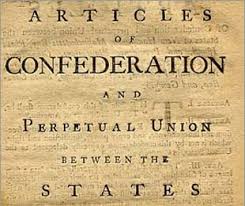
Under the Articles of Confederation, which government had the MOST power?
a)
Legislative branch
b)
the president
c)
the state governments
d)
national government
46.
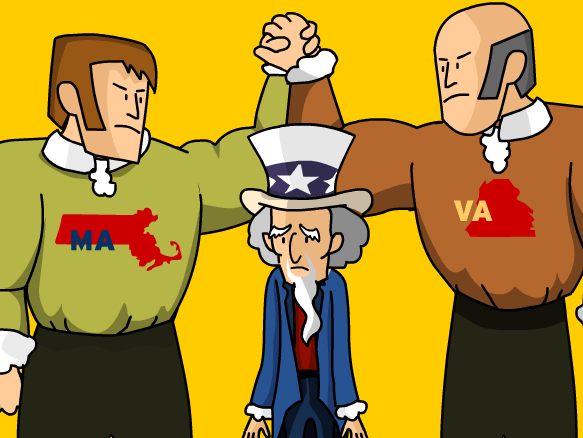
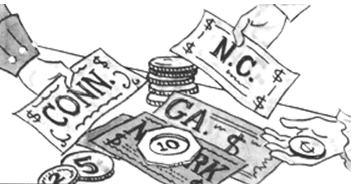
Which of the following weaknesses  in the Articles of Confederation does  this picture represent?
a)
no common currency (money)
b)
no executive branch
c)
no power to tax
d)
one vote for each state
47.
Under the Articles of Confederation, how many votes did each state get?
a)
Zero
b)
One
c)
Two 
d)
Three
48.
Which of the following is an example of a weakness in the Articles of Confederation?
a)
Congress couldn't collect taxes
b)
Weak national government
c)
Provided no common currency/money for all 13 states
d)
All of the  above
49.
Why was this first U.S. government so weak?
a)
King George III  was still in charge of USA
b)
Americans were afraid to give their new government too much power
c)
The American army did not win their independence from Great Britain and King George III
d)
ask; no
50.

One of the biggest problems facing the US after the Revolution was...

a)

George Washington's retirement

b)

The huge amount of debt the country had

c)

The British dragging their feet to sign the Treaty of Paris

d)

The number of people still loyal to the king

51.

Why were farmers in Massachusetts so upset in 1786 and 1787?

a)

The US was getting ready to go to war with France and they'd have to be soldiers again

b)

The national government kept raising taxes on farmers to pay off the war debt

c)

They were losing their farms because they could not afford the taxes on them

d)

No one would buy their crops because they were over priced

52.

Who was Daniel Shays?

a)

A former soldier and farmer who was worried about losing his farm, so he started a rebellion

b)

A tax collector from Massachusetts who had to go and collect money from the poor

c)

He was the Governor of Massachusetts at the time of a huge rebellion by farmers

53.
What was the goal of the 3/5th's Compromise?
a)
To get states to buy slaves
b)
To get rid of slavery
c)
To get the states to agree to the Constitution
d)
To get states to reject the Constitution
54.
What was the 3/5ths Compromise?
a)
Slaves counted as 2/4ths of a person
b)
Slavery was outlawed
c)
Slaves counted as 3/5ths of a person
d)
Slaves in the South were set free
55.
The legislative branch is made up of ___.
a)
federal courts
b)
Congress
c)
magistrates
d)
departments and agencies
56.
The exective branch is led or headed by the ___.
a)
Justices
b)
Senators
c)
President
d)
Represenatives 
57.
The judicial branch is made up ___.
a)
departments and agencies 
b)
lobbyists
c)
electors
d)
federal courts
58.
The highest court in the land is the ___.
a)
U.S. District Court
b)
U.S. Ciricuit Court
c)
U.S. Supreme Court
d)
U.S. Appeallate Court
59.
Freedom of speech, press, religion, assembly, and petition.  Which amendment is this?
a)
1st
b)
2nd
c)
3rd
d)
4th
60.
"Right to bear arms" (Gun rights)
a)
1st
b)
2nd
c)
3rd
d)
4th
61.
Guarantees freedom from testifying against yourself
a)
1st Amendment
b)
3rd Amendment
c)
5th Amendment
d)
7th Amendment
62.
What treaty secured the use of the Mississippi River? 
a)
Pickney's Treaty
b)
Jay's Treaty
c)
Treaty of Greenville
d)
Treaty of Paris
63.
A tax on liquor led to the ____, which marked the first time the government sent troops to fight American citizens.
a)
Shays' Rebellion
b)
Pennsylvania tax rebellion
c)
Whiskey Rebellion
d)
Farmer Rebellion
64.
What do you call a group of advisers to the president?
a)
Cabinet
b)
Closet
c)
Congress
d)
Senate
65.
Jefferson reduced the size of all of the following except...
a)
Military
b)
Government
c)
US Territories
66.
This political party would not campaign among the "common people"
a)
Democratic-Republicans
b)
Federalists
67.
Significance of Marbury v Madison
a)
Veto power
b)
Judicial Review
68.
He killed Alexander Hamilton
a)
Jefferson
b)
Burr
c)
Boone
69.
Jefferson purchased the Louisiana Territory from 
a)
England
b)
France
c)
Spain
70.
All of the following helped to explore the Louisiana Territory except
a)
Sacajawea
b)
Meriwether Lewis
c)
William Clark
d)
Daniel Boone
71.

A series of four laws passed by the U.S. Congress in 1798 amid widespread fear that war with France was imminent. The four laws–which remain controversial to this day–restricted the activities of foreign residents in the country and limited freedom of speech and of the press.

a)

The Alien and Addition Acts

b)

The Alien and UFO Acts

c)

The Alien and Sedition Acts

d)

The Alien and Planet Acts

72.

The act took direct aim at those who spoke out against Adams or the Federalist-dominated government. The new law outlawed any “false, scandalous and malicious writing” against Congress or the president, and made it illegal to conspire “to oppose any measure or measures of the government.”

a)

Alien Enemies Act

b)

Naturalization Act

c)

Sedition Act

d)

Alien Friends Act

73.

Which rights did the Sedition Act go against in the First Amendment?

a)

Freedom of Speech

b)

Freedom of Religion

c)

Freedom of the Press

d)

Freedom of Assembly

74.
An attempt by French officials to bribe American diplomats became known as the...
a)
XYZ Affair
b)
French Affair
c)
Barbary Wars
d)
Sedition Acts
75.
What parallel was the northern boundary for the Convention of 1818?
a)
48
b)
57
c)
42
d)
49
76.
Who led operations to stop Seminole raids in Florida and Georgia?
a)
Horatio Gates
b)
George Washington
c)
Andrew Jackson
d)
George Rogers Clark
77.
The US received what territory from the Adams-Onis Treaty?
a)
Texas
b)
Missouri
c)
Alabama
d)
Florida
78.
Which of the following stopped European colonization in America.
a)
Adams-Onis Treaty
b)
Monroe Doctrine
c)
Watauga Compact
d)
Convention of 1818
79.
Who proposed the Missouri Comprimise?
a)
Andrew Jackson
b)
John Adams
c)
John Quincy Adams
d)
Henry Clay
80.
What was the only state above the line of the Missouri Compromise that allowed slavery?
a)
Missouri
b)
Nebraska
c)
Ohio
d)
Kansas
81.

Who invented the Cotton Gin?

a)

George Harrison

b)

Eli Whitney

c)

Thomas Singleton

d)

Matthew Pershing

82.

Which states benefited the most from the Cotton Gin?

a)

The northern states.

b)

The southern states.

c)

The states that had the most factories.

d)

The states along the western coast.

83.

How did the Cotton Gin affect slavery?

a)

Plantation owners needed less slaves.

b)

It didn't affect it.

c)

Plantation owners needed more slaves.

d)

Plantation owners no longer needed slaves.

84.

How did Eli Whitney's ideas about making weapons contribute to an improvement in manufacturing?

a)

The parts of his weapons were interchangeable.

b)

His ideas contributed to the invention of the assembly line in factories.

c)

His ideas contributed to other inventions that improved manufacturing.

d)

All are correct.

85.
the process of moving from an agricultural society, in which most goods are handmade, to a society that thrives on machine-manufactured goods
a)
textile
b)
economy
c)
industrialization
d)
technology
86.
What was the importance of the Erie Canal?
a)
more water for the settlers to use for their crops
b)
it connected the Hudson River to Lake Erie making transportation of goods easier
c)
it connected the Mississippi River and the Hudson River and made transportation of goods easier
87.
In what country did the Industrial Revolution begin?
a)
United States
b)
France
c)
Great Britain
88.
Who invented the first cotton-spinning mill?
a)
Eli Whitney
b)
Robert Fulton
c)
Francis Cabot Lowell
d)
Samuel Slater
89.
Who invented the first factory that combined machines which spun cotton into yarn with power looms?
a)
Samuel Morse
b)
Francis Cabot Lowell
c)
Elias Howe
d)
Cyrus McCormick
90.
Who invented the steamboat?
a)
Robert Fulton
b)
Samuel Morse
c)
Cyrus McCormick
d)
Francis Cabot Lowell
91.
Who invented the telegraph?
a)
Elias Howe
b)
Eli Whitney
c)
Samuel Slater
d)
Samuel Morse
92.
Who invented the mechanical reaper?
a)
Eli Whitney
b)
Samuel Morse
c)
Cyrus McCormick
d)
John Deere
93.
Who invented the steel plow?
a)
Cyrus McCormick
b)
John Deere
c)
Samuel Slater
d)
Robert Fulton
94.
President Jackson sent soldiers to remove the ____ to the Indian Territory.
a)
Cherokee
b)
Iroquois
c)
Souix
d)
Red Hawks
95.
The Chief Justice of the Supreme Court who ruled in favor of the Cherokee Nation was
a)
John Adams
b)
John Jay
c)
John Bon Jovi
d)
John Marshall
96.
This tribe lived mostly in Florida and were either killed or forced to leave their homes.
a)
Souix
b)
Choctaw
c)
Iroquois
d)
Seminole
97.
This man was president from 1829-1837.
a)
Thomas Jefferson
b)
Andrew Jackson
c)
George Washington
d)
Henry Clay
98.
_________  in 1830 authorized the removal of Native Americans who lived east of the Mississippi river to lands in the west.
a)
Bureau of Indian Affairs
b)
Worcester v. Georgia
c)
Indian Removal Act
d)
None of the above
99.

Which two presidential candidates were accused of making a "Corrupt Bargain?

a)

John Q. Adams and Henry Clay

b)

Henry Clay and Andrew Jackson

c)

Andrew Jackson and John Q. Adams

d)

William Crawford and John Q. Adams

100.

This Supreme Court Case ruled only congress can pass laws governing interstate commerce.

a)

Fletcher vs Peck 1810

b)

Gibbons vs Ogden 1824

c)

McCulloch vs Maryland 1819

d)

Kramer vs Kramer 1979

101.

This Supreme Court Case ruled a state cannot tax property of the National Government.

a)

Fletcher vs Peck 1810

b)

Gibbons vs Ogden 1824

c)

McCulloch vs Maryland 1819

d)

Stephenson vs Sanford 1994

102.

__________________ is the replacing of government employees with the winning candidate's supporters.

a)

Spoils System

b)

Nullification Crisis

c)

Era of Good Feelings

d)

Mudslinging

103.
The war with Mexico BEGAN with
a)
California's rebellion
b)
a border dispute in Texas
c)
the Battle of Buena Vista
d)
a US invasion of Mexico City
104.
Which of the following presidents purchased Louisiana?
a)
Washington
b)
Adams
c)
Jefferson
d)
Jackson
105.
How did the U.S. acquire Oregon? 
a)
treaty with the British
b)
war with England
c)
purchased from the British
d)
war with Mexico
106.
Which of the following contributed to the westward expansion of the United States?
a)
European warships attacked the eastern seaboard, forcing citizens to move westward for safety.
b)
Most of the land east of the Mississippi River was not suitable for farming.
c)
Many Americans felt it was their right and duty to move westward.
d)
The standard of living on the Pacific Coast was very high, so many people wanted to move there.
107.
Name the piece of land.
a)
Mexican Cession
b)
Northwest Territory 
c)
Trans-Appalachian West 
d)
Oregon Country 
108.
What is Manifest Destiny?
a)
The belief that it was America's destiny to control and civilize all of North America
b)
The belief that their destiny was to manifest
c)
A religious term used to explain how to be saved
109.
Border Ruffians from Missouri voted in the first territorial election because:
a)
they intended to move to Kansas Territory in the future.  
b)
they wanted to see if they could get away with illegally voting in another state.  
c)
they wanted the proslavery forces to take control of Kansas Territory.  
d)
they did not know where the border of Missouri was located.  
110.
? was a well-known abolitionist who was willing to use violence to end slavery and was hanged for treason.  
a)
David Rice Atchison
b)
John Brown
c)
Andrew Reeder
d)
Charles Robinson
111.

The Compromise of 1850 allowed what to happen?

a)

Missouri joined the Union and Maine joined the Confederate states

b)

California joined the Union and Maine joined the Union

c)

California joined the Union and the Fugitive Slave Act was introduced

d)

The KS-NB Act was passed

112.

Who was Dred Scott?

a)

Ex-slave, Lincoln's advisor

b)

Escaped slave, ended free in Iowa

c)

Pro-slavery sheriff

d)

Slave who sued the government for his freedom

113.
Pick the candidates that were BOTH in the 1860 election
a)
Stephen Douglas, John Calhoun
b)
Abraham Lincoln, Stephen Douglas
c)
Stephen Douglas, Alexander Hamilton
d)
Abraham Lincoln, John Brown
114.
Formally withdrawing from the United States
a)
To Confederate
b)
Leaving
c)
Succession
d)
Secession
115.
What serious problem in the U.S. led to the Civil War?
a)
sectionalism
b)
free enterprise
c)
patriotism 
d)
consumerism
116.
What state was first state to secede from the union?
a)
Georgia
b)
Alabama
c)
South Carolina
d)
North Carolina
117.
Which side won the Civil War?
a)
Union
b)
Confederacy
118.
What is the name for people who wanted to put an end to slavery?
a)
Underground Railroaders 
b)
Suffragists
c)
Bushwackers
d)
Abolitionists
119.
What was the time period that followed the Civil War called?
a)
The Golden Age
b)
The Roaring Twenties
c)
The Industrial Revolution
d)
Reconstruction
120.
Which amendment officially ended slavery in the United States?
a)
12th
b)
13th
c)
14th 
d)
15th
121.
How did the Confederates believe they would end up winning the Civil War?
a)
The Confederates thought the North would run out of money
b)
The Confederates thought the North would get tired and give up. 
c)
The Confederates didn't think they would win.
d)
The Confederates thought Britain would help them.
122.
What did Congress think about President Andrew Johnson's Reconstruction Plan?
a)
They agreed with his plan.
b)
They helped President Johnson form his plan.
c)
They thought his plan was too easy on the South.
d)
They thought his plan was too hard on the South.
123.
The Union General that forced General Lee to surrender at Appomattox.
a)
Fort Sumter
b)
Abraham Lincoln
c)
Robert E. Lee
d)
Ulysses S. Grant
124.
A book written by Harriet Beecher Stowe that described the cruelty of slavery.
a)
Gone with the Wind
b)
Across the Lines
c)
Uncle Tom's Cabin
d)
Gettysburg
125.
General Sherman's troops marched toward Atlanta to capture it because of Atlanta's railroad center and supplies.
a)
The Atlanta Campaign
b)
Sherman's March to the Sea
c)
John Brown's Raid on Harper Ferry
d)
Fort Sumter
126.
One of General Lee's most important generals who would stand like a "Stonewall" during battles and was accidentally killed by his own men.
a)
Jefferson Davis
b)
Thomas "Stonewall" Jackson
c)
Robert E. Lee
d)
Ulysses S. Grant
127.
The 1st and only President of the Confederacy during the Civil War.
a)
Abraham Lincoln
b)
Robert E. Lee
c)
Ulysses S. Grant
d)
Jefferson Davis
128.
The place where Confederate cannons opened fire thus starting the Civil War
a)
Sherman's March to Sea
b)
Gettysburg
c)
Atlanta Campaign
d)
Fort Sumter
129.
What is the name for northerners who moved to the South to work as teachers, missionaries, and entrepreneurs? 
a)
Scalawags
b)
Carpetbaggers
c)
Freedmen
d)
Sharecroppers