
 Worksheets
Natural Selection Review
Total questions: 29
Worksheet time: 38mins
An organisms' observable characteristics or traits
genotype
phenotype
phylotype
genetic make-up


Individual spiders in a population of tarantulas have a variety of phenotypes. Some of the spiders have the ability to flick hairs into the eyes of predators allowing the spiders to escape from being eaten. Yet a small percentage of the spider population does not have these hairs.
Why are the tarantulas that have these hairs more likely to produce offspring than the hairless tarantulas?
The egg sacs of tarantulas that have the hairs are larger and produce more offspring.
Hairless tarantulas attract more mates. Therefore, they produce more offspring.
Hairy tarantulas are less likely to be eaten, so they are more likely to survive to mate.
Tarantulas that have the hairs will blend in with their environment.

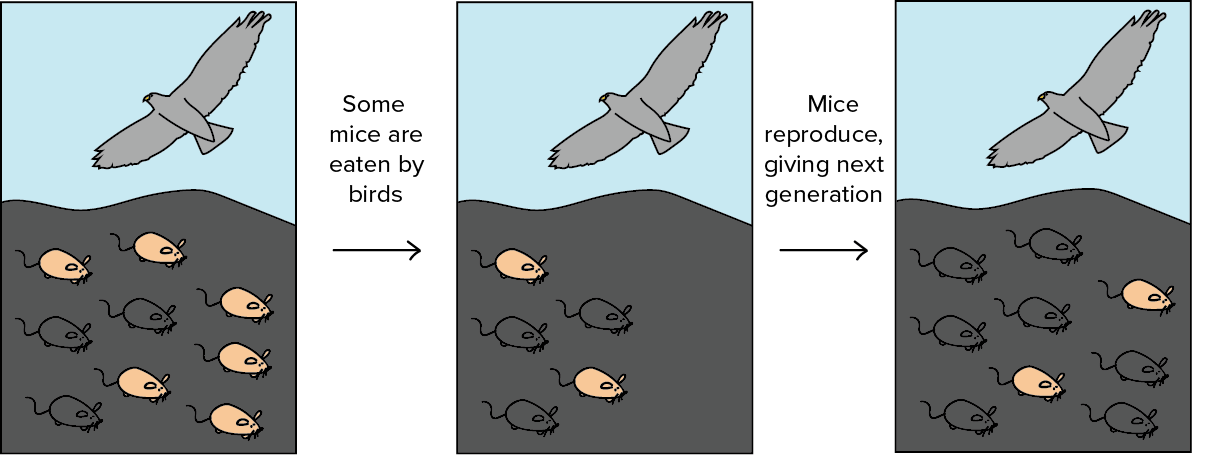
The habitat of a moth species included trees with both light and dark colored bark. Therefore, the moth species included both light and dark colored variants.
Then the light-colored trees were wiped out by a disease, and within a few years nearly all the moths in this forest were dark colored .
Which of the following choices BEST explains what happened?
The light moths changed their wing pigments to darker colors to avoid being eaten.
The light moths that survived all had dark offspring in order to adapt to the change.
The few light moths that survived did not mate, and therefore they had no offspring.
The dark moths were less visible to predators, so mostly light moths were eaten.
Phenotype variation occurs as a result of the exchange of genetic information from sexual reproduction and/or from genetic mutations.
Which of the following is true about inherited variation?
Variation can influence the amount of available food in an ecosystem
Variation can influence whether organisms are more likely to survive to reproduce.
Variation can influence the amount of rainfall in an ecosystem.
Variation can influence the resources that are available to an organism.

A single bird species only ate seeds from two different types of trees in a forest. About half of the birds had smaller beak phenotype for eating small seeds, and the other half had a larger beak phenotype for eating big seeds.
A drought occurred over several years, and it killed off nearly all of the trees with the small seeds. At the end of this dry period, most of the birds had larger beaks.
How is this best explained?
The birds with larger beaks killed and ate the birds with smaller beaks.
The small-beaked birds grew larger beaks so they could eat big seeds.
Larger beaked birds were better at eating the large seeds from the trees that survived.
A new predator arrived in this ecosystem, and it only ate small beaked birds.

The diagram shows male stag beetles with different mandible phenotypes.
---These male beetles often fight each other over food sources and to mate with female beetles.
---Males with larger mandible phenotypes have a significant advantage over those with smaller mandibles.
If food resources in these beetle’s habitat become scarce, which two mandible phenotypes will have the best chance of surviving?
Large and Small
Large and Medium
Absent and Medium
Small and Medium
One population of rabbits in a meadow near a forest in Canada contained four variants:
---1) Phenotype: rabbits with a larger tail
---2) Phenotype: rabbits with a light-colored fur (white or gray)
---3) Phenotype: rabbits with a dark-colored fur (black or brown)
---4) Phenotype: rabbits with a larger ears
From 2005 to 2016 the winters is this area lasted much longer than usual, and there was increased snowfall.
Which variant of rabbits most likely benefited during this period of climate change?
Rabbits with lighter colored fur benefited and increased in numbers.
The rabbits with larger tails had a significant advantage over the other rabbits.
Rabbits with darker colored fur benefited and increased in numbers.
The rabbits with larger ears were the best adapted to this change in climate.

Examine the pictures of various tortoises that live in different locations in the Galapagos Islands.
Based on the pictures shown above of these three tortoises, which of the following is the best explanation of why they have different neck lengths?
Over many generations the tortoises with the most effective neck length phenotypes survived to reproduce as they adapted to the unique environment on each island.
The Pinta Island tortoise has a medium neck because they are a hybrid of the Hood and Isabela Island tortoises. Their neck length is not related to their environment.
The Hood Island tortoise has a long neck because there is plenty of food resources on their island, so their long neck allows them to reach up to eat plant leaves.
The Isabela Island tortoise has a short neck because there is limited food resources on their island, so they do not need to reach very far.
If the environment is constantly changing, which organisms are most likely to survive?
Organisms that do not change at all
Organisms that change slightly, one time
Organisms that are constantly adapting
What happens if too many organisms within a species are not able to adapt?
the species will most likely go extinct
the species evolves into a new species
the species continues to live in its habitat
the species will remain the same
Which of the following is the correct definition for a genotype?
The physical expression of a gene. (Characteristics)
A strand of DNA made up of multiple mutations.
The expression of one of your parents traits.
The set of genes in our DNA which is responsible for a particular trait.
have the ability to interbreed.

The Canyon Spotted Whiptail and the Sonoran Spotted Whiptail are lizard species that live in the same desert. Canyon Spotted Whiptails reproduce sexually, but the Sonoran Spotted Whiptails reproduce asexually.
Which lizard species is more likely to survive a drastic sudden change in climate?
Sonoran Spotted Whiptails are more likely to survive because all members of the species can reproduce.
Sonoran Spotted Whiptail are more likely to survive because their genetic similarities will keep the species stable
Canyon Spotted Whiptail are more likely to survive because sexual reproduction results in greater genetic diversity.
Canyon Spotted Whiptail are more likely to survive because species with male and female members produce more offspring.
Phenotype variations appear due to the results of sexual reproduction and/or due to mutations.
If a mutation introduces a new skin color in a lizard population, which factor might determine whether the frequency of this new phenotype will increase?
whether the mutation resulted from harmful chemical introduced into the ecosystem as pollution
whether the mutation makes some lizards more fit for their environment than other lizards
whether the mutation was caused by nature (natural selection) or by human intervention (artificial selection)
whether the mutation formed due electromagnetic radiation or excessive solar radiation

Three species of birds live on a remote island in the Pacific Ocean.
If the climate changed so that all the seed-bearing plants on the island died off, which bird or would probably be the least affected?
Bird A
Bird B
Bird C
All birds would be greatly impacted

A termite population was sprayed with insecticide. After being sprayed, the number of surviving termites were counted and recorded. This process was repeated for six generations. The results are shown the table below.
Which statement best explains why later generations had higher percentages of termites that survived?
Earlier termite generations had larger numbers of old and weak individuals.
Earlier termite generations had smaller population numbers than later generations.
Later termite generations were better at avoiding the insecticide spray effects.
Later termite generations were the offspring of those with resistance to the insecticide.

John was not feeling well, and he therefore was seen by his doctor. It was determined that John had a bacterial infection in his lungs (pneumonia). John was prescribed amoxicillin, an antibiotic, to fight the infection. He was supposed to take one pill three times a day for three days. However, after the second day, John felt much better and he stopped taking the antibiotic pills (see table below).
By the fifth day he was feeling unwell again and was having a difficult time breathing.
Which diagram below most likely represents the bacterial population in his lungs on day five?



