
 Worksheets
Waves
Total questions: 35
Worksheet time: 3hrs 42mins

Which letter(s) represent the crest of the wave?
A & E
B & D
C & E
C & F

Which letter(s) represent the trough of the wave?
A & E
B & D
C & F
C & E

Which term is used to identify the distance between points A & E?
Amplitude
Crest
Frequency
Wavelength
Which term is used to identify the distance between points A & B?
Amplitude
Crest
Frequency
Wavelength
Which term is used to identify the line at point B?
Amplitude
Baseline
Frequency
Wavelength

What is a wavelength?
How many waves pass a certain point each second
The distance from one wave crest to another
The entire length of a wave
The height of the wave from the baseline to the crest.
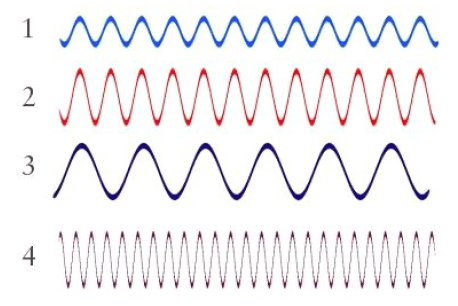

Which has the longest wavelength on the EMS (electromagnetic spectrum)?
Radio Waves
Visible Light
Gamma Rays
X-Rays

A change in wavelength is displayed by what property of visible light?
Intensity
Brightness
Color
Reflectivity
What is a frequency?
How many waves pass a certain point each second.
The distance from one wave crest to another.
The entire length of a wave.
The height of the wave from the baseline to the crest.

A change in frequency is displayed by what property in sound?
Loudness
Static
Softness
Pitch

What is amplitude?
How many waves pass a certain point each second.
The distance from one wave crest to another.
The entire length of the wave.
The height of the wave from the baseline to the crest.

Amplitude is directly related to what other wave property?
The energy of the wave
The velocity of the wave
The period of the wave
The medium a wave travels through

A change in amplitude is displayed by what property in sound?
Loudness
Static
Softness
Pitch

Waves move ___ through vibrations
Mass
Matter
Energy
Weight
In transverse waves, the direction of energy is _________ the direction of particle motion?
Parallel to
Perpendicular to
Greater than
Less than
In Longitudinal waves, the direction of energy is _________ the direction of particle motion?
Parallel to
Perpendicular to
Greater than
Less than

What kind of wave is pictured above?
Compressional wave
Transverse wave
Longitudinal wave
Rolling wave

What kind of wave is pictured above?
Electromagnetic wave
Longitudinal wave
Transverse wave
Rolling wave

Light waves are which of the following wave types?
(select 2)
Mechanical waves
Electromagnetic waves
Transverse waves
Longitudinal Waves

Sound waves are which of the following wave types?
(select 2)
Mechanical waves
Electromagnetic waves
Transverse waves
Longitudinal waves

What can electromagnetic waves travel through?
(select all that apply)
Solids
Liquids
Gases
Empty Space

Which are properties of a mechanical wave?
(select all that apply)
Can be longitudinal or transverse
Can move through empty space
Requires matter to move
Carries energy

Any material that a wave travels through is called a ____________________.
Vibration
Compression
Medium
Particle

Waves that require a medium are called
Transverse waves
Electromagnetic waves
Gamma waves
Mechanical waves

Which of the following is NOT a mechanical wave?
Sound
Light
Water
Seismic

Which type of wave travels fastest
Water
Sound
Light
Seismic

You cannot hear sound in outer space because
Space is a medium
Space is a vacuum
Space has particles
Space has no light

When light passes through a prism, why do you see different colors?
A prism reflects all wavelengths
A prism absorbs all wavelengths
Different wavelength bend at different angles as they pass through the prism.


When light hits the shirt in the picture, which color(s) will reflect?
Red
Indigo
Orange
Violet
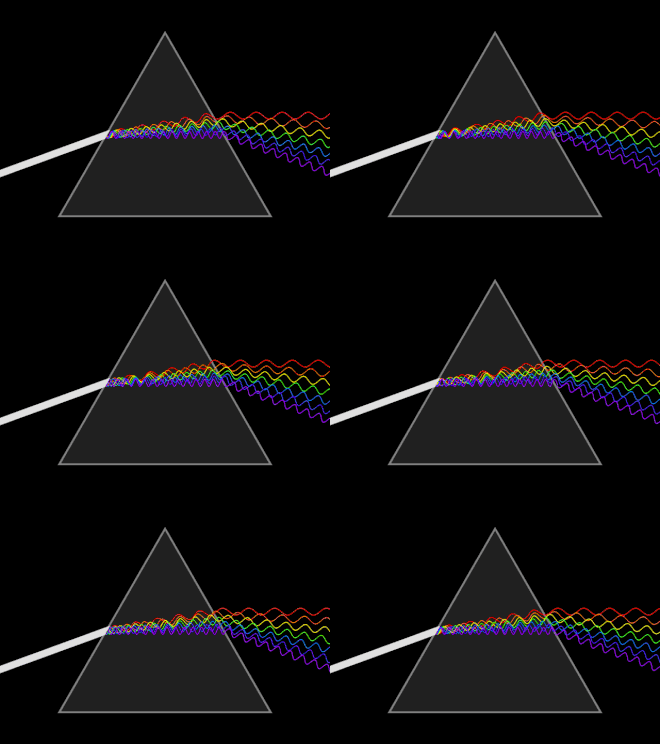
When light hits something like a raindrop or a prism, it will...
Absorb
Refract
Reflect
Transmit unchanged

What does it mean when the energy from a wave is absorbed?
It reflects back
It bends or scatters
It is transmitted
None of these

To transmit means to
Pass through
Bounce back
Spread out
Store inside

How is digital information transmitted?
Through mechanical waves from one point to another
As pulses through a medium only
Through changes in the frequency of electromagnetic waves
By adjusting the amplitude of various sound waves

The Doppler Effect can be described as a change in ________ of sound or other wave as the source and observer move toward or away from each other.
Frequency
Amplitude
Energy
Speed

