
 Worksheets
Lesson 8.1 Review
Total questions: 20
Worksheet time: 2hrs 40mins
The current through a 10-ohm resistor is 1.2 amperes. What is the potential difference across the resistor?
8.3 V
12 V
14 V
120 V
During a thunderstorm, a lightning strike transfers 12 coulombs of charge in 2.0*10^-3 seconds. What is the average current produced in this strike?
1.7*10^-4 A
2.4*10^-2 A
6.0*10^3 A
9.6*10^3 A
In a simple circuit, a 110-volt electric heater draws 2.0 amperes of current. What is the resistance of the heater?
0.018 Ω
28 Ω
55 Ω
220 Ω
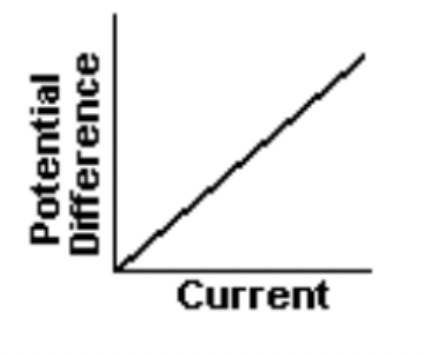
The slope of the line on the graph represents
resistance of a material
electric field intensity
power dissipated in a resistor
electrical energy
What is the resistance of a 20.0-meter-long tungsten rod with a cross-sectional area of 1.00*10^-4 meters squared at 20 degrees Celsius?
2.80*10-5 Ω
1.12*10-2 Ω
89.3 Ω
112 Ω
If the diameter of a wire were to increase, its electrical resistance would
decrease
increase
remain the same
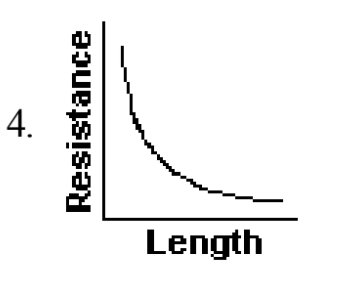
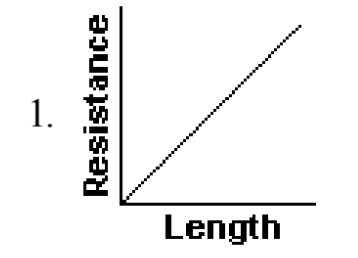
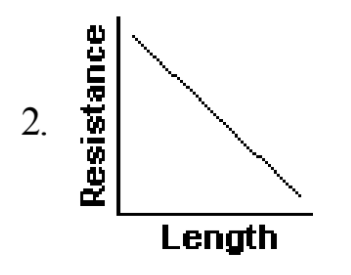
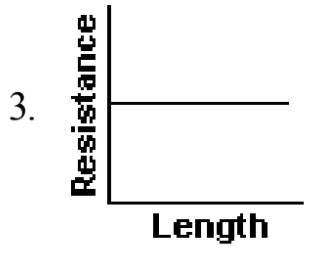
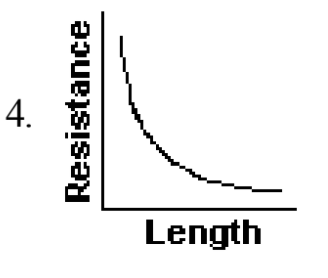
Which graph below bests represents the relationship between the resistance of a copper wire of uniform cross-sectional area and the wire's length at constant temperature?
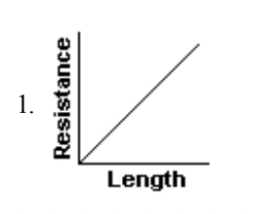
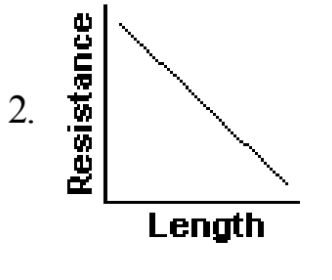
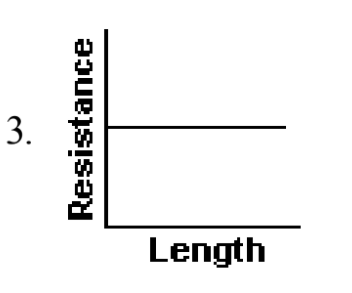
How much current flows through a 12-ohm flashlight bulb operating at 3.0 volts?
0.25 A
0.75 A
3.0 A
4.0 A
Which if the following units is NOT one of the units used for work?
joules
electronvolt
ampere
watt-second
The amount of work required to move charge across a potential difference of 32 volts was 96 electronvolts. What is the value of the charge?
0.333 e
3 e
4.8*10-19 e
3072 e
A 0.500-meter length fo wire with a cross sectional area of 3.14*10^-6 meters squared is found to have a resistance of 2.53*10^-3 ohms. According to the resistivity chart, the wire could be made of
aluminum
copper
nichrome
silver
Which scenario would result in the smallest resistance value at room temperature for a copper wire?
Keeping the cross-sectional area and the length of the wire the same
Keeping the cross-sectional area the same and doubling the length of the wire
Doubling the cross-sectional area and keeping the length of the wire the same
Doubling both the cross-sectional area and the length of the wire
If the cross-sectional area of a metallic conductor is halved and the length of the conductor is doubled, the resistance of the conductor will be
halved
doubled
unchanged
quadrupled
Which graph below best represents the relationship between the resistance of a copper wire of uniform cross-sectional area and the wire's length at constant temperature?
In a flashlight, a battery provides a total of 3.0 volts to a bulb. If the flashlight bulb has an operating resistance of 5.0 Ω, the current through the bulb is
0.30 A
0.60 A
1.5 A
1.7 A
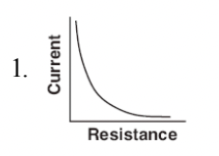
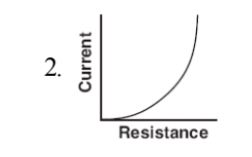
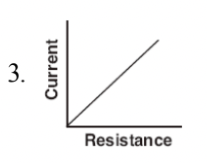
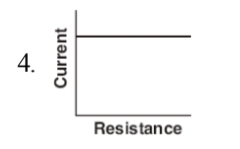
An electric circuit contains an 'ohmic' resistor connected to a source of a constant potential difference. Which graph best represents the relationship between current and resistance in this circuit?
The current through a light bulb is 2.0 amperes. How many coulombs of electric charge pass through the light bulb in one minute?
60 C
2.0 C
120 C
240 C
The current traveling from the cathode to the screen in a television picture tube is 5.0*10^-5 ampere. How many ELECTRONS strike the screen in 5.0 seconds?
3.1*1024
6.3*10-2
1.6*1015
1.0*105
If 4.8*10^-17 joule of work is required to move an electron between two points in an electric field, what is the electric potential difference between these points?
1.6*10-19 V
4.8*10-17 V
3.0*102 V
4.8*102 V
According to Ohm's Law, current equals the potential difference divided by
Inductance
Capacitance
Conductance
Resistance

