
NEW
Font size
 Worksheets
Topic 1 Method, Data, and Microscope review
Total questions: 20
Worksheet time: 24mins
Scientists frequently repeat the experiments of others scientists. Why is this important in science?
Scientists often ask each other for help in performing experiments.
Replication of experiments helps to confirm and verify results.
Scientists frequently perform other scientists’ experiments in order to practice their technique.
Repeating experiments is an effective way to make sure a laboratory is in optimal condition.
Cara read an article on why repetition and replication are so important, but she did not understand the difference between them. Which of the following best explains the two terms?
Repetition is when a scientist repeats an experiment; replication is when a scientist conducts an experiment on genetic material.
Repetition is when a scientist does the same experiment a number of times; replication is when other scientists reproduce a scientist’s experiment.
Repetition is when a scientist publishes in more than one scientific periodical; replication is when another scientist reproduces another scientist’s results.
Repetition is when a scientist commits an error in an experiment the first time and must repeat it; replication is when a scientist repeats an experiment to make sure it is valid.
Kaylee reads an article that states that the frequency of chirping by crickets is related to the temperature of
their environment. She wants to conduct an experiment to see if this is true. Kaylee states this hypothesis:
Crickets chirp more frequently when the temperature of their environment increases. What is the test
variable (independent variable) and outcome variable (dependent variable) in Kaylee’s experiment?
a.test variable (independent variable): number of crickets; outcome variable (dependent variable): frequency of chirping
b. test variable (independent variable): temperature of environment; outcome variable (dependent variable): frequency of chirping
c. test variable (independent variable): number of crickets; outcome variable (dependent variable): temperature of environment
d. test variable (independent variable): frequency of chirping; outcome variable (dependent variable): temperature of environment
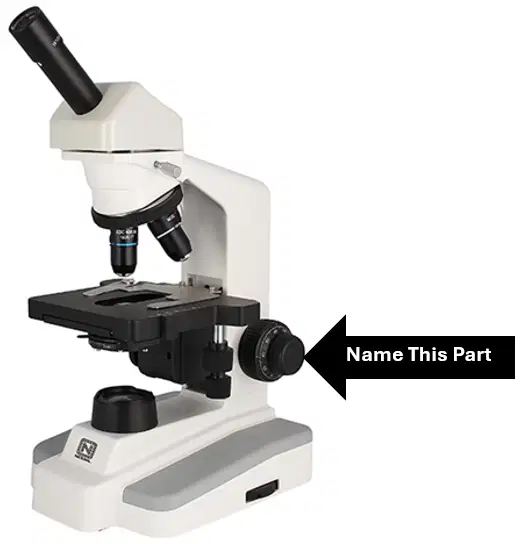
Identify this part of a compound light microscope
Objective Lens
Rack Stop
Eye Piece
coarse focus
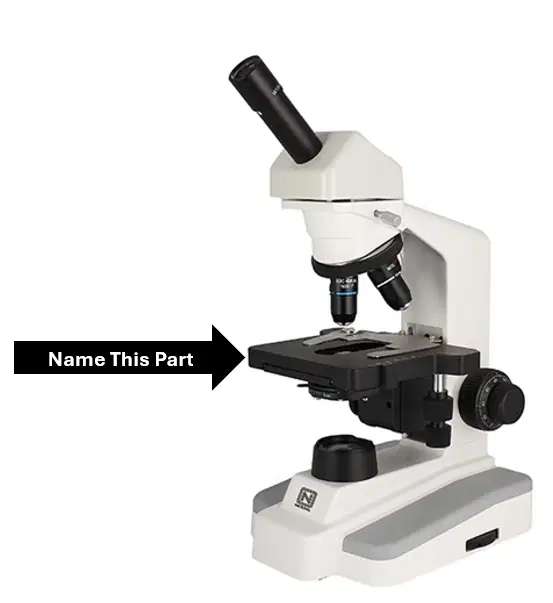
Name this part of a Compound Light Microscope
Objective Lens
Coarse Focus
Stage Clip
Stage
What is the dependent variable?

Jill wanted to see which type of food her rabbit liked the most. For several days she feed the rabbit equal amounts of cabbage, lettuce and apples. She recorded the results in the chart. Based on these results, she can conclude that
all rabbits prefer cabbage over apples and lettuce
her rabbit will likely eat lettuce first over cabbage and apples
her rabbit will likely eat cabbage over apples and lettuce
all rabbits prefer lettuce over cabbage and apples

The graph shows the relationship between pressure and the depth in the earth's layers as rock is formed. Which statement summarizes the cause-and-effect relationship that the graph shows?
As the amount of pressure increases, the depth decreases
As the amount of pressure decreases, the deph increases
As the amount of pressure increases, the depth increases
As the amount of pressure decreases, the depth remains the same

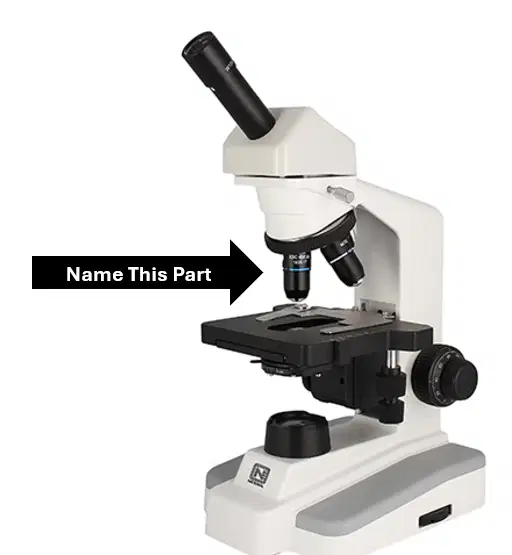
Name this part of a Compound Light Microscope
Coarse Focus
Objective Lens
Stage
Eye Piece
A scientific idea tested by multiple scientists and supported by multiple pieces of tested factual qualitative evidence that can be modified if improved technology produces new evidence is called:
Scientific Theory
Scientific Law
Hypothesis
Qualititative Data
What is a hypothesis
An idea in science
A question used to investigate a phenomenon
An idea backed by tested factual evidence
Data and facts from experimentation
An experiment
Marcia did an experiment to find out whether tulips grow faster under fluorescent lighting or incandescent lighting. Under flourescent lighting, Marcia's plants grew 1.5 cm taller in two months. She gave her notes to Alex, who did the same experiments with similar results. Which term describes Alex's experiment?
plagiarism
replication
pseudo science
repitition

What is the outcome (DEPENDENT) variable?
plant height
time in days
sunflower
daisy
Identifying the Test (Independent) Variable and Outcome (Dependent) Variable in an experiment will help you interpret results. What is the difference between the Test (Independent) and the Outcome (Dependent) Variable in an experiment?
Test Variable changes due to the outcome variable, the Outcome Variable is what is measured in an experiment.
Test Variable changes due to the outcome variable, the Outcome Variable is what stays the same in an experiment.
The Test Variable is what we change in an experiment, and the Outcome Variable is what changes as a result of that change.
The Test Variable is what is measured in an experiment, and the Outcome Variable is what changes as a result of that change.
Fred and Barney were given an assignment to go to a school basketball game and write down everything they each saw, heard, smelled, and touched. Afterwards the two students were to compare and contrast their findings and write up a summary of their combined data. In this case when they wrote down what they saw, heard, smelled and felt was considered?
They were creating a hypothesis
They were making inferences
They were writing down their observations
None of the above
Cindy placed three beehives with the same mass into separate (but identical) glass containers. Hive A was kept at 10 degrees Celsius (˚C), Hive B was kept at 29 ˚C, and Hive C was kept at 37 ˚C. For the next month she measured the amount of honey each hive produced. Hive B produced more than the other two hives.
What is the Manipulated (INDEPENDENT) variable in her experiment?
The temperature of each hive
The number of hives
The mass of each hive
The amount of honey produced
What is the best definition of the term "theory", as it’s used in science?
What is the best definition of the term "theory", as it’s used in science?
It is well tested set of ideas that explains events that occur in nature.
A theory is based on laws that can be proven true.
It is a hypothesis that has been confirmed

