wayground logo

Free Printable Worksheets

NEW

Font size

S
M
L
XL
Worksheets

Six Week Test: Grade 9

Total questions: 45

Worksheet time: 2hrs 34mins

Name
Class
Date
1.
What size resistor would produce a 3 Amp current flow with a 12 Volt battery
a)
1 Ohm
b)
3 Ohms
c)
4 Ohms
d)
12 Ohms
2.
What is current measured in?
a)
Ω (Ohms)
b)
V (Volts)
c)
A (Amps)
d)
W (Watts)
3.
What is resistance measured in?
a)
Ω (Ohms)
b)
V (Volts)
c)
A (Amps)
d)
W (Watts)
4.
What is Resistance?
a)
The flow of electrons
b)
Electric potential difference
c)
A battery
d)
The ability to reduce the flow of electrons
5.
The mathematical relationship among Voltage, Current, and Resistance
a)
Faraday's Law
b)
Tesla's Law
c)
Edison's Law
d)
Ohm's Law
6.
Current times Resistance equals
 (I X R)
a)
Power
b)
Voltage
c)
Amperage
d)
Ohm
7.

What is the current in a circuit with 6 ohms of resistance and a battery containing 24 Volts?

a)

1/4 A

b)

144 A

c)

4 A

d)

0.4 A

8.

What is the resistance of a lightbulb that experiences 9 Volts and 3 amps of current?

a)

1/3 ohms

b)

3 ohms

c)

27 ohms

d)

9 ohms

9.
How do you calculate voltage?
a)
Current X Resistance
b)
Resistance ÷ Current
c)
Current ÷ Resistance
d)
Measure it with a ruler
10.

What is voltage?

a)

the amount of push the electrical source supplies to the circuit

b)

how much a given device resists the flow of electric current

c)

flow of electric charge

d)

none of the above

11.

What is current?

a)

the amount of push the electrical source supplies to the circuit

b)

how much a given device resists the flow of electric current

c)

flow of electric charge

d)

none of the above

12.

What is the current in a circuit with 9 ohms of resistance and a battery containing 36 Volts?

a)

.25 A

b)

324 A

c)

4 A

d)

0.4 A

13.

What resistance is needed to cause a 2A current flow because of a 220V battery?

a)

222 Ώ

b)

110 Ώ

c)

440 Ώ

d)

.0090 Ώ

14.
This circuit has a 24 volt battery and the resistor is 8 ohms. How many amps are running through the circuit?
a)
3 Amps
b)
192 Amps
c)
2 Amps
d)
4 Amps
15.
If the hair dryer and the vacuum cleaner are both on, what is the power used?
a)
2600 watts
b)
400 watts
c)
2200 watts
d)
1100 watts
16.
Electrical power can be calculated using
a)
Resistance x Voltage
b)
Voltage x Current 
c)
Voltage ÷ Current
17.

What is the unit of Electrical Power?

a)

Joule

b)

Watt

c)

Where

d)

Amp

18.

In order for electricity to flow through a circuit, the circuit must be a closed, complete:

a)

Path, so that the electricity can make a complete circle.

b)

Donut, because circuits get hungry.

c)

Wire, made out of rubber.

d)

Solar panel, because circuits only work with the sun.

19.
Metal is used to make electrical wires because_______.
a)
It allows an electric current to freely flow.
b)
It slows electric currents from flowing.
c)
It is very cheap.
d)
It is very expensive.
20.
Which of these materials is a good insulator?
a)
Plastic and metal
b)
Metal and rubber
c)
Plastic and rubber
21.
What are three things all circuits must have?
a)
Switch, conductor, light bulb
b)
Switch, conductor, power source
c)
Power source, conductor, load (light bulb)
d)
Conductor, resistor, switch
22.
What is the type of circuit that stops working when one bulb goes out?
a)
A broken circuit
b)
Parallel Circuit
c)
Series Circuit
d)
A metal circuit
23.
Material that electricity can easily flow through
a)
Insulators
b)
Rubber
c)
Conductor
d)
Wood
24.

Solve for all unknown values:

a) Find the total resistance

b) Find the total current

a)

18 ohms, 2 A

b)

18 K ohms, 2A

c)

18K ohms, 0.0005 A

d)

18 K ohms 0.0005 V

25.

Calculate the total resistance of the parallel circuit.

a) total current flowing in the circuit.

a)

0.625 ohms, 144A

b)

0.625 ohms, 14.4 A

c)

6.25 ohms, 14.4A

d)

0.625 ohms, 14.4 V

26.

Solve for all unknown values:

a) Find the voltage through Resistor 2

b) Find the current through resistor 1

a)

1.5 volts, 2000A

b)

2.5 volts, 0.0005A

c)

5 volts, 0.0005A

d)

5 volts, 2000A

27.

Find the total resistor value, the total current (I) passing through the circuit and the voltage across resistor one in the circuit below.

a)

57.1 Ω, 0.01 A, 1 v

b)

70 Ω, 0.1 A, 1 v

c)

700 Ω, 0.01 A, 4 v

d)

700 Ω, 0.01 A, 1 v

28.

Solve for the voltage drop at resistor 1

a)

38 volts

b)

60 Kvolts

c)

50 volts

d)

25 volts

29.

Using the circuit shown solve for total power dissipated in this circuit.

a)

20 watts

b)

30 watts

c)

1.8 Kilowatts

d)

180 watts

30.

Total series circuit wattage is equal to source voltage ____.

a)

multiplied by the voltage value going through any resistor

b)

multiplied by the current value going through any resistor

c)

divided by the current value going through any resistor

d)

divided by the voltage applied to the circuit and the total resistance of the circuit

31.

The voltage drop across R1 is ______________________________ V.

a)

20

b)

30

c)

40

d)

50

32.
How does resistance affect current?
a)
less resistance - less current
b)
more resistance - less current
c)
more resistance - more current
d)
resistance does not affect current
33.
Power  = ?
a)
Current
b)
Voltage
c)
Current X Voltage
d)
Current / Voltage
34.

When only one lightbulb blows out, an entire string of decorative lights goes out. The lights in this string must be connected in

a)

series with multiple current pathways

b)

series with one current pathway

c)

parallel with multiple current pathways

d)

parallel with one current pathway

35.
What is the resistance of a light bulb that uses 15 watts of power when placed across a 15-volt battery?
a)
1.5 ohms
b)
15 ohms
c)
50 ohms
d)
150 ohms
36.
What is the total resistance of three resistors in parallel with values of 4 ohms, 10 ohms, and 25 ohms?
a)
1.50 ohms
b)
2.25 ohms
c)
2.56 ohms
d)
3.43 ohms
37.
What is the total resistance of the circuit in the figure?
a)
19 ohms
b)
29 ohms
c)
30 ohms
d)
50 ohms
38.
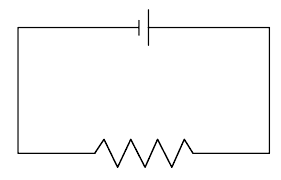
This is an example of a ______ circuit
a)
Series
b)
Parallel
c)
Open
d)
Dihexihedral
39.
This is an example of a _______ circuit
a)
open
b)
series
c)
parallel
d)
square
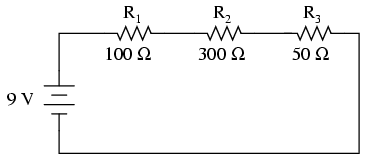
40.
The total resistance in this circuit is 
a)
100 ohms
b)
450 ohms
c)
400 ohms
d)
30 ohms
41.
The voltage dropped across the 300 ohm resistor is 
a)
6 V
b)
9 V
c)
2 V
d)
30 V
42.
As resistors are added in series to a circuit, the total resistance will...
a)
increase
b)
decrease
c)
stay the same
43.
In a parallel circuit which of the following is the same value throughout the circuit?
a)
Voltage
b)
Current
c)
Resistance
d)
Charge
44.
As the resistance of a circuit increases, the current will...
a)
increase
b)
decrease
c)
stay the same
45.

______________ are materials that electrical current cannot pass through.

a)

resistors

b)

circuits

c)

conductors

d)

insulators