
 Worksheets
Waves
Total questions: 15
Worksheet time: 8mins

This is the distance between two crests. What is this called?
amplitude
wavelength
longitude
trough

What does this picture represent?
wavelength
echolocation
amplitude
peak

Which transverse wave has the highest frequency?
1
2
3
4
What does a wave carry from place to place?
energy
matter
people
If the wavelength of a wave increased, what would happen to the frequency?
decrease
increase
stay the same
A wave that can travel through matter and empty space is a:
electromagnetic wave
longitudinal wavy
transverse wave
mechanical
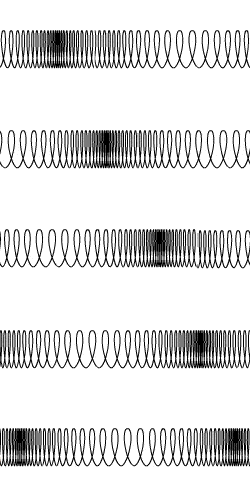
What type of wave is this?
Longitudinal
Transverse
Electromagnetic
x ray


Increasing the amplitude means you are increasing the _______________ of a wave.
frequency
amplitude
energy
wavelength
What is the amplitude of a wave?
how often a wave passes a certain point
the distance from the middle of the wave to a crest or a trough
the highest point of a wave
chick-fil-a
The wavelength of a sound wave is 20m. The frequency is 5 Hz. What is the wave speed?
4 m/s
100 m/s
25 m/s
15 m/s
Number of waves passing a given point in a certain amount of time, measured in Hertz (Hz)
wavelength
frequency
amplitude
wave speed

