
 Worksheets
simple harmonic motion
Total questions: 15
Worksheet time: 9mins
What are the two requirements for a simple harmonic oscillator?
The object vibrates about the equilibrium point and the restoring force is proportional to the displacement
The object moves left to right and the restoring force is proportional to the displacement
The object vibrates about the equilibrium and the restoring force is greater than the displacement
The object moves left to right and the restoring force is greater than the displacement
When is the pendulum at 0 velocity
At its lowest point
At its highest point
It moves at a constant velocity
It is at rest
When is the pendulum at maximum velocity
At its lowest point
At its highest point
It moves at a constant velocity
It is at rest
When does the mass move at maximum velocity in a mass-spring system?
At equilibrium
At the farthest point from the equilibrium
At its hightest point
At its lowest point
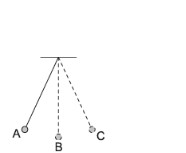
A pendulum oscillates as shown. At which of the following positions is the potential energy equal to the total energy?
A
B
C
Not enough information
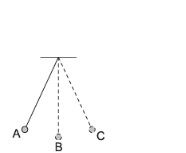
A pendulum oscillates as shown. At which of the following positions is the kinetic energy equal to the total energy?
A
B
C
Not enough information given.
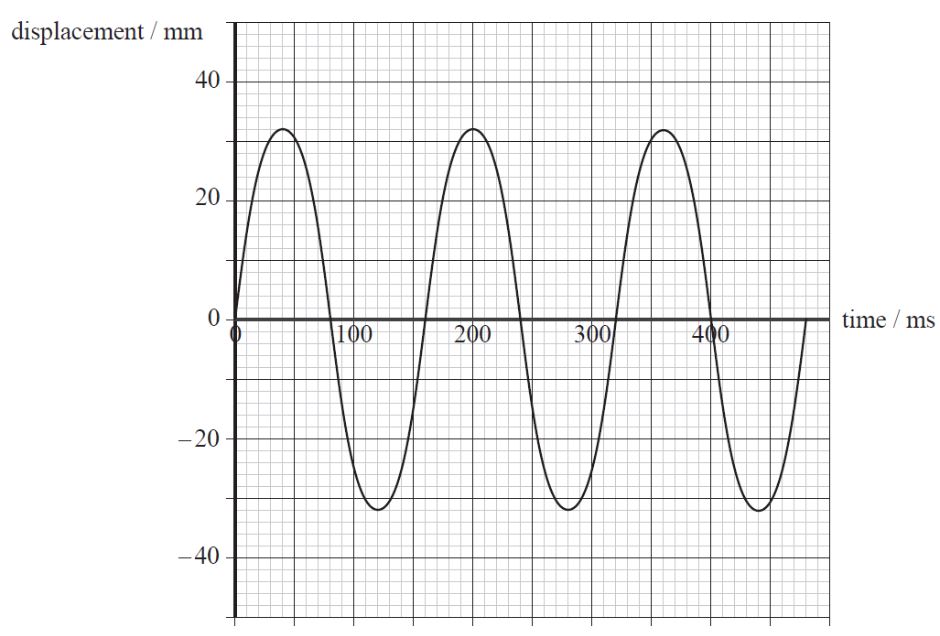
The graph shows the variation with time of the displacement of an object undergoing simple harmonic motion. At which of the following time values is kinetic energy zero?
0 ms
40 ms
80 ms
100 ms
Which one of the following statements is true when an object performs simple harmonic motion about a central point O?
The acceleration is always away from O
The acceleration and velocity are always in opposite directions.
The acceleration and the displacement from O are always in the same direction.
The graph of acceleration against displacement is a straight line.
The frequency of a body moving with simple harmonic motion is doubled. If the amplitude remains the same, which one of the following is also doubled?
the time period
the total energy
the maximum velocity
the maximum acceleration
Given an expression of a SHM
x = 10 sin (11.4t). Calculate the time taken when x=10 cm for the 1st time
0.138 s
1.24 s
11.11 s
0.79 s

