
 Worksheets
Evolution
Total questions: 22
Worksheet time: 12mins
When organisms are better adapted to their environment they will survive and reproduce more successfully than organisms less adapted. This process is called what?
Selective breeding
Natural Selection
Cloning
Evolution of all species
Which scientist visited the Galapagos Islands and came up with the theory of natural selection?
Theodor Schwann
Gregor Mendel
Charles Darwin
Rudolf Virchow

Gigantopithecus were very large primates that lived 500,000 years ago. Since none of these mammals are still today, they are said to be....
Extinct
Threatened
Endangered
Declining

Scientists have collected millions of fossils of different organisms, and have developed a timeline of life on Earth. What do we call this?
Mutation
Natural Selection
The theory of evolution
Fossil Record

Sometimes bones in the front limbs of animals are very similar in structure. What do we call similar bone structures that indicate a link to a common ancestor?
Adaptations
Gradualism
Homologous Structures
Extinction
A physical or behavioral trait that helps an organism survive and reproduce in its environment is called a what?
An adaptation
A response to a stimulus
A mutation
Evolution
What most likely caused the finches on the Galapagos Islands to have beaks that were different from the finches on the mainland?
There were different types of predators on the island.
There were different types of food available on the island.
The finches had no water to drink.
The finches on the mainland could not fly high enough.
What do we call a change in a species over time?
Adaptation
Evolution
Extinction
Environmental influences

Evolution is best defined as:
the process which organisms die.
the process which organisms change over time.
the process which organisms that are extinct become revived.
the process which non-living things fossilize.

The solidified remain or imprint of a once living thing are called:
Fossils
Homologous Structures
Vestigial Structures
DNA

Which two animals are closer relatives?
Dolphin and Wolf
Wolf and Shark
Shark and Dolphin

Which two animals are closer relatives?
Bear and Raccoon
Bear and Opossum
Opossum and Raccoon

Which two animals are closer relatives?
Human and Sponge
Sponge and Tunicate
Human and Tunicate
What caused the Horse and Whale to evolve?
They wanted to become bigger so they ate as much as they could.
Their environments changed so they had to adapt.
They wanted to look different so they changed their appearance.

Which animal is the MOST similar to the Human from the list below?
Bat
LIzard
Whale
Bird
Which animal is the LEAST similar to the Human from the list below?
Bat
LIzard
Whale
Bird
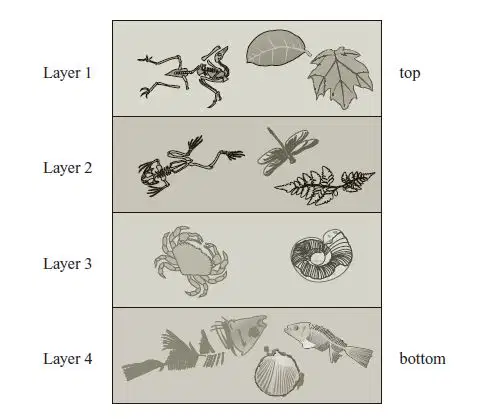
According to the picture, how has the environment led to changes over time?
Animals were able to walk in the past, but now they swim.
A species has lived there and never changed.
Animals used to swim in the past, but now they walk.
The environment was changed when animals decided to walk instead of swim.
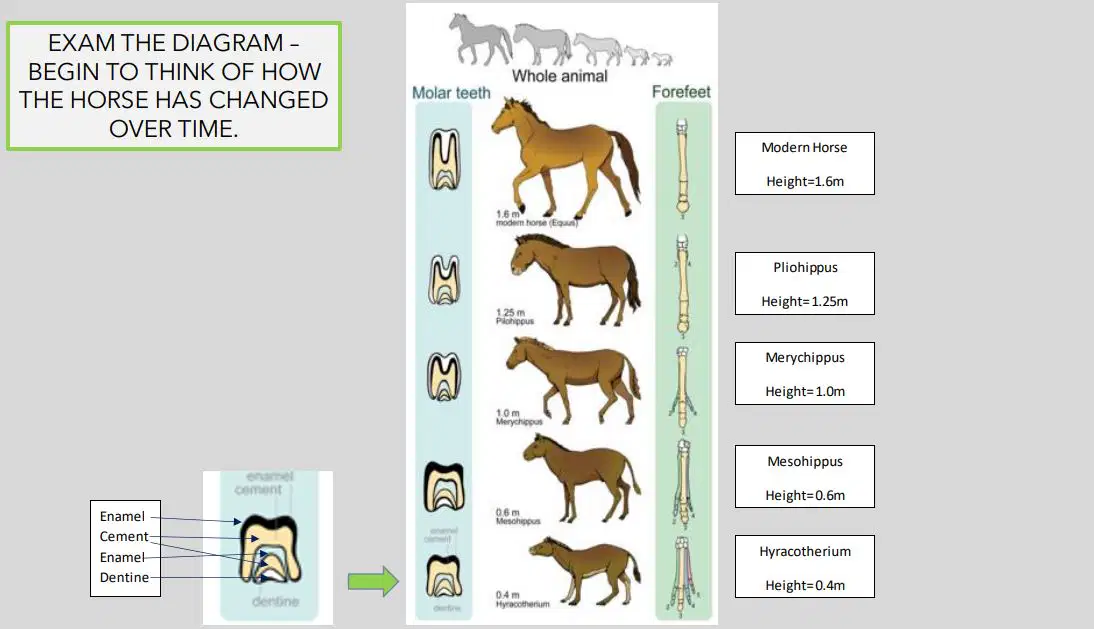
What are some changes that have occurred in the Horse over time?
teeth, feet, body
hair, color, feet
body, feet, color
Which trait MOST likely helps an animal survive in a very cold environment?
Long ears
Large eyes
Thick fur
Sharp Claws
The solidifed remain or imprint of a once living thing is called:

