wayground logo

Free Printable Worksheets

NEW

Font size

S
M
L
XL
Worksheets

Andrew Jackson and Industrial Revolution Review 2020-2021

Total questions: 53

Worksheet time: 1hrs 10mins

Name
Class
Date
1.

What is the manufacturing method that produced large quantities of uniform pieces that could replace any other identical pieces?

a)

interchangeable parts

b)

Bessemer steel process

c)

cotton gin

d)

free enterprise system

2.

What is a free enterprise economic system?

a)

People can buy, sell, and produce whatever they want

b)

People are free to farm whatever land they own

c)

People are allowed steal the innovations of patented products as their own

3.

How did the invention of the steamboat impact the United States?

a)

The steamboat allowed enslaved people to escape to the North undetected.

b)

The steamboat encouraged the growth of new cities.

c)

The steamboat reduced the need for a Transcontinental Railroad.

d)

The steamboat encouraged increased trade with foreign countries.

4.

What sparked the start of the Industrial Revolution in the United States?

a)

The War of 1812

b)

The Missouri Compromise

c)

George Washington's Farewell Address

d)

The Embargo Act

5.

Mass production led to:

a)

Products being more superior in quality

b)

Goods became less expensive

c)

Laborers received higher wages

d)

Industries moved to rural areas

6.

What is the movement from rural to urban areas called?

a)

Discrimination

b)

Colonization

c)

Inflation

d)

Urbanization

7.

Any fabric that is woven (by machine or hand) is called -

a)

interchangeable parts

b)

textiles

c)

Morse Code

d)

industrialization

8.
This machine separated the seed from cotton fibers.
a)
Spinning Mule
b)
Spinning Jenny
c)
Steam Engine
d)
Cotton Gin
9.

Present-day Oklahoma was designated as _______ in 1830.

a)

A Free State

b)

An official state in the Union

c)

A Slave State

d)

Indian Territory

10.

_____ means to reject or cancel out a law.

a)

nullify

b)

override

c)

resolve

d)

rebuttal

11.
Andrew Jackson's election victory in 1828 depended on support from
a)
the rich and well-born.
b)
Native Americans.
c)
the common people.
d)
states'  rights supporters.
12.
Which group was most hurt by Jackson's removal policy?
a)
the rich and well-born
b)
Native Americans
c)
the common people
d)
states' rights supporters
13.
Why did Jackson oppose the Bank of the United States?
a)
He thought its president was inexperienced and poorly educated.
b)
He thought it loaned too much money to farmers and workers.
c)
He thought it was unconstitutional and that it favored the rich.
d)
He thought it benefited western business owners over those in the east.
14.
What is Jacksonian Democracy?
a)
the idea that the common people should control their government
b)
the political party that supported Jackson in the election of 1828
c)
the notion that the rich and upper class should have the most power
d)
the nickname Andrew Jackson earned in the War of 1812
15.
How did tariffs affect imported goods?
a)
Tariffs lowered the prices of imported goods.
b)
Tariffs made imported goods illegal to buy.
c)
Tariffs set weight restrictions for imported goods.
d)
Tariffs raised the cost of imported goods.
16.

Which Supreme Court decision is most closely associated with the Trail of Tears?

a)

McCullough v. Maryland

b)

Gibbons v. Ogden

c)

Worcester v. Georgia

d)

Dred Scott v. Sanford

17.
Interchangeable Parts, Cotton Gin
a)
Samuel Morse
b)
Francis Cabot Lowell
c)
Cyrus McCormick
d)
Eli Whitney
18.
Samuel Morse
a)
Spinning Mill
b)
Steel Plow
c)
Telegraph, Morse Code
d)
Committees Of Correspondence
19.
Nullification Crisis
a)
Jay's Treaty
b)
John Calhoun, S.C. Threatens To Secede
c)
National Bank Declared Constitutional
d)
Indians Moved For Land & Gold
20.
Indians Removed To Oklahoma, 1/4 Died
a)
Oregon Trail
b)
Nullification Crisis
c)
Trail Of Tears
d)
Spoils System
21.
Spread Slavery
a)
Steel Plow
b)
Interchangeable Parts
c)
Cotton Gin
d)
Lowell Factory System
22.

Which of the following inventions allowed for instant long distance communication?

a)

Steamboat

b)

Spinning Jenny

c)

Telegraph

d)

Interchangeable Parts

23.

TRUE or FALSE: the Cotton Gin led to a higher demand of slaves in the South

a)

TRUE

b)

FALSE

24.

Which country suffered from a famine which led to a large number of immigrants to the U.S.?

a)

Germany

b)

Italy

c)

France

d)

Ireland

25.

During the early Industrial Revolution, production of goods went from being made in ________________ to being made in __________________

a)

homes / factories

b)

factories / homes

c)

homes / stores

d)

pubs / factories

26.

Which group below migrated from farms to the cities to work in spinning factories?

a)

Young Men

b)

Young Women

c)

Immigrants

d)

Slaves

27.
During Andrew Jackson's Presidency, the "spoil system" resulted in -
a)
federal laws being nullified by the states
b)
the expansion of the right to vote to all free males
c)
an end to political corruption in the federal government
d)
rewarding supporters of elected officials with government jobs
28.
Which political party was created to oppose Jackson?
a)
Democrats
b)
Whigs
c)
Republicans
d)
Liberals
29.
The "Trail of Tears" was an event that resulted from the-
a)
Intolerable Acts
b)
Lewis and Clark Expedition
c)
Quartering Act
d)
Indian Removal Act
30.
Which political leader argued that states could nullify federal laws?
a)
John Quincy Adams
b)
John C. Calhoun
c)
Daniel Webster
31.
Which is the best description of the works of the Hudson River School?
a)
They excelled in portrait paintings
b)
They glorified the majesty of nature
c)
They introduced abstract painting
d)
Their themes involved meetings during the "Second Great Awakening"
32.
What was President Jackson's response to the nullification crisis?
a)
He admitted that the Union was a "compact" of states
b)
He threatened to use force against South Carolina if it did not repeal its nullification policies
c)
He conceded South Carolina's right to secede
33.
What was one of the South's objections to the higher tariffs enacted by Congress?
a)
They would allow them access to cheap forign imports
b)
They would prevent domestic manufacturing from growing
c)
They would make it more difficult to export crops
34.
Threatened succession from the Union over states rights issue
a)
Georgia
b)
Alabama
c)
Missouri
d)
South Carolina
35.

Which of the following is most associated with the formation of the Democratic Party?

a)

The election of Andrew Jackson as president

b)

The use of protective tariffs

c)

The impeachment of President Andrew Johnson

d)

The abolition movement

36.

What was one effect of these events on the 1828 presidential election?

a)

Votes were cast by secret ballot.

b)

Property qualifications for voting were strengthened.

c)

Poll taxes were reduced.

d)

Voter participation increased.

37.

What was the primary question surrounding the 1832 Nullification Crisis?

a)

Can the federal government regulate interstate commerce?

b)

Can a state regulate a federal agency?

c)

Can a state overturn a federal law?

d)

Can the federal government levy taxes on states?

38.

In 1832 the Supreme Court ruled that Georgia did not have legal authority over the Cherokees living in the state. President Andrew Jackson responded to this decision by --

a)

filing another petition against the Cherokee Nation

b)

ignoring the ruling and allowing Georgia to evict the Cherokee Nation

c)

ordering state officials in Georgia to negotiate with the Cherokee Nation

d)

asking Congress to pay reparations to the Cherokee Nation

39.

Which of the following correctly completes this graphic organizer?

a)

President Jackson annexes land west of the Mississippi River.

b)

President Jackson ignores a Supreme Court ruling.

c)

President Jackson introduces a ill to Congress.

d)

President Jackson vetoes an act passed by Congress.

40.

The Hudson River School artists were influenced by the --

a)

success of social reform movements in the U.S.

b)

migration of settlers to the U.S. frontier

c)

natural landscape of the U.S.

d)

environmental effects of the U.S. industrialization

41.

What was one result of these regional differences?

a)

Cities in the South emerged as centers for textile mills.

b)

Immigrants settled in the Midwest to establish small farms.

c)

Slavery increased in the Northeast as industrialization expanded.

d)

Plantation systems in the South were replaced by large plantations.

42.
What was one major effect of the Erie Canal on the United States in the early nineteenth century?
a)
The rapid growth of cities in the Northeast.
b)
A rise in cotton exports to the United Kingdom.
c)
An increase in the cost of shipping goods to Europe.
d)
A decrease in trade between settlers and American Indians,
43.
What was one major effect of the opening of the Erie Canal?
a)
The cost of shipping goods on eastern roads increased.
b)
The number of ships passing through northern ports decreased.
c)
The cost of shipping goods from the Midwest decreased.
d)
The volume of trade passing through southern ports increased.
44.
Which of these best completes the diagram below?
a)
The demand for slaves increases in the South.
b)
More textile factories are established in the South.
c)
The number of European immigrants arriving at southern port cities increases.
d)
More tobacco and food crops are cultivated on southern plantations.
45.
Which factor accounts for this trend below?  
a)
The Second Great Awakening motivated people to join reform movements.
b)
Manifest Destiny inspired many people to become homesteaders.  
c)
Jacksonian Democracy allowed more people to vote in elections.  
d)
The Industrial Revolution encouraged people to pursue jobs in cities. 
46.
Which factor best completes this diagram below?
a)
New transportation systems.
b)
Increased government regulation.
c)
A decline in agricultural production.
d)
The growth of labor unions.
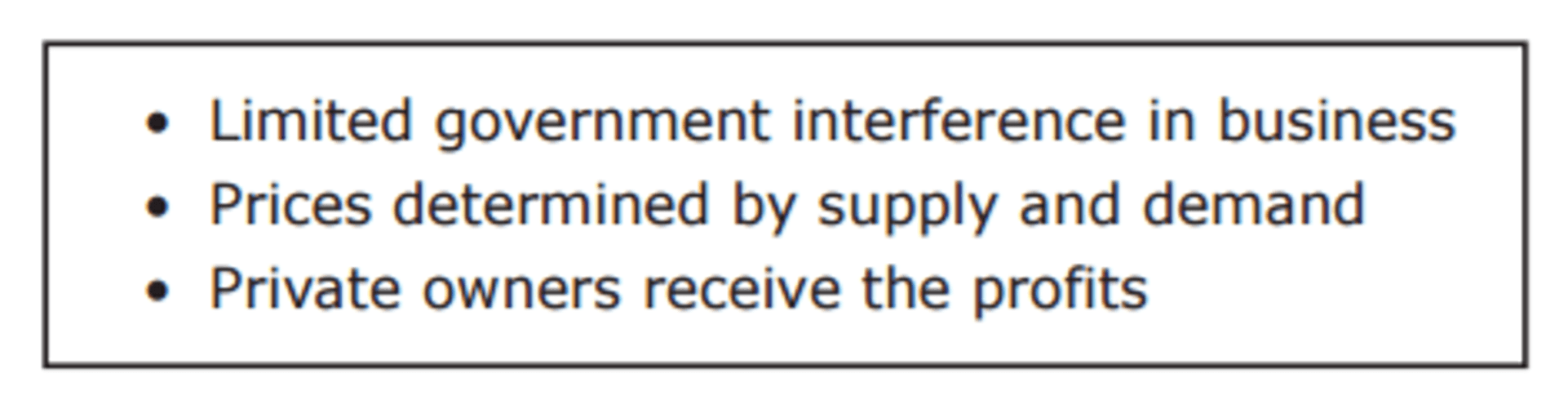
47.
Which type of economy is best described by these characteristics below?
a)
Subsistence farming.
b)
Free enterprise.
c)
Mercantilism.
d)
Socialism.
48.
Which box below lists some results of improved steamboat technology in the United States as of the mid-1830s?
a)
A
b)
B
c)
C
d)
D
49.
The innovation shown in this photograph below most affected the U.S. economy by?
a)
decreasing the need for canals.
b)
allowing more efficient movement of goods.
c)
reducing the costs of settling in western territories.
d)
transporting workers from southern states to northern states.
50.
The Bessemer steel process affected westward expansion in the United States by enabling?
a)
clipper ships to be built in order to transport passengers from the East Coast to the West Coast.
b)
interstate canal systems to be built in order to transport agricultural goods from west to east.
c)
Conestoga wagons to be built in order to carry people and goods to the West.
d)
railroads to be built in order to carry people and goods to the West.
51.
The introduction of interchangeable parts led directly to the?
a)
formation of the patent system.
b)
creation of labor unions.
c)
use of mass-production techniques.
d)
eight-hour workday.
52.
These developments below occurred as a result of increased —
a)
industrialization
b)
westward migration
c)
expansion of U.S. territory
d)
government regulation of business
53.

Which sentence best completes this diagram?

a)

Cities grew rapidly.

b)

Demand for artisans increased.

c)

Farms experienced a shortage of labor.

d)

Government regulation of factories increased.