wayground logo

Free Printable Worksheets

NEW

Font size

S
M
L
XL
Worksheets

Classification

Total questions: 52

Worksheet time: 36mins

Name
Class
Date
1.
Who organized living things by creating binomial nomenclature?
a)
Carolus Linnaeus
b)
Robert Hooke
c)
Anton van Leeuwenhoek
d)
James Watson
2.

What are the 8 levels of classification of living things from most general to most specific?

a)

domain, kingdom, phylum, class, order, family, genus, species

b)

domain, kingdom, phylum, class, order, family, species, genus

c)

domain, kingdom, phamily, class, order, family, genus, species

d)

domain, king, phillip, class, order, family, genus, species

3.
The scientific name for water bear is Hypsibius dujardini.  What is its genus?
a)
Hypsibius 
b)
dujardini
c)
water 
d)
tardigrade
4.
The scientific name for water bear is Hypsibius dujardini.  What is its species?
a)
Hypsibius 
b)
dujardini
c)
water 
d)
tardigrade
5.
How do scientists organize living things?
a)
by looks
b)
by shared characteristics
c)
by size
d)
by differences
6.
What is the science of organizing, classifying and naming living things.
a)
taxonomy
b)
taxadermy
c)
taxicab
d)
toxicology
7.
If two species share the same class, they also share the same______.
a)
phylum
b)
order
c)
genus
d)
species
8.
In a properly written scientific name, which part is lowercase?
a)
species
b)
genus
9.
In a properly written scientific name, which part is capitalized?
a)
species
b)
genus
10.
Who is the closest relative to the birds?
a)
crocodiles
b)
sharks
c)
fish
d)
amphibians
11.
Who is the closest relative to the sharks?
a)
crocodiles
b)
sharks
c)
ray-finned fish
d)
amphibians
12.
A student discovers an arachnid with a segmented abdomen, long legs, and a tail with no stinger. The student uses the dichotomous key below to identify it. Which arachnid has the student found?
a)
Whip Scorpion
b)
Wind Scorpion
c)
Daddy long legs
d)
Scorpion
13.
An illustration and a dichotomous key are given. What is the correct classification for this organism?
a)
Class Insecta
b)
Order Amblygygi
c)
Order Araneae
d)
Order Scorpiones
14.

Which of the following is the correct way to show the scientific name for tiger?

a)

Panthera Tigris

b)

Panthera tigris

c)

panthera Tigris

d)

panthera tigris

15.

Scientists group similar organisms together through a process called .....

a)

identification

b)

Estimation

c)

Classification

d)

Organization

16.
An organism that has cells that lack a nucleus are called:
a)
Eukaryote
b)
Heterotroph
c)
Prokaryote
d)
Autotroph
17.

Who created the 2 name system?

a)

Linnaeus

b)

Edison

c)

Darwin

d)

Einstein

18.

The 3 domains are Eukarya, Archaea, and

a)

Fungi

b)

Plantae

c)

Animalia

d)

Bacteria

19.

What level comes after order?

a)

genus

b)

kingdom

c)

family

d)

species

20.

What level comes before class?

a)

phylum

b)

domain

c)

order

d)

family

21.

The _________ levels that 2 organisms share, the more similar they are to each other.

a)

fewer

b)

more

22.

The 4 eukaryote kingdoms are Animals, Plants, Fungi, and

a)

Bacteria

b)

Archaea

c)

Humans

d)

Protists

23.

All living things are made of

a)

cells

b)

prokaryotes

c)

autotrophs

d)

heterotrophs

24.

Scientists place organisms into domains and kingdoms based on cell type, number of cells, and

a)

if they are able to grow.

b)

if they drink water.

c)

if they have the ability to make food.

d)

if they are able to move.

25.

What is a prokaryote?

a)

an organism that has nuclei in its cells

b)

an autotroph

c)

a heterotroph

d)

an organism without a nucleus in its cells

26.

A heterotroph

a)

cannot make its own food.

b)

is able to make its food.

27.
What step do we always start with when using dichotomous keys?
a)
1
b)
2
c)
3
d)
4
28.
Members of this kingdom never have a cell wall
a)
Animalia
b)
Plantae
c)
Archaebacteria
d)
Protista
29.
In a dichotomous key, each question contains four choices.
a)
TRUE
b)
FALSE
30.
I have cell walls
I am an autotroph
I am multicellular
What am I?
a)
Plant
b)
Animal
c)
Eubacteria
d)
Unicorn
31.
I am unicellular
I am prokaryotic
I am found in extreme ecosystems
What kingdom do I belong to?
a)
The Candy Kingdom
b)
Kingdom Plantae
c)
Kingdom Animalia
d)
Kingdom Archaebacteria
32.
Kingdom Animalia is
a)
Eukayotic
b)
Prokaryotic
c)
Pick me!
d)
No, Pick me!!
33.
Kingdom Archaebacteria is...
a)
unicellular
b)
multicellular
c)
bigger than life!
d)
really pretty, just so pretty.
34.
Members of  Kingdom Animalia are...
a)
heterotrophs.
b)
autotrophs
35.
My Kingdom includes mushrooms and yeast!
a)
Animalia
b)
Plantae
c)
Eubacteria
d)
Fungi
36.
Do prokaryotes have a nucleus? 
a)
yes
b)
no
37.
In my kingdom, we have strange and amazing members that don't seem to fit well in any of the other kingdoms.
Who am I?
a)
Plantae
b)
Animalia
c)
Oz
d)
Protista
38.
Which kingdom is prokaryotic?
a)
Animalia
b)
Archaebacteria
c)
Planta
d)
Fungi
39.
In what kingdom would you find trees and flowers?
a)
Plantae
b)
Fungi
c)
Eubacteria
d)
Animalia
40.
What is the difference between unicellular and multicellular?
a)
They are the same
b)
One has a nucleus and one doesn't
c)
Unicellular has one cell and multicellular has many 
d)
One is bacteria and the is archaebacteria
41.
I sometimes get confused by others to be a plant. I'm heterotrophic and digest decaying material. What kingdom to I belong to?
a)
Archaebacteria
b)
Animalia
c)
Fungi
d)
Protista
42.
How many kingdoms are there?
a)
3
b)
4
c)
6
d)
9
43.

Multicellular, no cell wall, moves and is heterotroph; which kingdom does it belong to?

a)

Animalia

b)

Eubacteria

c)

Fungi

d)

Plantae

44.

I have no nucleus and live in very hot liquids. Which Kingdom am I in?

a)

Fungi

b)

Protist

c)

Eubacteria

d)

Archaebacteria

45.
Which organism is MOST closely related to the common chimpanzee?
a)
grey wolf
b)
human
c)
monarch butterfly
d)
tiger snake
46.
What animal is most closely related to the American badger?
a)
Coyote
b)
European otter
c)
Gray wolf
d)
Leopard
47.
From the table, which two animals are MOST CLOSELY related
a)
House Cate and Red Fox
b)
Red Fox and Dog
c)
Dog and Wolf
d)
Wolf and Gopher
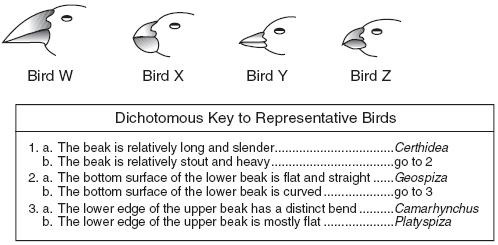
48.

What is the name of bird Z?

a)

Certhidea

b)

Geospiza

c)

Camarhynchus

d)

Platyspiza

49.
What is the name of bird W?
a)
Certhidea
b)
Geospiza
c)
Camarhynchus
d)
Platyspiza
50.
Which species’ DNA is most similar to the DNA of the toothed whale? 
a)
Hippopotamus 
b)
Baleen Whale
c)
Grazing Mammals
d)
Camels
51.
Which of the following is a term for a group of similar organisms that can reproduce fertile offspring?
a)
individual
b)
population
c)
species
d)
fossil
52.
For most living things, this characteristic of life could mean to move?
a)
Reproduce
b)
Exchanging gases
c)
Responds to environment
d)
Needs Water