
NEW
Font size
 Worksheets
Mirrors, Refraction, Lenses
Total questions: 49
Worksheet time: 2hrs 38mins


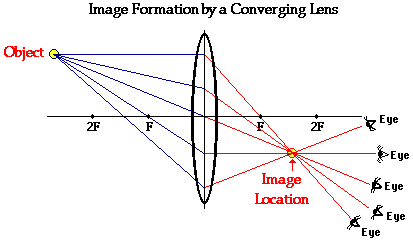


Which device uses refraction to converge light?


Which device uses reflection to diverge light?


How could a convex lens cause house fires?
Because it creates an upright image of the sun.
Because it could cause all the sunlight to diverge away from a single spot.
Because it could project a virtual image of the sun.
Because it could cause all the sunlight to converge on a single point.
Which ray diagram shows a real image?


None of the above

The ray diagram when the object is placed on the focal point shows no image. Why is no image formed?
Because the principal rays intersect on the virtual side of the lens.
Because the principal rays are parallel to each other.
Because the principal rays are perpendicular to each other.
Because convex lenses cannot form images.
Four ray diagrams show the images formed in mirrors and lenses. Which shows a virtual image?


All of the above.

Which of the following is evidence that this is a virtual image?
Virtual images are always upright.
Virtual images are always larger than the original object.
Virtual images always have converging rays.
Virtual images always have positive focal lengths.

This gif best shows
that images are always largest when an object is near the focal point
that images are always virtual for converging mirrors
that images are always larger for converging mirrors
that images are smallest when the object is on the focal point

Based on this picture, what is known about the focal length of this device?
f is positive
f is negative
there is no focal length of this device
there is not enough information to determine
An image is created whose magnification is m = +0.5. What does this value signify about the image?
A. It is virtual.
B. It is upright.
C. It is smaller than the original object
All of the above
An image is created whose di = -5 cm. What does this indicate?
The image is virtual.
The image is smaller than the original object.
The image is inverted.
The image is larger than the original object.

In the thin lens equation, do represents
Distance of the object from the lens
Distance of the image from the lens
The focal point

In the thin lens equation, f represents
Distance of the object from the lens
Distance of the image from the lens
focal length
focal point
A converging lens produces an image twice the size of the original. The object is placed 0.40 m from the lens, and the image is produced 0.80 m from the lens.
What does the 0.40 m represent?
do
di
f
1/f
A tree is located 40 m from the converging lens of focal length 0.08 m. What does the 0.08 m represent?
do
di
f
1/f
A normal human eye has a focal length of about 0.023 m. The tip of a pencil is 0.553 m from your eye. What does the 0.553 m represent?
do
di
f
1/f
The focal length of the lens in your eye is about 0.015 m. The object is 1 m from your eye. What does the 0.015m represent?
do
di
f
1/f
An object is located 35.0 cm from a convex lens. The lens forms a real image at a distance of 15.0 cm. What does the 15.0 cm represent?
do
di
f
1/f

What is the angle of reflection?
650
500
250
400

Which letter represents the angle of incidence?
A
B
C
D
An object is located 35.0 cm from a convex lens. The lens forms a real image at a distance of 15.0 cm. What does the 35.0 cm represent?
do
di
f
1/f
What is the angle of incidence?
650
500
250
400
Which letter represents the angle of reflection?
A
B
C
D
Which letter represents the angle of reflection?
A
B
C
D
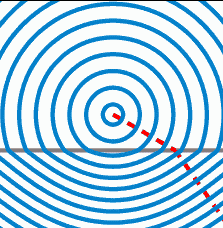
Snell's Law describes the relationship between the ________ angle and the _______ angle of waves passing through two different media
incident - reflected
incident - refracted
incident - bounced
answer is not here
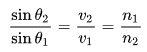
If light travels from a higher to a lower index of refraction medium the light will
bend away from the vertical axis or may not refract
bend closer to the vertical axis
not bend
answer is not here
If light travels from a lower to a higher index of refraction medium the light will
bend away from the vertical axis
bend closer to the vertical axis
not bend
answer is not here
A higher index of refraction means that the wave travels _____________ the speed of light in a vacuum in that medium.
Faster than
Slower than
Equal to
Answer is not here
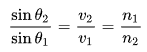
Light travels from air (n = 1.000) into an optical fiber. If the angles of incidence and refraction are 22oand 15º respectively. what is the index of refraction inside the fiber? Round off your values to 3 sig. figs.
1.45
1.44
0.69
0.70
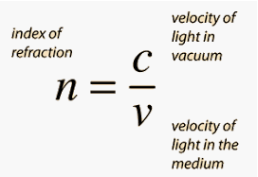
The index of refraction, is defined as the ratio of the speed of light in a vacuum (c = 3x10^8 m/s) to the speed of light in a medium. What is the index of refraction of a medium where the speed of light is 0.7c ? Round off your values to 3 sig. figs.
1.42
1.43
1.28
1.29
For light passing across the boundary from higher to lower index of refraction medium, the angle of refraction is always _________________________
greater than the angle of incidence
less than the angle of incidence
equal to the angle of incidence
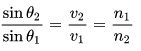
Light travels from water (n = 1.333) into an unknown medium. If the angles of incidence and refraction are 45oand 24º respectively. what is the index of refraction of the unknwon medium? Round off your values to 3 sig. figs.
2.32
2.31
0.77
0.76
There are certain angles of incidence for which the angle of refraction is close to 90°. What is this angle called?
Total internal angle
Critical angle
Reflection angle
Refracted angle

