
 Worksheets
Unit 10 Review - Electricity
Total questions: 48
Worksheet time: 25mins
What is an insulator?
a material that allows electrons to flow easily
a material that does not allow electrons to flow easily
What is a conductor?
a material that allows electrons to flow easily
a material that does not allow electrons to flow easily
a person in charge of an orchestra
A series circuit has ____ path(s) that the electric current can take.
one
two or more
infinite
zero
Electricity is the flow of _________.
Protons
Neutrons
Electrons
Water

What is a circuit with several paths for electricity to flow?
conductor
series circuit
parallel circuit
open circuit
What direction does current move in a circuit?
positive to negative
negative to positive
north to south
left to right
Devices in a parallel circuit receive
total current and different voltage than battery
equal voltage to battery, but different current from total
equal voltage & current based on total circuit
different voltage than battery, and different current from total
Devices in a series circuit receive
Equal current but different voltage from battery
Equal voltage from battery but different current from total in circuit
Equal voltage from battery and equal current from total in circuit
different voltage from battery and different current from total in circuit

In a parallel circuit
All devices receive the same current
There are 2 or more paths for current to flow
All devices always go on and off together
Each device operates with a different voltage
A light switch...
is a resistor
opens and closes a circuit
changes voltage
generates electricity
Currently only flows in...
series ciruits
parallel circuits
closed circuits
open circuits
The unit of measurement for electric current is the:
volt
ohm
ampere
resistance


Kamal walked across a carpet on a dry winter day. The results are illustrated in this drawing. What happened to Kamal’s shoes and the carpet?
Both the shoes and the carpet lost electrons.
The shoes gained electrons and the carpet lost electrons.
Both the shoes and the carpet gained electrons.
The shoes lost electrons and the carpet gained electrons.
Sandra, being quite tired and still sluggish with sleep, drags her feet across the carpet as she walks toward the bathroom. When she touches the metal doorknob, she receives an electric shock. Why?
She has generated in the door an excess of charges and the charges are released when she touches the doorknob.
She has generated in her body an excess of charges, which are then transferred to the doorknob when she touches it since metal is a good insulator.
She has generated in her body an excess of charges, which are then transferred to the metal doorknob when she touches it since metal is a good conductor.
She has generated in the door an excess of charges and the charges are released when she touches the doorknob since she is a good insulator.
Sandra knows that the small sparks from static electricity are nothing to be concerned about since they are just small transfers of electrical energy called electrical _______________.
discharge
charge separation
polarization
current

The plastic covering on the wire is there to:
Provide a conductor for electrical energy to flow.
Provide an insulator so that electrical energy will not pass outside of the wires.
Provide a conductor so that electrical energy can NOT flow.
Provide an insulator so that electrical energy can flow.
Batteries are devices that change _______________ energy into _______________ energy.
chemical, thermal
thermal, electrical
chemical, electrical
electrical, mechanical
The amount of electric charge flowing through the wire is called its
Current
Voltage
Power
Resistance
The unit used to measure how much electrical potential energy within an electrical circuit is the…
ampere (A)
watt (W)
ohm (Ω)
volt (V)
A 220 Ω resistor is connected in series with a 9 V battery in a circuit. According to Ohm’s Law, what will happen to the circuit if another 220 Ω resistor is added in series?
Total current will decrease.
Total current will increase.
Total voltage will decrease.
Total voltage will increase.
Which circuit diagram symbol would be a source of potential difference for a circuit?


Why do households use parallel rather than series circuits?
Series circuits are more complicated, so parallel circuits are used.
There is not enough electric power going into most houses to operate series circuits.
Households have several appliances that need to operate independently of each other.
Series circuits require more wires and are, therefore, more expensive.
One of the characteristics of the type of circuit in the previous question is that it has several _______________, or paths.
branches
currents
resistors
series

The diagram shows an electric circuit. Which switch(es) must be closed so that only Bulb A and Bulb B light up?
Switch 3 only
Switches 1 and 2 only
Switches 1 and 3 only
Switches 1, 2 and 3

Daniel sets up a circuit with two batteries, 3 light bulbs, X, Y and Z and some wires. One of the light bulbs, X, is broken. When he sets up the electric circuit as shown, which of the bulb(s) will remain lit?
Bulb Y only
Bulb Z only
Bulb Y and Bulb Z only
None of the bulbs

What happens when the middle bulb burns out in the circuit shown?
All bulbs go out.
Only the first stays on.
The remaining bulbs stay on.
Only the last stays on.

The picture shows an electrical circuit. This circuit is a series circuit because:
It has 3 light bulbs.
The same current flows through all three light bulbs.
It uses a single battery.
The electrical current is divided between the three light bulbs.

In which circuit will the bulbs be the brightest and why?
Circuit A, because series circuits have a single path and offer the least resistance.
Circuit B, because series circuits have a single path and offer the least resistance
Circuit A, because parallel circuits have multiple paths and offer the least resistance.
Circuit B, because parallel circuits have multiple paths and offer the least resistance.

In Circuit A, what will happen if bulb B burns out?
Both bulb A and bulb C will go out.
Bulb A will stay lit, but bulb C will go out.
Bulb A and bulb C will stay lit.
Bulb A will go out, but bulb C will stay lit.

In Circuit B, what will happen if bulb F burns out?
Both bulb D and bulb E will go out.
Bulb D will stay lit, but bulb E will go out
Both bulb D and bulb E will stay lit.
Bulb E will go out, but bulb E will stay lit.

Which bulbs are connected in parallel with each other?
A and C
B and D
A and D
C and D

When a switch is in the “ON” position,
Electrons can flow freely and the circuit is considered to be open.
Electrons cannot flow freely and the circuit is considered to be open.
Electrons cannot flow freely and the circuit is considered to be closed.
Electrons can flow freely and the circuit is considered to be closed

If a bulb is added between the battery and the switch, ____
The bulbs get brighter
The bulbs get dimmer
The bulb brightness stays the same
All the bulbs go out

If you add another bulb in parallel,_____
The bulbs get brighter
The bulbs get dimmer
The bulb brightness stays the same
All the bulbs will go out

If the top bulb goes out,
All the bulbs go out
The other bulbs get dimmer
There is no effect on the other bulbs
The other bulbs get brighter


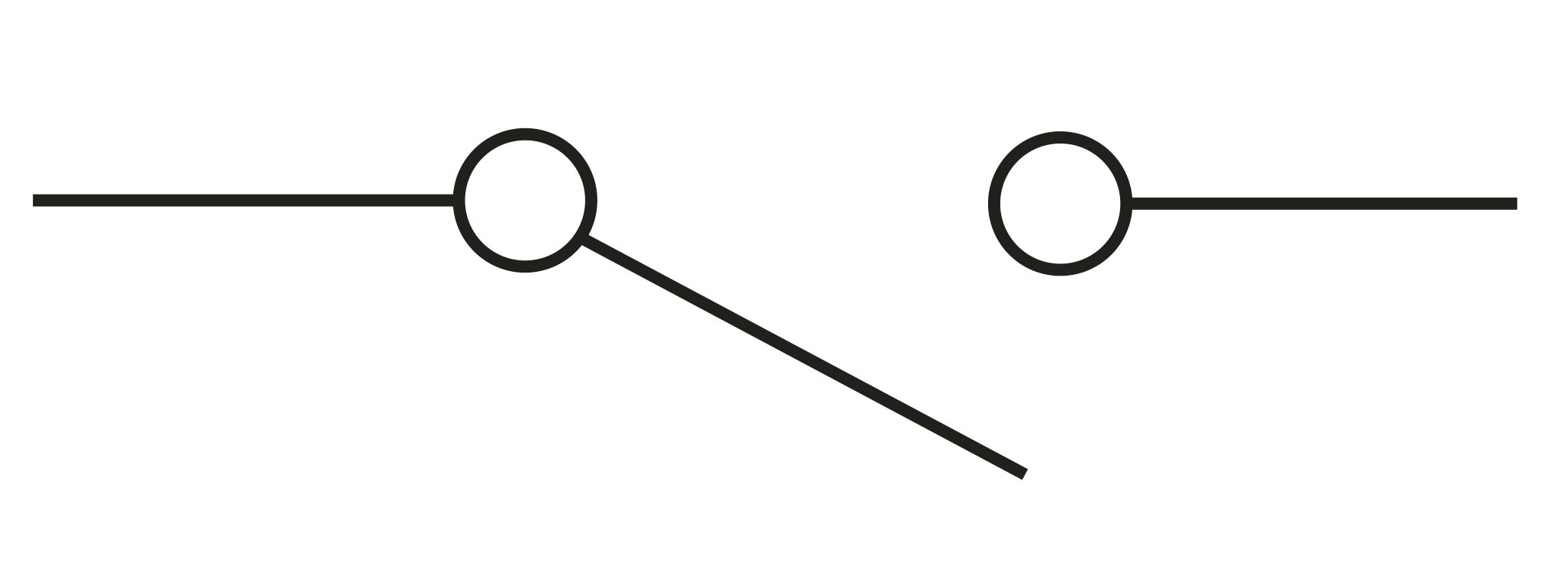
this is the symbol for a _____?
switch
light
battery
wire

