
 Worksheets
SBI3C 1.1-1.2 Quiz
Total questions: 23
Worksheet time: 26mins
Which of the following statement(s) are part of the "Cell Theory"? (you may choose more than one)
All living things are composed of one or more cells.
Cells are the basic structural and functional units of life.
All cells arise from the division of other cells.
All living things require oxygen to live
This plastid contains chlorophyll and is where photosynthesis takes place.
mitochondria
chloroplast
vacuole
cytoplasm

Correctly label A.
Cell Wall
Golgi Apparatus
Ribosome
Rough Endoplasmic Reticulum

What is the correct name and function of D?
Vacuole, water and nutrient storage.
Chloroplast, water and nutrient storage.
Vacuole, food production.
Chloroplast, food production.
Which organelle acts as the"construction worker" because it assembles proteins?
Golgi bodies
ribosomes
Chloroplasts
Mitochondria

Phospholipid Bilayer
A
B
C
D
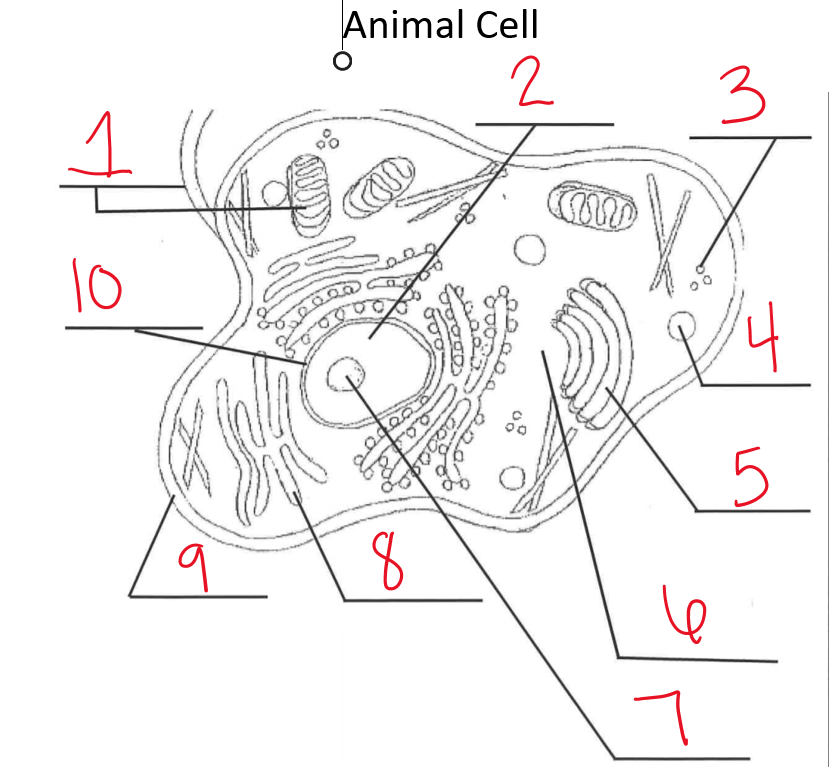
What organelle is labeled #1?
Mitochondria
Vacuole
Chloroplast
Nucleus

Channels proteins to transport vesicles, has attached ribosomes
Rough Endoplasmic Reticulum
Smooth Endoplasmic Reticulum
Golgi Apparatus
Vesicle

Contains most of the genes that control the eukaryotic cell. Contains the nucleolus and chromatin.
Nucleoid
Nucleus
Chromosome
Plasmid

Consists of flattened, membranous sacs; receives transport vesicles from the ER, modifies ER proteins, produces secretory vesicles
Smooth Endoplasmic Reticulum
Rough Endoplasmic Reticulum
Golgi Apparatus
Lysosome

Forms the boundary of the cell, acts as a selective barrier allowing certain materials to pass but not others
Cell Wall
Cytoplasm
Cell Membrane
Nuclear Membrane


Which type of microscope is the MOST suitable for observing the surface of a virus?
Transmission Electron Microscope
Confocal Microscope
Light Microscope
Scanning Electron Microscope
Why do muscle cells contain more mitochondria than fat cells do?
Why are plant cells generally firmer than animal cells?
Explain why cells vary so much in shape.

