
NEW
Font size
 Worksheets
Evolution CFE Mini-review
Total questions: 30
Worksheet time: 29mins
Individual organisms undergo evolution.
True
False
A phenotype that improves an organism’s chance of survival in their environment is considered a(n) ____________.
natural selection
adaption
speciation
Eyes that can see in the dark is a(an) _______ inherited by nocturnal animals.
adaptation
acquired trait
learned ability
Evolution, gravity, and plate tectonics are all examples of scientific...
hypotheses
theories
laws

Homologous structures such as the forelimbs of humans, cats, whales, and bats show evidence of what?
different ancestors evolving in similar ways
a big coincidence
a shared common ancestor


the fossils show similarities to each other
What are fossils?
Are the remains or evidence of once-living organisms
Is the change over time in populations of related organisms
A chart that divides Earth’s history into different time units
Occurs when the last individual organism of a species dies

In the model are rock strata and fossils. The fish fossil is in the first layer of the rock strata, is this the youngest or oldest fossil in these rock strata layers?
Youngest
Oldest

A scientist drew some diagrams of ancestors of elephants based on fossil evidence. Which is the BEST conclusion that can be made from comparing the diagrams?
Ancient elephants were better adapted than modern elephants.
Elephant habitats have remained the same over time.
Elephant ancestors stretched their trunks and had babies with longer trunks.
Elephant species have changed over time.
Fossil record
Anatomical Structures
4. Finding fossils of coral reefs in the Nevada desert provides evidence that:
a) Nevada used to be much colder than it is today
b) an ocean once covered what is now Nevada
c) there was a mistake because no coral reefs exist in deserts
d) ancient corals used to live on land
7. What evidence is used to understand that the early ancestors of whales walked on land?
a) all mammals walk on land
b) the presence of blubber
c) the change in the shape of their limbs (flippers and tail)
d) the absence of hair
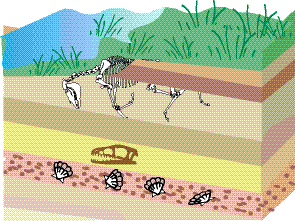
According to the law of superposition, the oldest fossils are found
At the top of the rock layers
Near the bottom of the rock layers
Somewhat near the surface
Which word describes the word "variation"?
Adaptations
Differences
Traits
Genetics
Which of the following is an environmental pressure that might affect the survival of a species?
Predators
Seasonal Changes
Disease
All of the Above
Which of the following can be learned by using the fossil record?
When organisms changed or evolved
when organisms appeared on Earth
when organisms became extinct
All the above
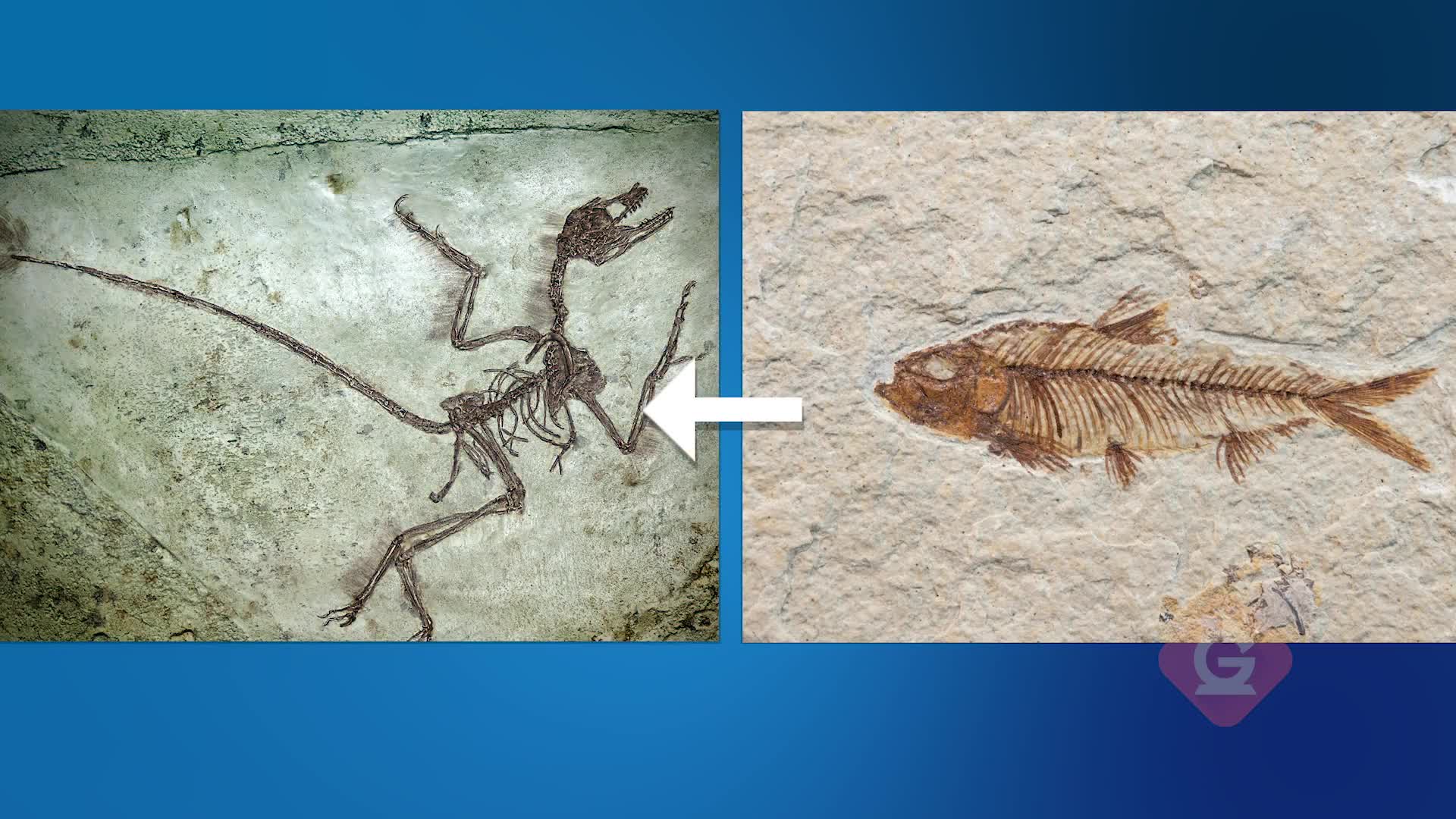
A scientist described two modern-day species as sharing a common ancestor. What does it mean when two species share a common ancestor/
It means that the two species are actually the same species
It means that one of the species evolved from other species
It means that both species evolved from one species that lived in the past.

Which species of mouse will most likely go extinct, and why?
The white mice because don't reproduce as fast
The gray mice because they aren't as good at finding food
The gray mice because they don't reproduce as fast
The white mice because they are more likely to get eaten

