wayground logo

Free Printable Worksheets

NEW

Font size

S
M
L
XL
Worksheets

Rates of reaction/Le Chateliers

Total questions: 22

Worksheet time: 19mins

Name
Class
Date
1.

2SO2(g)+O2(g) ⇌ 2SO3(g) + Heat


Adding SO2(g) will

a)

shift equilibrium right

b)

shift equilibrium left

c)

increase rate of reaction

d)

have no change

2.

2SO2(g)+O2(g) ⇌ 2SO3(g) + Heat


Increasing the temperature will...

a)

shift equilibrium right

b)

shift equilibrium left

c)

increase pressure

d)

have no change

3.

2SO2(g) + O2(g) ⇌ 2SO3(g) + Heat


Removing O2(g) will

a)

shift equilibrium right

b)

shift equilibrium left

c)

increase pressure

d)

have no change

4.

2SO2(g)+1O2(g) ⇌ 2SO3(g) + Heat


Increasing the pressure on the system will...

a)

shift equilibrium right

b)

shift equilibrium left

c)

slow rate of reaction

d)

have no change

5.

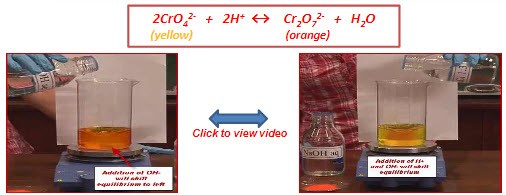
2CrO42- + 2H+ → Cr2O72- + H2O


What will happen when H+ ions are added to the system?

a)

Position of equilibrium will shift to left and become more yellow

b)

Color of system will turn all yellow

c)

Color of system will turn all orange

d)

Equilibrium will shift to right and become more orange
6.
Increase in temperature of the reactants can do one of the following
a)
Slow collision frequency
b)
Allow less effective collision between the particles
c)
Neutralise the reaction
d)
increase collision between the particles thus increasing the rate.
7.
Why does a catalyst increase the rate of reaction?
a)
it produces extra energy for the reactants
b)
it increases the speed of the reactant particles
c)
it increases the frequency of particle collisions
d)
it reduces the activation energy of the reaction 
8.
Which of the following increase the reaction rate?
a)
less surface area
b)
lower temperature
c)
an inhibitor
d)
increased concentration
9.
Why don't all collisions between particles cause a reaction?
a)
the particles also need to collide with a catalyst
b)
not all the particles collide with enough energy
c)
not all the particles collide at a high enough temperature
d)
the particles need to collide with each other twice
10.
To slow down a chemical reaction you will do one of the following:
a)
Place the reactants in hot water
b)
Place the products in ice bath
c)
Place the reactants in a ice bath
d)
Keep stirring the reactants with a stirring rod
11.

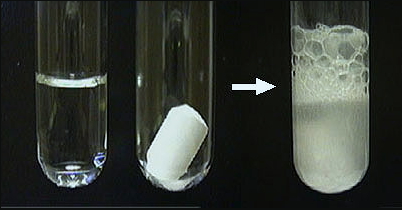
How could we make this reaction happen more quickly?

a)

Decrease the concentration of the acid

b)

crush the chalk to increase the surface area

c)

Put the test tube in an ice bath

12.
ΔH value in an endothermic reaction is a positive number.
a)
True
b)
False
13.

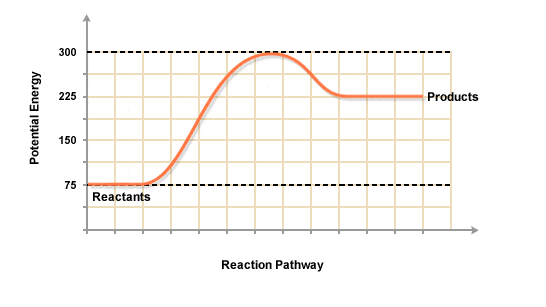
What is the Heat of Reaction  ΔH\Delta H  for this reaction?

a)

-200 KJ

b)

200 KJ

c)

400 KJ

d)

-300 KJ

14.

How much activation energy is needed for this reaction?

a)

300 KJ

b)

500 KJ

c)

400 KJ

d)

100 KJ

15.

Are the products or reactants of this reaction storing more energy in their chemical bonds?

a)

Both storing the same

b)

No way to tell

c)

Products

d)

Reactants

16.

What type of reaction is this?

a)

Exothermic

b)

Endothermic

c)

Energy Producing

d)

No way to tell

17.

What kind of equation is this: 2KI + MgCl2 + 200KJ ----> 2KCl + MgI2

a)

Endothermic

b)

Exothermic

18.

How can you tell this reaction is exothermic: MgO + CaS ----> CaO + MgS + 200 KJ

a)

Energy is written on the products side

b)

Energy is being released

c)

Less energy is stored on product side

d)

All of these tell me

19.
During an endothermic reaction in a beaker if we are part of the surroundings and touched the beaker, it would feel _______. 
a)
Warm
b)
Cold
20.

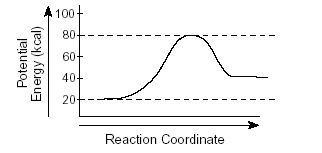
What is the ΔH of this reaction?

a)

40 kJ

b)

20 kJ

c)

80 kJ

d)

-60 kJ

21.
What is the energy of the activated complex?
a)
75 kJ
b)
225 kJ
c)
300 kJ
d)
225 kJ
22.
What is the PE of the products?
a)
100 kJ
b)
175 kJ
c)
50 kJ
d)
75 kJ