
 Worksheets
B3L1-2 Continental Movement Quiz - summative
Total questions: 11
Worksheet time: 20mins

What type of plate boundary do you see in the picture?
Convergent
Divergent
Transform (slip-strike)
Subduction

Breaks in the crust called __________ form where plates meet or slide past each other.
earthquakes
rift valleys
faults
trenches

Which of these best describes the motion of Earth's plates?
fast and in short bursts
slow and short bursts
fast and constant
slow and constant

What type of boundary is pictured?
Convergent
Divergent
Transform

Mountains are created at this type of boundary.
Divergent
Convergent
Transform
Scientists hypothesize that a super continent existed 200 million years ago. This continent is called
Laurasia
Gondwanaland
Pangaea
Eurasia

Which of these is a true statement? Check all that apply.
The lithosphere is hard and rigid, while the asthenosphere is much more flexible.
The crust is part of the lithosphere, and the asthenosphere is part of the mantle.
The lithosphere and asthenosphere are both part of the mantle.
Movement of tectonic plates is caused by convection currents deep in the Earth.
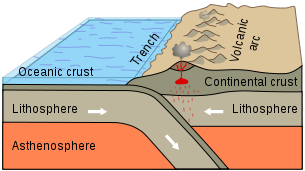
Subduction zones occur on Earth where dense oceanic crust dives under more less dense continental crust. These boundaries are characterized by a deep ocean trench next to a high continental mountain range, and many earthquakes and volcanoes. This is strong evidence for
The Big Bang theory.
Plate tectonic theory.
Continental drift theory.
The theory of Natural Selection.
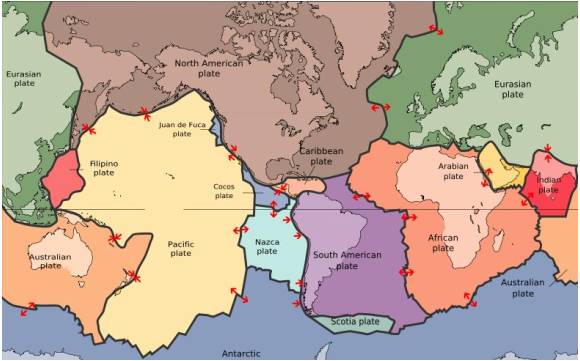
The map in the picture shows plate boundaries. What can this map help predict? Check all that apply.
droughts
volcanoes
earthquakes
tornadoes
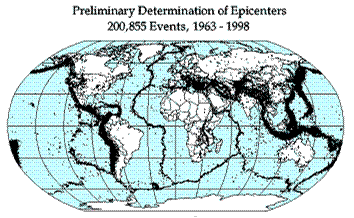
Earthquake epicenters (center of where the earthquakes started) were mapped for a 35 year period in the diagram above. The black dots indicate these epicenters. The black dots appear along what feature on Earth?
hot spots
plate boundaries
rift zones
sea floor spreading
BONUS: The Atlantic Ocean gets about 3-5 ______ wider each year.
centimeters
kilometers
miles
meters

